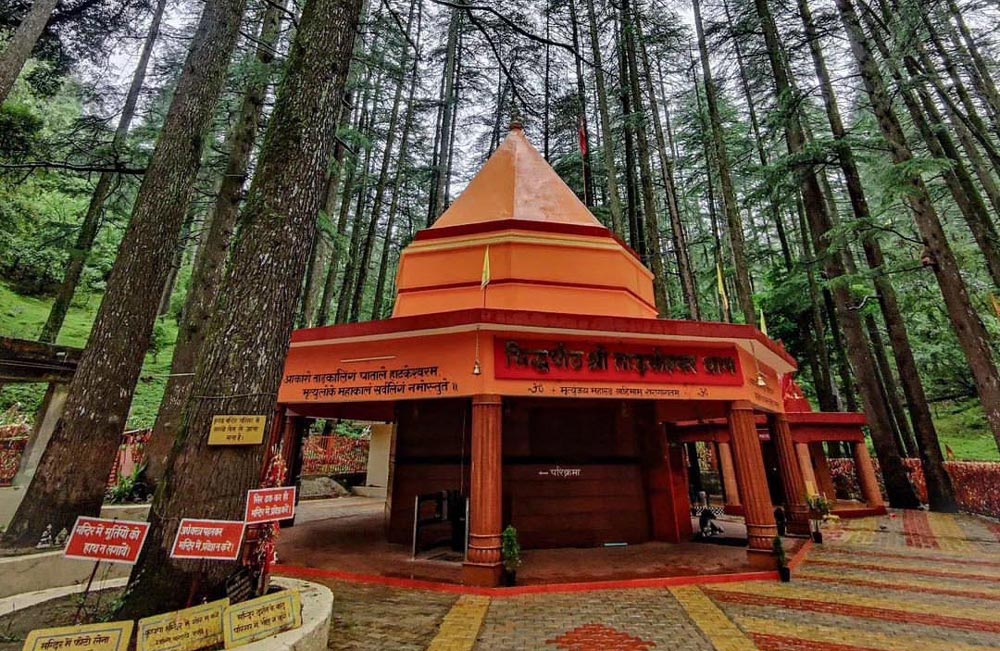
Nestled amid the peaceful deodar forests of Pauri Garhwal in Uttarakhand, Tarkeshwar Mahadev Temple, also spelled Tadkeshwar Mahadev, is one of the region’s important Shiva shrines and a destination where spirituality and Himalayan nature come together. Located approximately 36–38 kilometres from Lansdowne, the temple stands at an elevation of around 1,800 metres and is surrounded by dense cedar and pine forests. The District Pauri Garhwal administration describes the temple as a place dedicated to Lord Shiva and highlights its forest setting, special worship during Shivratri and the availability of a dharamshala for pilgrims.
Unlike some of Uttarakhand’s better-known pilgrimage centres, Tarkeshwar Mahadev is not primarily associated with enormous temple complexes or crowded pilgrimage routes. Its appeal lies in something quieter: the sound of temple bells, the fragrance of deodar trees, the mountain air and the sense of solitude that surrounds the shrine. For devotees, the temple is a sacred place connected with Lord Shiva; for travellers, it provides an opportunity to experience a less urbanised side of the Garhwal Himalayas.
Where Is Tarkeshwar Mahadev Temple Located?
Tarkeshwar Mahadev Temple is situated in Pauri Garhwal district of Uttarakhand, in the wider Lansdowne region. The temple is generally described as being about 36 to 38 kilometres from Lansdowne, although the exact distance varies according to the starting point and route used. The road journey passes through hilly terrain, making the trip considerably longer in time than the distance might suggest.
The temple’s location is one of its greatest attractions. It is surrounded by tall deodar trees, with the forest creating a naturally secluded environment around the shrine. Uttarakhand’s official tourism material also identifies Tarkeshwar Mahadev as an attraction in the Lansdowne area and describes the temple as an ancient Shiva shrine set in a tranquil environment.
The journey itself becomes part of the experience. Roads in the mountains are often narrow and winding, and visitors should allow sufficient time rather than treating the temple as a quick stop on a sightseeing itinerary. A travel account published by Incredible India describes the final approach from Lansdowne as particularly narrow in places and notes a descent from the parking area toward the temple.
The Spiritual Importance of the Temple
Tarkeshwar Mahadev is dedicated to Lord Shiva, one of the principal deities of Hinduism. Shiva worship has an especially deep association with Uttarakhand, where numerous ancient temples, sacred caves, rivers and pilgrimage routes are connected with Shaivite traditions.
Tarkeshwar Mahadev is regarded locally as a place of deep spiritual significance. The surrounding forest contributes strongly to the atmosphere of the shrine. Instead of the sounds of a busy town, visitors encounter birdsong, wind moving through the trees and the ringing of bells offered by devotees.
The District Pauri Garhwal website specifically notes that special worship is conducted at the temple during Shivratri, one of the most important festivals dedicated to Lord Shiva.
The temple is therefore not simply a sightseeing attraction. For devotees, visiting Tarkeshwar Mahadev can be part of a religious journey involving prayer, darshan, offerings and meditation.
The Legend of Tarkasur and Tarkeshwar Mahadev
One of the best-known traditions associated with the temple concerns Tarkasur, a powerful asura who, according to Hindu mythology, performed severe penance to please Lord Shiva.
According to the local legend, Tarkasur undertook intense worship of Shiva at the place associated with the present temple. Pleased by his devotion and austerities, Lord Shiva granted him a powerful boon. Tarkasur sought protection from death, believing that he could make himself virtually invincible. The condition associated with the boon was that he could be defeated only by a son of Shiva.
At the time, Shiva was associated with a life of detachment and asceticism. Tarkasur therefore believed that such a condition would make him effectively immortal. The legend continues with Tarkasur becoming increasingly destructive and troubling sages and other beings.
The gods eventually sought a solution. Shiva married Goddess Parvati, and their son Kartikeya was born. Kartikeya ultimately confronted Tarkasur and defeated him.
Local tradition connects the later part of the story with the temple. According to the legend recorded by travel sources, Tarkasur recognised his mistake and sought forgiveness from Lord Shiva before his death. Shiva granted him forgiveness and allowed his name to remain associated with the place where he had performed his penance. Thus, the shrine became known as Tarkeshwar or Tadkeshwar Mahadev.
This story is part of the temple’s religious folklore rather than a historically documented account, but it remains important to understanding why the shrine has such a strong association with Shiva and Tarkasur.
A Temple Surrounded by Deodar Trees
Perhaps the most distinctive feature of Tarkeshwar Mahadev is its natural setting. The shrine is surrounded by deodar and pine forests, creating an atmosphere that feels very different from temples situated in busy towns or cities. The Pauri Garhwal district administration specifically highlights the thick deodar and pine forests surrounding the temple.
Deodar trees have a particularly strong visual and cultural association with the Himalayan landscape. Their tall trunks and spreading branches create a dramatic forest canopy, especially around a secluded religious site.
For visitors, the forest also changes the character of the pilgrimage. The approach to the temple can feel like a walk through a Himalayan woodland rather than an ordinary road trip. The combination of trees, mountain air and religious architecture gives Tarkeshwar Mahadev much of its distinctive identity.
The natural environment also makes the temple appealing to people interested in meditation and quiet retreats. Travel sources describe the location as peaceful and suitable for meditation, while the government tourism information emphasises its tranquil setting.
The Bells of Tarkeshwar Mahadev
One of the most memorable sights associated with Tarkeshwar Mahadev is the large number of bells placed around the temple.
Devotees traditionally offer bells at Hindu temples as an expression of faith, gratitude or fulfilment of a prayer. At Tarkeshwar Mahadev, the accumulated bells have become an important visual part of the shrine.
A detailed account published by Incredible India describes a cobbled approach decorated with hundreds of bells on both sides. The same account notes that bells also surround the temple itself and that devotees ring them while offering prayers and performing circumambulation.
The sound of these bells is particularly striking because of the temple’s forest environment. In a busy urban temple, bells may become one sound among many. Here, their ringing can echo through an otherwise quiet woodland.
For photographers and nature lovers, the combination of old bells, stone pathways and tall deodar trees creates some of the most distinctive visual features of the destination.
Shrines, Gauri Kund and the Temple Complex
The temple complex contains more than one sacred feature. According to Incredible India, there are two principal shrines, one associated with Shiva and another with Goddess Durga. The complex also includes a small water body known as Gauri Kund.
Gauri Kund adds another dimension to the religious landscape. Sacred water bodies known as kunds have traditionally held an important place in Indian pilgrimage culture, often being associated with purification, ritual practice or mythology.
Visitors should remember that the temple is an active religious site. Its features are therefore best approached with the same respect one would show at any functioning place of worship.
Architecture and Sacred Atmosphere
Tarkeshwar Mahadev does not depend on monumental architecture to create its appeal. Its surroundings play an equally important role in defining the temple experience.
Government tourism material states that Tarkeshwar Mahadev is associated with a single-piece black-stone carving, adding an interesting architectural and artistic detail to the shrine.
The temple environment is relatively intimate compared with some of Uttarakhand’s larger pilgrimage destinations. Stone pathways, bells, forest vegetation and the shrine itself create a setting in which the natural landscape and religious space appear closely connected.
Rather than separating the temple from its surroundings, the forest becomes part of the spiritual experience. The deodar trees provide shade, the mountain climate creates a cool atmosphere and the absence of dense urban development allows visitors to experience the quietness of the area.
Tarkeshwar Mahadev During Shivratri
Maha Shivratri is the most important annual festival associated with the temple. The District Pauri Garhwal administration confirms that special worship is conducted at Tarkeshwar Mahadev during Shivratri.
During the festival, devotees visit the shrine to offer prayers to Lord Shiva. Shivratri traditionally involves practices such as fasting, night-long worship, chanting of Shiva mantras and offerings to the Shiva lingam, although specific practices can vary from temple to temple.
The normally quiet surroundings of Tarkeshwar Mahadev take on a very different character during major religious occasions. Devotees travelling from surrounding areas add energy and activity to the otherwise peaceful forest environment.
For someone visiting specifically for the religious experience, Shivratri can be particularly meaningful. For travellers primarily interested in solitude, however, a quieter period outside major festival days may provide a different experience.
Accommodation and Dharamshala Facilities
Visitors planning an overnight pilgrimage should consider their accommodation arrangements in advance. The District Pauri Garhwal website states that the temple committee provides a dharamshala for accommodation.
Travel sources also mention an ashram and dharamshala associated with the temple and indicate that visitors may need to make arrangements in advance if they wish to stay there.
Because facilities in remote Himalayan religious destinations can change according to season, festival schedules and local arrangements, travellers should verify availability before depending on temple accommodation.
For visitors who prefer hotels and a wider range of facilities, Lansdowne is the more practical base. The hill station has accommodation options and can be combined with a visit to Tarkeshwar Mahadev as part of a broader Garhwal itinerary.
How to Reach Tarkeshwar Mahadev Temple
For most visitors, the temple is easiest to reach by road from Lansdowne. The shrine is approximately 36–38 kilometres from the hill station, depending on the route and point of measurement.
Private vehicles and hired taxis are practical options. One commonly described route passes through the Lansdowne region toward the temple, with the final section involving narrower mountain roads. Travel accounts suggest that the road journey can take significantly longer than the distance might imply because of the terrain.
Another travel source identifies Kotdwar Railway Station as the nearest major railway connection and gives an approximate road distance of around 70 kilometres to the temple. It also lists Jolly Grant Airport near Dehradun as the nearest airport, though the road journey from there is considerably longer.
Because mountain road conditions can change with weather, especially during monsoon and winter, it is sensible to check local conditions before travelling.
Best Time to Visit
The ideal time to visit depends largely on what kind of experience a traveller wants.
Spring and the warmer months can be pleasant for exploring the forest surroundings and travelling through the Lansdowne region. The monsoon brings considerable rainfall to Uttarakhand, which can make mountain roads more challenging, although the forests become especially lush.
Autumn is often attractive for travellers seeking clearer mountain weather, while winter can bring colder conditions at the elevation of the temple.
For devotees, Maha Shivratri is naturally an important period. Those who want to participate in the festival atmosphere may plan their trip around the festival dates. Travellers looking for peace and solitude may prefer visiting outside major religious gatherings.
Places to Visit Around Tarkeshwar Mahadev
A visit to Tarkeshwar Mahadev can easily be combined with sightseeing in and around Lansdowne. The hill station itself is known for its quiet atmosphere and colonial-era heritage.
Tip-in-Top is one of the region’s recognised viewpoints and offers broad views across the surrounding Himalayan landscape. Bhulla Tal, a small lake near Lansdowne, provides another popular recreational stop. The official Incredible India tourism portal also lists attractions such as the Garhwal Rifles Regimental War Memorial, Darwan Singh Museum, St. Mary’s Church and Kaleshwar Mahadev Temple among the area’s attractions.
The Darwan Singh Museum is particularly relevant for visitors interested in the history of the Garhwal Rifles and the military heritage of Lansdowne. Its collection includes uniforms, weapons, medals and other historical objects connected with the regiment.
Combining these destinations with Tarkeshwar Mahadev allows travellers to experience several dimensions of the region: spirituality, forests, Himalayan scenery and colonial-era history.
Responsible Travel and Temple Etiquette
Because Tarkeshwar Mahadev is an active place of worship located within a sensitive forest environment, responsible tourism is particularly important.
Visitors should dress respectfully, follow local temple customs and avoid disturbing devotees during prayers. Photography should be undertaken only where permitted, particularly inside or close to the sanctum.
The forest surroundings should be treated with equal respect. Plastic waste should not be left behind, and visitors should avoid loud music or unnecessary noise. The peaceful character of the destination is one of its defining qualities.
Travellers should also be prepared for a relatively rural mountain setting rather than expecting the extensive commercial infrastructure found at major tourist centres.
Why Tarkeshwar Mahadev Is Worth Visiting
Tarkeshwar Mahadev represents a different side of Uttarakhand’s spiritual tourism. It is not simply a temple surrounded by mountains; it is a place where the forest itself becomes part of the pilgrimage experience.
The bells hanging along the pathway, the towering deodar trees, the Shiva shrine, the associated legends and the quiet mountain environment combine to create an atmosphere that is difficult to reproduce elsewhere. The official Pauri Garhwal tourism information specifically presents the temple as a Shiva shrine surrounded by thick deodar and pine forests, while national tourism material includes it among the important attractions around Lansdowne.
For devotees of Lord Shiva, the temple provides a place for prayer and reflection. For nature lovers, it offers a beautiful forest setting. For travellers interested in mythology, the story of Tarkasur provides a fascinating connection between local tradition and the wider Hindu mythological world. And for visitors exploring Lansdowne, it provides an opportunity to venture beyond the hill station and discover a quieter corner of Pauri Garhwal.
Final Thoughts
Tarkeshwar Mahadev Temple is a destination where faith, mythology, forest and Himalayan tranquillity come together. Its relatively secluded location gives it an intimate character, while its connection with Lord Shiva makes it an important spiritual destination in the Lansdowne region.
The temple’s legends should be understood as part of local religious tradition rather than as archaeological history, but they remain central to the identity of the shrine. The dense deodar forest, hundreds of bells, sacred spaces and peaceful surroundings provide the physical setting in which those traditions continue to live.
A journey to Tarkeshwar Mahadev is therefore more than a conventional sightseeing excursion. It can be a pilgrimage, a nature experience, a cultural journey or simply an opportunity to spend time in one of Uttarakhand’s quieter Himalayan landscapes. For anyone exploring Pauri Garhwal and Lansdowne, this forest-enveloped Shiva temple offers an experience built not around grand scale, but around silence, devotion and the enduring presence of the mountains.

