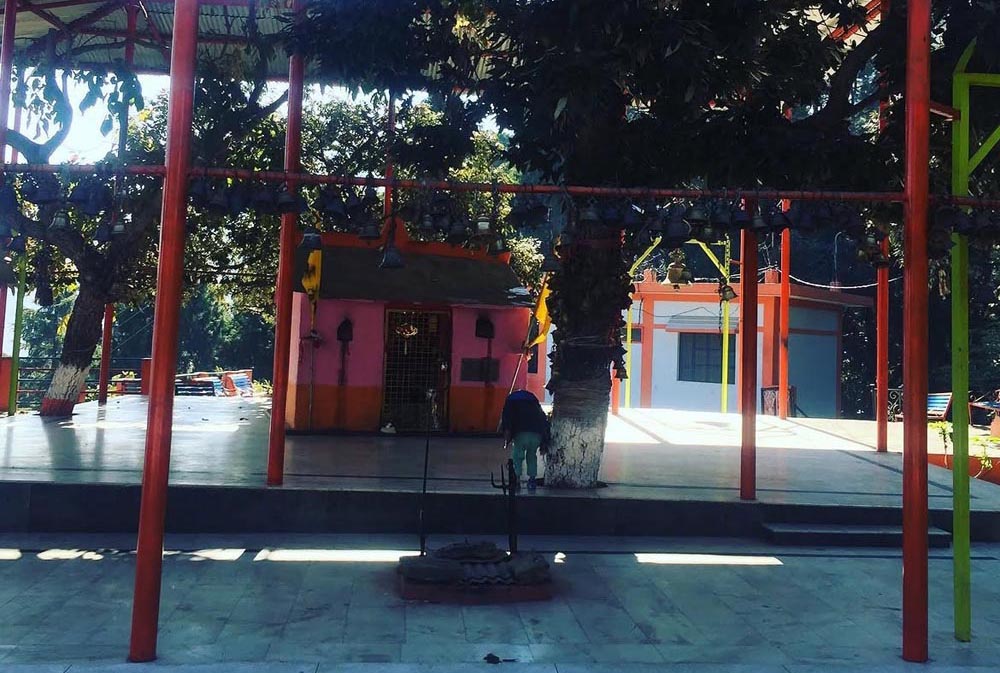
High above the picturesque hill town of Pauri in Uttarakhand, surrounded by the quiet beauty of oak and pine forests, stands Kandoliya Temple, one of the important religious and cultural landmarks of the Pauri Garhwal region. Dedicated to Kandoliya Devta, a local manifestation of Lord Shiva and a revered guardian deity, the temple is much more than a place of worship. It represents the deep connection between Himalayan communities, their local deities, forests, mountains and centuries-old traditions.
The temple is situated on Kandoliya Hill, close to Pauri town, and its elevated position gives visitors an opportunity to experience both spirituality and spectacular Himalayan scenery. The District Pauri Garhwal administration describes Kandoliya as a Shiva temple situated amid dense oak and pine forests. A park, sports complex and the Ransi Stadium are located nearby, while the surrounding viewpoints provide expansive views of Pauri and the Gangwarsyun valley.
For travellers, Kandoliya Temple offers a particularly interesting combination. A visit can begin with prayers at the shrine, continue with a peaceful walk through the forest and end with views across the valleys and distant Himalayan mountains. This combination makes Kandoliya one of the places that captures the character of Pauri itself: religious, peaceful, green and closely connected with the mountains.
Where Is Kandoliya Temple Located?
Kandoliya Temple is located in Pauri, the headquarters of Pauri Garhwal district in Uttarakhand. Pauri itself stands at approximately 1,814 metres above sea level and is known for its Himalayan landscapes, pleasant summer climate and surrounding forests. The Uttarakhand Tourism Department lists Kandoliya Temple among the attractions to visit as part of a Pauri and Khirsu itinerary.
The shrine is positioned on a hill above the town, giving it a naturally elevated and peaceful setting. According to the district administration, the temple can be reached by an approximately one-kilometre uphill walk from the bus stand, while the motorable approach is about two kilometers.
For visitors already staying in Pauri, this makes Kandoliya relatively easy to include in a sightseeing itinerary. The journey itself is part of the experience because the surroundings gradually change from the built-up town to a greener landscape of Himalayan trees and open viewpoints.
The Religious Importance of Kandoliya Devta
Kandoliya Devta occupies a special place in the religious life of Pauri. The deity is commonly associated with Lord Shiva, but the traditions surrounding Kandoliya also reflect the distinctive culture of local Himalayan guardian and village deities.
In the religious traditions of Uttarakhand, a deity can have a deeply local identity connected with a particular village, family, landscape or community. Such deities are often regarded as protectors of the settlement and its people. Kandoliya Devta is similarly revered as a guardian deity associated with Pauri.
Local traditions also describe Kandoliya Devta as a deity connected with justice. Stories surrounding the shrine have helped establish its reputation as a place where devotees seek protection, guidance and justice. These traditions are part of local belief and folklore rather than independently documented historical facts, but they remain important to understanding why the shrine continues to hold such significance for residents.
The Fascinating Legend Behind the Name Kandoliya
One of the most interesting aspects of Kandoliya Temple is the traditional story associated with the origin of the deity’s name.
According to local tradition, a woman from Kumaon married into the Dungariyal Negi family of Pauri. She was devoted to her family deity, traditionally identified in local accounts with Goril or Golu Devta, a deity strongly associated with the Kumaon region. After moving to Pauri following her marriage, she brought her beloved deity with her in a kandi, a traditional Himalayan basket.
The deity was subsequently worshipped in Pauri. Local accounts say that the deity later appeared in a dream and expressed a desire to be established on a higher location. The deity was then moved to the hilltop where the present shrine developed. Because the deity had been brought in a kandi, the name Kandoliya became associated with the deity and eventually with the surrounding area. This story is reported in local and regional accounts and forms an important part of the temple’s oral tradition.
The legend is especially interesting because it reflects the cultural links between Kumaon and Garhwal. Uttarakhand is traditionally divided into these two major cultural regions, and the story of a Kumaoni bride bringing her deity into a Garhwali community illustrates how religious traditions have travelled with families and communities across the Himalayan region.
Another local account connects Kandoliya with Goril or Golu traditions and describes the deity as a guardian or kshetrapal, meaning a protector of the area. Such traditions demonstrate how Himalayan religious culture frequently combines broader Hindu traditions with highly localized beliefs and stories.
Kandoliya Temple and the Concept of a Guardian Deity
The location of the temple helps explain its symbolic importance. It stands above Pauri, almost like a spiritual presence overlooking the settlement. Local belief regards Kandoliya Devta as a protector of the town and surrounding area.
The idea of a guardian deity is deeply rooted in the religious culture of the Himalayas. Mountains, forests, springs, villages and agricultural lands have traditionally been associated with sacred beliefs. A local deity may therefore be connected not only with individual worshippers but also with the welfare of an entire community.
At Kandoliya, this relationship between deity and landscape is particularly visible. The temple occupies a high point above Pauri, while the surrounding forest and valleys form a natural setting for worship. Visitors can therefore experience the shrine not as an isolated architectural monument but as part of a larger sacred landscape.
Architecture and Atmosphere
Kandoliya Temple is not primarily famous for monumental architecture on the scale of some of India’s major historic temples. Its attraction lies more strongly in its religious significance, location and atmosphere.
The temple’s hilltop setting creates a distinctive Himalayan character. The surrounding oak and pine forests provide shade and a sense of seclusion, while the elevated landscape allows visitors to move quickly from a temple courtyard into open mountain scenery.
The soundscape is equally important. Bells, devotional activity and conversations among pilgrims combine with the natural sounds of birds and wind moving through the trees. On quieter days, the surroundings can feel remarkably peaceful.
This combination of modest shrine architecture and dramatic natural surroundings is characteristic of many Himalayan places of worship. At Kandoliya, the forest is not simply a backdrop; it is an essential part of the experience.
Kandoliya Park and the Surrounding Landscape
One of the major advantages of visiting Kandoliya Temple is that the temple is surrounded by attractions that make the area suitable for more than a brief religious visit.
Kandoliya Park is situated adjacent to the temple. The Pauri Garhwal district administration notes that the park is particularly popular with local families during the summer months. From one side of the area, visitors can see Pauri town, while another direction opens towards the Gangwarsyun valley.
The park gives visitors an opportunity to relax after visiting the temple. Families, photographers, walkers and travellers can enjoy the forest environment without having to travel far from Pauri.
The nearby sports facilities add another dimension to the location. Ransi Stadium is situated only a short distance from the temple area and is frequently highlighted as one of the notable attractions around Kandoliya. The district’s tourism information specifically mentions the sports complex and Ransi Stadium as nearby points of interest.
Views of the Himalayas
The scenery is one of the strongest reasons to include Kandoliya Temple in a Pauri itinerary. Pauri’s elevated location provides opportunities to see Himalayan peaks and valleys, and Kandoliya’s hilltop position adds to the experience.
On clear days, the surrounding landscape can reveal distant mountain ranges, forested slopes and deep Himalayan valleys. The exact visibility depends heavily on weather and atmospheric conditions. During monsoon or periods of cloud cover, the mountains may disappear behind mist, while winter and clear-weather mornings can provide much wider views.
Uttarakhand Tourism notes that Pauri offers views towards major Himalayan peaks including Nanda Devi and Trisul.
For photographers, this changing mountain atmosphere can be particularly appealing. Early morning light, evening shadows, clouds moving across the valleys and seasonal changes in the forest can produce very different views from the same location.
Festivals and Community Traditions
Kandoliya Temple is not simply a tourist attraction; it remains connected with the religious life of local communities. Annual religious gatherings and community celebrations associated with Kandoliya Devta bring devotees together.
Recent regional reporting has highlighted the annual celebration and bhandara associated with Kandoliya Thakur, with people returning to Pauri from different places to participate in the religious festivities.
Such occasions are important because Himalayan temples frequently function as community spaces as well as religious institutions. Festivals allow people who have moved away from their ancestral towns and villages to reconnect with their cultural roots.
The atmosphere during a festival can therefore be very different from an ordinary day. Religious ceremonies, offerings, gatherings and communal meals create a strong sense of shared identity.
Visitors interested in experiencing such events should remember that festivals are primarily religious and community occasions. Respectful behaviour, appropriate clothing and sensitivity towards worshippers are important.
Best Time to Visit Kandoliya Temple
The best time to visit depends on what a traveller wants to experience.
Spring and summer are particularly attractive for visitors who want pleasant weather, greenery and comfortable outdoor exploration. Uttarakhand Tourism notes that Pauri experiences blooming forests and cooler conditions during summer compared with the plains.
The monsoon season brings lush greenery, but heavy rainfall can make roads and walking routes more difficult and can reduce mountain visibility.
Autumn is often appealing for travellers interested in clearer Himalayan views. The post-monsoon atmosphere can provide excellent visibility when skies are clear.
Winter offers a completely different experience. Pauri can become very cold during January and February, and snowfall may occur. Uttarakhand Tourism specifically notes the extreme cold associated with these winter months. Visitors travelling during winter should carry warm clothing and check local weather and road conditions.
How to Reach Kandoliya Temple
Pauri is connected by road with other important towns of Uttarakhand. Uttarakhand Tourism identifies road travel as one of the principal ways to reach Pauri and notes that the town can be approached via the road network connecting it with Kotdwar and other parts of the state.
For travellers arriving by train, Kotdwar is an important railway access point for Pauri. Uttarakhand Tourism identifies Kotdwar as the most reliable railway station for reaching Pauri.
For air travellers, Jolly Grant Airport near Dehradun is the nearest major airport listed by Uttarakhand Tourism for Pauri. From the airport, visitors can continue towards Pauri by road.
Once in Pauri, Kandoliya Temple is comparatively accessible. The district administration states that the temple is approximately one kilometre uphill on foot from the bus stand or around two kilometres by motorable road.
Nearby Places to Explore
A visit to Kandoliya Temple can easily be combined with other attractions in and around Pauri.
Kyunkaleshwar Mahadev Temple is another important religious site in Pauri. The district administration describes it as an eighth-century Shiva temple traditionally associated with the visit of Adi Shankaracharya and notes its views towards the Himalayan ranges and Alaknanda Valley.
Nagdev Temple is another attraction for visitors interested in Himalayan religious traditions and forests. It lies in a forested setting of pine and rhododendron, with viewpoints along the approach offering mountain scenery.
Khirsu is another destination that can be combined with Pauri. Uttarakhand Tourism promotes a Pauri–Khirsu itinerary featuring natural and religious attractions, making it possible to turn a temple visit into a broader Himalayan getaway.
Why Kandoliya Temple Is Special
The significance of Kandoliya Temple comes from several elements working together. It is a place of worship, a centre of local tradition, a guardian shrine associated with Pauri and a scenic Himalayan viewpoint.
Its legends provide insight into the movement of religious traditions between Kumaon and Garhwal. Its forest setting reflects the intimate relationship between nature and spirituality that is common throughout the Himalayan region. Its festivals demonstrate the continuing importance of community-based religious traditions, while Kandoliya Park and the surrounding viewpoints make the area accessible to families and tourists.
Perhaps the most memorable aspect is the contrast between the peaceful temple environment and the expansive landscape beyond it. A visitor can stand in the forest beside the shrine and, within moments, look across the valley towards the mountains.
Responsible and Respectful Visiting
Kandoliya is a functioning place of worship, so visitors should treat the temple and its surroundings respectfully. Modest clothing is appropriate, particularly when entering the shrine. Photography should be done only where permitted, especially during ceremonies.
The forest environment also deserves attention. Visitors should avoid littering, damaging vegetation or disturbing wildlife. Carrying reusable water bottles and taking waste back with you are simple ways to help preserve the area’s natural character.
During festivals and religious gatherings, the temple may become considerably busier than on ordinary days. Visitors should allow worshippers to perform rituals without interruption and follow instructions from temple volunteers or local authorities.
Final Summary
Kandoliya Temple is one of those Himalayan destinations where religion, folklore, community and nature cannot easily be separated. Located above Pauri amid oak and pine forests, the shrine of Kandoliya Devta represents a deeply rooted local tradition while also offering travellers an opportunity to experience the distinctive spiritual atmosphere of Uttarakhand.
The traditional story of a Kumaoni woman bringing her deity in a kandi, the belief in Kandoliya Devta as a protector, the temple’s association with justice, the annual community celebrations and its hilltop setting all contribute to the shrine’s identity. Some elements belong to oral tradition and local belief rather than formally documented history, but that does not diminish their cultural importance; these stories are part of the living heritage through which communities understand their sacred places.
Beyond the temple itself, Kandoliya offers forests, walking routes, parkland, sports facilities and panoramic views of Pauri and the surrounding valleys. Its convenient location also makes it easy to combine with Kyunkaleshwar Temple, Khirsu and other attractions in the Pauri region.
For travellers exploring Uttarakhand beyond its most famous pilgrimage destinations, Kandoliya Temple offers a quieter and more locally rooted experience. It is a place where a short journey uphill can lead not only to a sacred shrine but also to an appreciation of the landscape, traditions and community life that make the mountains of Pauri distinctive.

