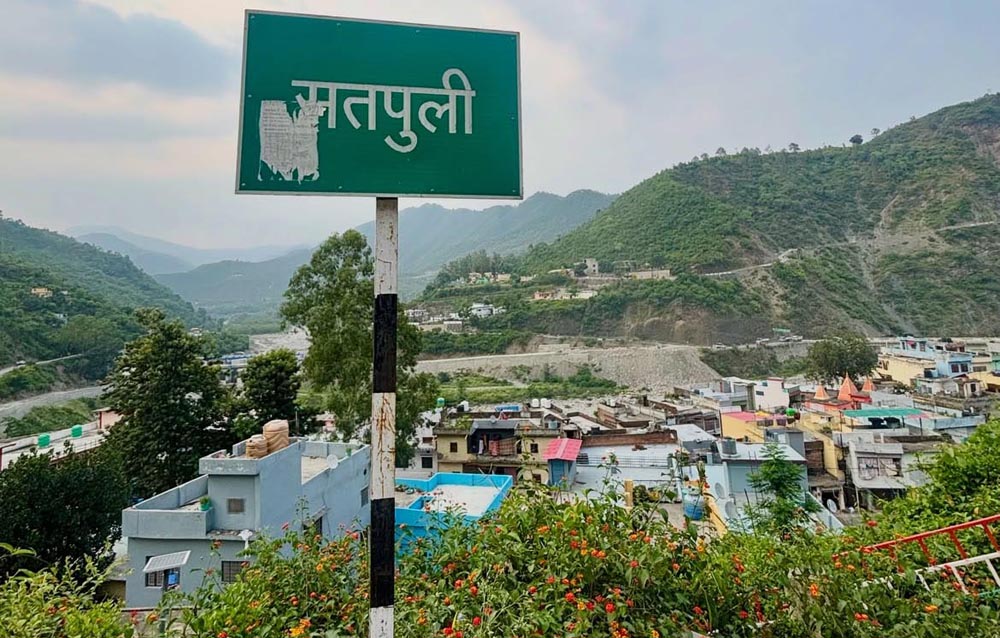
Tucked away in the picturesque Garhwal Himalayas of Uttarakhand, Satpuli is one of those places that often escapes the attention given to more famous hill stations. Yet this small town on the Pauri–Kotdwar road has a distinctive character of its own. Set beside the Nayar River and surrounded by forested hills, villages, temples and winding mountain roads, Satpuli combines the practical importance of a regional market town with the peaceful atmosphere of a Himalayan getaway.
Unlike destinations such as Mussoorie, Nainital or Rishikesh, Satpuli is not primarily built around large-scale tourism. Its charm lies in its everyday life: roadside eateries serving local food, buses and taxis moving through the valley, villagers arriving for shopping, mountain streams and rivers flowing below the roads, and spectacular landscapes appearing around seemingly ordinary bends. The town is also strategically situated between Kotdwar and Pauri, making it an important stopping point for people travelling deeper into the Garhwal region.
Where Is Satpuli?
Satpuli is located in Pauri Garhwal district of Uttarakhand in northern India. The town stands at an elevation of roughly 657 metres above sea level and lies on the important road connecting Kotdwar with Pauri. It is approximately 50 kilometres from both Kotdwar and Pauri, although actual travel time depends considerably on road conditions, traffic and the winding mountain terrain.
Geographically, Satpuli has a particularly interesting setting because of the Nayar river system. The eastern and western branches of the Nayar meet in the Satpuli area, after which the combined river continues through the Garhwal landscape. The district administration identifies the Nayar as one of Pauri Garhwal’s important rivers and notes that it becomes the Nayar after the eastern and western branches meet at Satpuli.
This riverside location contributes significantly to the identity of the town. Instead of being located high on a mountain ridge like many well-known Uttarakhand hill stations, Satpuli occupies a relatively lower valley environment. The result is a landscape where steep hills rise around a river corridor, creating a mixture of subtropical vegetation, cultivated slopes, forests and settlements.
The Story Behind Satpuli
The history of Satpuli is closely connected with transportation, trade and the Nayar River. One commonly cited explanation for the town’s name connects it with the Hindi words saat pul, meaning “seven bridges.” The name is traditionally associated with the route from Kotdwar toward the hills.
Satpuli was historically much less developed than it is today. The surrounding area was largely agricultural, while small shops gradually developed near the river to serve travellers and residents of neighbouring villages. Because the town lies on a natural route toward Pauri and other parts of Garhwal, it gradually became an important stopping and trading point.
The river, however, has also shaped the town through natural disasters. A major flood in the early 1950s caused extensive destruction in the Nayar valley. Historical accounts commonly refer to the devastating flood of 1951 or 1952, after which many shopkeepers relocated and the settlement developed in its present area. A memorial associated with the disaster commemorates people who lost their lives in the great Nayar flood.
Satpuli’s wider historical setting is the ancient Garhwal region. Pauri Garhwal has experienced successive periods of Katyuri influence, Garhwal kingdom rule, Gorkha expansion and British administration. The district’s official history records the emergence of Garhwal as a unified kingdom under Ajaypal and describes the Gorkha invasion of the early nineteenth century, followed by British control after the Gorkhas were defeated in 1815.
Understanding this wider history helps explain why Satpuli is more than a roadside settlement. It sits within a region shaped by centuries of mountain kingdoms, migration, trade routes, military history and religious traditions.
Natural Beauty and Landscape
The landscape around Satpuli is one of its greatest attractions. The town itself may appear busy because it functions as a commercial and transport centre, but only a short distance away the scenery becomes distinctly Himalayan. Hills covered with vegetation rise from the river valley, while roads curve through forests and villages.
The Nayar River provides an especially important natural feature. The riverbanks and surrounding countryside create opportunities for peaceful walks, photography and simply enjoying the sound of flowing water. The river environment has traditionally attracted fishing and angling enthusiasts, although visitors should always check current local rules and conditions before attempting any activity in or around the water.
The relatively low elevation also gives Satpuli a different appearance from the high-altitude towns of Uttarakhand. Rather than dramatic snow-covered landscapes, visitors are more likely to encounter green hills, river valleys, agricultural land and warm-weather vegetation. This makes Satpuli particularly interesting for travellers who want to experience a less conventional side of the state.
Things to See Around Satpuli
Satpuli itself is best experienced as part of a broader Garhwal itinerary. Several destinations can be visited from the town, making it a convenient base or stopping point.
Lansdowne is one of the most popular nearby destinations. The quiet hill station, associated with the Garhwal Rifles, is considerably higher than Satpuli and offers pine forests, viewpoints, colonial-era surroundings and a cooler mountain climate. Satpuli’s location on the route toward Lansdowne makes it useful for travellers combining the two destinations.
The wider Lansdowne area includes attractions such as Bhulla Tal and various viewpoints. Bhulla Taal is a popular tourist attraction in Lansdowne, while nearby viewpoints provide opportunities to admire the surrounding mountain landscape.
Pauri is another important destination accessible from Satpuli. As the headquarters of Pauri Garhwal district, Pauri offers panoramic Himalayan views, temples, forests and access to several other attractions in the region. The Uttarakhand Tourism Master Plan places Satpuli within the broader Kotdwar–Lansdowne–Pauri leisure circuit and identifies the area for nature trails, camping, tourist cottages, parking facilities and interpretation infrastructure.
Religious tourism is also significant. Jwalpa Devi Temple is located in the wider Pauri region, while other temples and sacred sites can be incorporated into journeys around Satpuli. The region’s religious landscape reflects the strong relationship between Himalayan communities, local deities, forests and rivers.
Bhairav Garhi is another destination of interest for visitors exploring the surrounding hills. The site combines religious importance with the remains and atmosphere of a traditional mountain fortification.
Adventure and Outdoor Activities
Satpuli has considerable potential for nature-based and adventure tourism. Fishing and angling have historically been associated with the Nayar rivers, and the river environment remains one of the area’s most distinctive recreational features.
There has also been interest in developing kayaking and canoeing opportunities in the Nayar River. Tourism planning has considered the potential for adventure activities as a way of creating employment and diversifying the local economy. Such activities should only be undertaken through properly managed operators and under suitable weather and river conditions.
For ordinary visitors, hiking, nature photography, birdwatching, village walks and short excursions may be more accessible than organized adventure sports. The surrounding countryside offers many opportunities to observe Himalayan vegetation and rural life without needing an elaborate itinerary.
Satpuli is particularly suitable for travellers who enjoy slow travel. Instead of rushing from one famous attraction to another, visitors can spend time beside the river, explore local markets, stop at roadside eateries, visit nearby temples and take short drives into the hills.
Local Food and the Famous Maachha Bhaat
Food is an important part of Satpuli’s identity. The town is traditionally associated with maachha bhaat, a local preparation involving fish curry and rice. Its popularity is closely connected with Satpuli’s location beside the Nayar River and its long-standing role as a stopping place for travellers.
For many people travelling between Kotdwar, Pauri and the surrounding Garhwal areas, stopping in Satpuli for a meal is part of the journey itself. Local restaurants and roadside establishments generally focus on straightforward, filling meals rather than elaborate tourist cuisine.
Visitors can also encounter North Indian staples, vegetarian meals, tea, snacks and regional preparations. Because Satpuli serves local residents as well as travellers, its food culture has a practical, everyday quality that can be more representative of mountain life than menus designed exclusively for tourists.
Among currently listed local establishments are Kukreti hotel and restaurant, Shri Prem Bhojnalaya and Mahalaxmi Sweet Shop & Restaurant. These listings can change over time, so travellers should verify operating hours locally before making plans.
Culture and Local Life
Satpuli provides an opportunity to experience Garhwali culture in an everyday setting rather than through a highly commercialized tourist experience. The surrounding villages maintain traditional social structures, agricultural practices, religious customs and local festivals.
Festivals and cultural events bring communities together throughout the year. Ramleela and seasonal celebrations are among the cultural activities associated with the town and surrounding areas. Such events can offer visitors a closer look at local music, theatre, food, clothing and community traditions.
The people of the region have historically depended on agriculture, military service, government employment, small businesses and migration. As in many parts of the Himalayan region, migration has influenced village demographics and economic life. At the same time, towns such as Satpuli remain important because they provide markets, transportation, education, healthcare and other services to surrounding rural communities.
Satpuli as a Regional Market and Service Centre
One of the most important aspects of Satpuli is its practical role. It is not simply a tourist destination. People from nearby villages come to the town to purchase groceries, household goods and other necessities, access banking and healthcare services, and connect with transportation routes.
The town has also developed educational and institutional facilities, contributing to its importance within the surrounding area. The growth of educational institutions and healthcare facilities has helped transform Satpuli from a simple roadside settlement into a regional service centre.
This dual identity is what makes the town interesting. During the day, Satpuli can feel like a busy mountain market, while the surrounding hills and river provide a peaceful natural setting only a short distance away.
Where to Stay
Accommodation in Satpuli is more limited than in established tourist centres such as Lansdowne, so visitors should plan according to their travel style. Small hotels, lodges, guesthouses and homestay-style properties are available in and around the town.
For example, Shivalik Riverine Homestay and Hotel is located near the Badhkholu Bridge on the Banghat road, while Dangwal restaurant And Lodge provides another local accommodation option. RRR Resort Satpuli is another property listed in Satpuli.
Travellers looking for a wider choice of resorts and more developed tourist accommodation can consider staying toward Lansdowne. Properties such as AstreVue Resort in the Gumkhal area and The Woods Retreat, Lansdowne provide options in the broader surrounding region.
The best choice depends on whether the priority is proximity to Satpuli’s market and transport facilities or a quieter stay surrounded by forests and mountain scenery.
How to Reach Satpuli
Road travel is the principal way to reach Satpuli. The town lies along the road between Kotdwar and Pauri, making it accessible from both directions. Travellers arriving by train generally use Kotdwar, which is the nearest major railway station, and continue by taxi or bus.
For travellers coming from Delhi and other northern Indian cities, a road journey through western Uttarakhand is a common option. The route generally passes through the plains before entering the foothills around Kotdwar and then climbing toward the Garhwal region.
The nearest airport is Jolly Grant Airport near Dehradun. From the airport, travellers need to continue by road. Because mountain journeys can take longer than the distance on a map suggests, it is sensible to allow extra time, especially during the monsoon season.
Satpuli also has bus connections toward various destinations in Pauri Garhwal. Local taxis are another practical option, particularly for travellers planning to visit several nearby locations.
Weather and Best Time to Visit
Satpuli’s lower elevation gives it a warmer climate than many Uttarakhand hill stations. Summers can be warm, particularly during the daytime, while winters are generally cooler but not as severe as in higher mountain destinations.
Spring and autumn are especially pleasant for exploring the region. March and November are traditionally regarded as comfortable periods, while September through November can provide particularly attractive conditions after the monsoon.
Summer is suitable for travellers who do not mind warmer weather, although daytime temperatures can become high. Monsoon travel requires greater caution because heavy rainfall can cause landslides, road disruptions and difficult driving conditions in the mountains.
Winter can be peaceful and rewarding for visitors seeking a quieter atmosphere. However, travellers should be prepared for cold mornings and evenings and should check road conditions before setting out for higher destinations.
Responsible Tourism in Satpuli
Satpuli’s appeal depends heavily on its natural environment, particularly the Nayar River and surrounding hills. Responsible tourism is therefore essential. Visitors should avoid throwing plastic or other waste into rivers and forests, minimize single-use plastic, and respect local religious sites and community spaces.
River activities require particular care. Mountain rivers can change rapidly after rainfall, so visitors should never assume that calm-looking water is always safe. Local advice and weather conditions should be taken seriously.
Supporting locally owned restaurants, homestays, shops, guides and transport providers can also help ensure that tourism benefits the communities that make Satpuli distinctive.
The Future of Satpuli Tourism
Satpuli has considerable potential to develop as an offbeat tourism destination. The Uttarakhand government’s tourism planning has already identified opportunities for camping, tourist cottages, nature trails, parking infrastructure and interpretation facilities in the Satpuli and Khairasain area.
The challenge will be balancing tourism growth with the environmental and infrastructural realities of a Himalayan settlement. Unplanned construction, waste management, drainage, traffic and pressure on natural resources can create serious problems in mountain towns. Tourism development therefore needs to preserve the river ecosystem and landscape while improving facilities for residents and visitors.
If developed thoughtfully, Satpuli could become an attractive stop for travellers looking beyond Uttarakhand’s heavily visited destinations. Its location allows it to function as a gateway to Lansdowne, Pauri and other Garhwal destinations while retaining an identity of its own.
Why Visit Satpuli?
Satpuli is not a destination that depends on a single monumental attraction. Its appeal comes from the combination of landscape, river, food, history, local culture and its position on the road through Garhwal.
A traveller can begin the day with a simple local breakfast, watch the Nayar River moving through the valley, explore the market, drive toward Lansdowne or Pauri, visit a nearby temple, stop for traditional food and return to a quiet riverside setting in the evening. That combination of ordinary mountain life and natural beauty is precisely what makes Satpuli special.
For travellers seeking an alternative to crowded hill stations, Satpuli offers a more grounded experience of Uttarakhand. It provides a window into the working Himalayan landscape: villages on steep slopes, rivers at the bottom of valleys, winding roads connecting remote communities, small markets serving large rural areas and traditions that remain closely connected to the mountains.
Ultimately, Satpuli is best understood not simply as a place to “see” but as a place to experience. It is a gateway, a market town, a riverside settlement and a quiet base for exploring the Garhwal hills. Its understated character makes it particularly appealing to travellers who prefer scenic road journeys, local food, cultural encounters and peaceful surroundings over conventional tourist attractions. As interest in offbeat Uttarakhand continues to grow, Satpuli has the potential to become one of the region’s more interesting destinations while still retaining the authentic character that makes it worth discovering.

