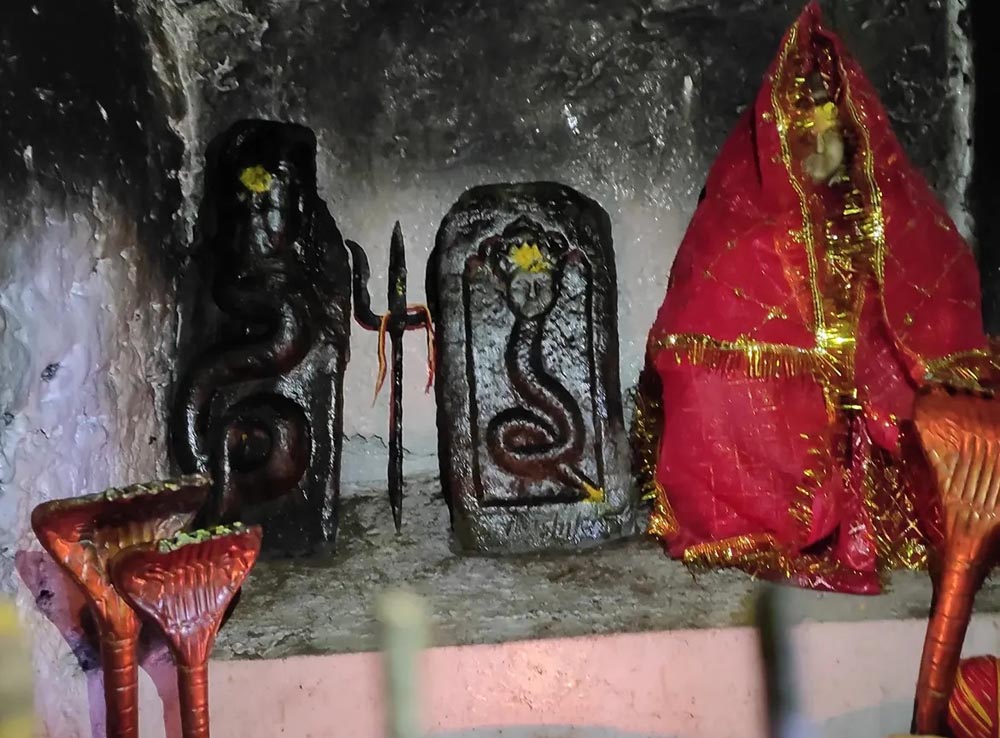
Tucked away in the peaceful forests surrounding Pauri in Uttarakhand, Nag Dev Temple is one of those Himalayan shrines where the journey is almost as meaningful as the destination. Surrounded by pine and rhododendron trees, the temple is dedicated to Nag Devta, the serpent deity, and is deeply associated with the religious traditions and local beliefs of the Garhwal region. Unlike some of Uttarakhand’s grand pilgrimage centers, Nag Dev Temple has a relatively intimate character. Its appeal comes from the combination of devotion, forest landscapes, mountain air, traditional beliefs and spectacular Himalayan views.
The temple is situated on the Pauri–Bubakhal road, approximately 5 kilometres from the Pauri bus stand according to the Pauri Garhwal district administration. Visitors reach the shrine by a forest approach that includes a trek of roughly 1.5 kilometres. An observatory along the route provides views toward several major Himalayan peaks, including Chaukhamba, the Gangotri Group, Bandarpunch, Kedardom and Kedarnath.
A Temple Hidden in the Forests of Pauri
Pauri itself is known for its mountain scenery, forests and religious heritage, and Nag Dev Temple adds a particularly peaceful dimension to the town’s attractions. Rather than being surrounded by a busy commercial settlement, the shrine is reached through a forested landscape dominated by pine and rhododendron. This setting gives the temple a distinctly secluded atmosphere.
The official Pauri Garhwal tourism information describes Nagdev as a much-worshipped temple of the snake god situated in dense pine and rhododendron forest. The natural surroundings are an important part of the experience because the temple does not feel separated from the Himalayan environment around it. The forest, mountain slopes and changing light create a setting that encourages visitors to slow down and experience the journey more quietly.
For travellers accustomed to major pilgrimage destinations with crowded markets, large complexes and extensive facilities, Nag Dev Temple can feel refreshingly different. Its attraction lies in simplicity. The sound of wind moving through the trees, birds in the surrounding forest and occasional glimpses of distant mountain ranges become part of the pilgrimage experience.
Religious Significance of Nag Devta
Nag Devta, or the serpent deity, occupies an important place in Hindu religious traditions, particularly in many Himalayan communities. Serpents have traditionally been associated with water, fertility, protection and the natural world. Across Uttarakhand, local Nag Devta traditions are expressed through temples, village shrines, seasonal worship and community rituals.
At Nag Dev Temple in Pauri, the principal focus of worship is Nag Devta. The shrine is therefore important not only as a religious site but also as an example of the way local Himalayan traditions connect spirituality with forests, springs and the landscape.
The temple’s significance is especially understandable within the broader religious culture of Garhwal, where many villages and communities have their own local deities and sacred places. Such shrines frequently become part of the cultural identity of the communities that maintain them.
Nag Dev Temple is consequently more than a sightseeing stop. For devotees, it is a place for prayer and darshan, while for visitors interested in culture, it provides an opportunity to understand one aspect of Uttarakhand’s living religious traditions.
The Local Legend Behind Nag Dev Temple
One of the most fascinating aspects of the temple is the local story associated with its origin. This account is part of oral religious tradition, so it should be understood as a local legend rather than independently documented historical fact.
According to a traditional account, Nag Devta was associated with the Dobhal lineage of Dobh village in the Pauri region. The story tells of a child born approximately two centuries ago who was believed to possess a human upper body and a serpent-like lower body. According to the legend, the child was regarded as a divine manifestation connected with Nag Devta.
The story says that the child instructed members of the family to carry him in a kandi, a traditional Himalayan basket, toward a particular place where he was to be established. They were reportedly instructed not to put the basket down during the journey until they reached the intended location.
According to the legend, however, the people carrying the basket eventually placed it on the ground at a particular spot. When they subsequently attempted to move it, they were unable to do so. The divine child then instructed them to dig at a nearby location.
The story continues that a natural water source emerged from the ground after they dug there. The water was considered sacred, and the child was subsequently established at the location. The place gradually became associated with Nag Devta and developed into the shrine that devotees visit today.
The natural spring mentioned in the story is particularly significant because water sources have traditionally held an important place in Himalayan religious culture. Springs and streams are often regarded not simply as physical resources but as sacred features of the landscape.
The Sacred Water Source
One of the interesting features associated with the temple is the natural water source near the shrine. Local accounts connect this spring with the traditional story of the temple’s establishment.
Whether approached from a religious or cultural perspective, the presence of a spring adds another layer to the identity of the site. In mountain regions, natural springs have historically been essential to settlements, agriculture and everyday life. Their association with religious places reflects the close relationship between nature and spirituality in the Himalayas.
The spring therefore forms part of the wider cultural landscape surrounding Nag Dev Temple. Visitors should treat the water source and surrounding environment respectfully rather than treating them simply as tourist attractions.
Beliefs Associated With the Temple
A number of fascinating beliefs have developed around Nag Dev Temple. One commonly repeated local tradition concerns a small opening or natural cavity associated with the deity. According to local accounts, priests place a bowl of milk near the sacred area, and devotees believe that the milk sometimes disappears, interpreting this as a sign of the presence of Nag Devta.
Such accounts belong to the sphere of local faith and oral tradition and are not scientific observations. Their importance lies primarily in what they reveal about the relationship between the temple and the beliefs of devotees.
For many visitors, these stories make the temple more intriguing. They demonstrate how religious places acquire layers of meaning through generations of storytelling, ritual and community memory.
Rather than attempting to prove or disprove such beliefs, visitors can understand them as part of the cultural heritage surrounding the shrine.
The Journey to the Temple
The approach to Nag Dev Temple is an important part of the experience. The Pauri Garhwal district administration states that the temple lies about 5 kilometres from the bus stop and can be reached through a trek of approximately 1.5 kilometres.
The route passes through forested surroundings, making the walk considerably different from an ordinary road journey. Pine and rhododendron trees provide shade, while the mountain environment creates a calm atmosphere.
The trek is relatively short, but visitors should still wear comfortable footwear because forest paths can become uneven or slippery, particularly during wet weather. The character of a Himalayan trail can change significantly with rain, fallen leaves and seasonal conditions.
The journey is particularly rewarding for travellers who enjoy combining religious tourism with nature walks. Instead of simply arriving by vehicle at a large temple complex, visitors gradually enter the forest environment before reaching the shrine.
Himalayan Views From the Observatory
Perhaps one of the most memorable features of the route is the observatory or viewing point mentioned by the district administration. From this location, visitors can look toward the Himalayan ranges and, under favourable weather conditions, see prominent peaks and mountain groups. These include Chaukhamba, the Gangotri Group, Bandarpunch, Kedardom and Kedarnath.
Mountain visibility naturally depends on weather, season and atmospheric conditions. On clear days, however, the views can transform the journey into a memorable Himalayan sightseeing experience.
Early mornings are generally useful for mountain photography because haze and clouds can increase later in the day. Winter and post-monsoon conditions can also provide particularly crisp mountain visibility, although temperatures can be considerably lower.
The observatory is therefore not merely an additional sightseeing point. It reinforces the relationship between Nag Dev Temple and the dramatic Himalayan landscape in which it is situated.
Forests, Flora and Natural Beauty
The vegetation surrounding Nag Dev Temple contributes strongly to its character. The official district tourism description specifically mentions pine and rhododendron forests.
Rhododendron is especially important to the Himalayan landscape of Uttarakhand. During its flowering season, the forest can acquire vibrant colours, creating a striking contrast with the darker green of the surrounding trees.
Pine forests, meanwhile, contribute to the characteristic appearance and atmosphere of many parts of the middle Himalayas. The combination of trees, mountain slopes and filtered sunlight makes the approach to the temple particularly attractive for nature lovers.
The forest should nevertheless be treated as a living ecosystem rather than simply a backdrop for photography. Visitors can help preserve its character by avoiding litter, keeping noise levels low and refraining from damaging plants or disturbing wildlife.
Nag Dev Temple as a Spiritual and Nature Destination
One reason Nag Dev Temple is interesting for modern travellers is that it combines several forms of tourism without losing its religious character. It is simultaneously a place of worship, a forest destination, a short trekking experience and a Himalayan viewpoint.
Religious travellers can come for darshan and prayer. Nature lovers can enjoy the forest setting. Photographers can explore the changing scenery and mountain views. Travellers interested in local culture can learn about the Nag Devta tradition and the legends associated with the shrine.
This combination makes the temple particularly suitable for people looking for a quieter experience around Pauri.
The temple also demonstrates how pilgrimage in the Himalayan region does not always involve monumental architecture. Sometimes the sacredness of a place is closely tied to a spring, a forest, a rock, a mountain or an oral tradition that has been preserved by generations.
Best Time to Visit Nag Dev Temple
The most suitable time to visit depends on what a traveller wants to experience. Spring can be attractive because the forests become lively with seasonal vegetation and rhododendron blossoms. Summer generally provides comfortable conditions for exploring the surrounding area compared with the hotter plains.
The monsoon season requires greater caution. Rain can make forest trails slippery, and cloud cover can obscure the Himalayan panorama. Anyone visiting during or immediately after heavy rainfall should check local conditions before beginning the walk.
Autumn and the post-monsoon period can be particularly rewarding for travellers interested in mountain views because the atmosphere may become clearer after the rains. Winter brings colder conditions but can also offer beautiful mountain scenery when skies are clear.
For photography, an early start is useful regardless of season. Morning light can create attractive conditions in the forest, while mountain visibility is often better before afternoon cloud development.
How to Reach Nag Dev Temple
The temple is located on the Pauri–Bubakhal road and is approximately 5 kilometres from the Pauri bus stand according to the official district website. From the road-access point, visitors continue on foot for approximately 1.5 kilometres.
Pauri can be reached by road from several parts of Uttarakhand. Travellers generally use buses, taxis or private vehicles to reach the town before continuing toward Bubakhal.
Travel information published by tourism sources places Kotdwar among the nearest railway options and Jolly Grant Airport near Dehradun among the principal airports used to access the wider region, although exact travel times can vary considerably with road conditions and weather.
Because mountain travel times can change with traffic, road construction, rainfall and seasonal conditions, it is sensible to check local road conditions before travelling.
What to Carry
A visit to Nag Dev Temple does not require extensive trekking equipment, but sensible preparation makes the experience more comfortable. Comfortable walking shoes are important because of the forest trail. A bottle of drinking water is also advisable.
Depending on the season, visitors may need a light jacket, rain protection or warmer clothing. The weather in the hills can change quickly, particularly around the monsoon and winter seasons.
Those carrying cameras or mobile phones should protect them against rain and accidental drops during the forest walk. Visitors should also avoid carrying unnecessary plastic and should take all waste back with them.
Since this is a religious site, modest and respectful clothing is appropriate. Visitors should follow local temple customs regarding photography, offerings and entry into restricted areas.
Nearby Attractions in Pauri
A visit to Nag Dev Temple can easily be combined with other attractions around Pauri. The district administration lists Kandolia among the area’s notable destinations. Kandolia is associated with a temple and is surrounded by oak and pine forest. A park and sports complex are located nearby.
Another important religious attraction is Kyunkaleshwar Mahadev Temple, which the Pauri district administration describes as an old Shiva temple associated with Pauri’s religious heritage.
Visitors interested in combining nature with sightseeing can also explore viewpoints around Pauri and the surrounding mountain landscape. Depending on the season and available time, these attractions can turn a visit to Nag Dev Temple into a broader Pauri travel itinerary.
Respecting the Sacred Landscape
The peaceful atmosphere of Nag Dev Temple depends partly on its natural setting. Visitors have an important role in keeping that environment clean and quiet.
Plastic bottles, food wrappers and other waste should never be left along the trail. Loud music should be avoided, particularly close to the shrine. Visitors should also respect religious rituals even when they do not personally follow the beliefs associated with them.
Wildlife should not be approached or fed. Because the temple is located in a forested environment, visitors should remain aware of their surroundings and avoid wandering away from established paths.
Responsible tourism is especially important in Himalayan destinations because fragile mountain ecosystems can be affected quickly by increasing visitor numbers.
Why Nag Dev Temple Is Worth Visiting
Nag Dev Temple represents a quieter side of Uttarakhand’s spiritual tourism. Its significance does not come from an enormous temple complex or a heavily commercialised pilgrimage centre. Instead, its identity has developed through local devotion, traditional stories, natural surroundings and the enduring presence of Nag Devta worship.
The short forest journey provides an opportunity to experience the landscape gradually. The trees create a peaceful atmosphere, the sacred traditions give the destination cultural depth, and the observatory provides an impressive Himalayan perspective. The local legends surrounding the shrine add another layer to the experience, connecting the temple with generations of community belief.
For travellers visiting Pauri, Nag Dev Temple can therefore be more than a quick stop on a sightseeing list. It can become a gentle introduction to the way faith, folklore, forests and mountains intersect in Garhwal. Ultimately, the charm of Nag Dev Temple lies in this combination. A visitor may arrive seeking blessings, mountain scenery, photography or simply a quiet walk, but the destination offers an experience shaped by all of these elements. Hidden among the forests near Pauri, Nag Dev Temple remains a small yet culturally meaningful Himalayan shrine where the natural landscape and spiritual traditions exist side by side.

