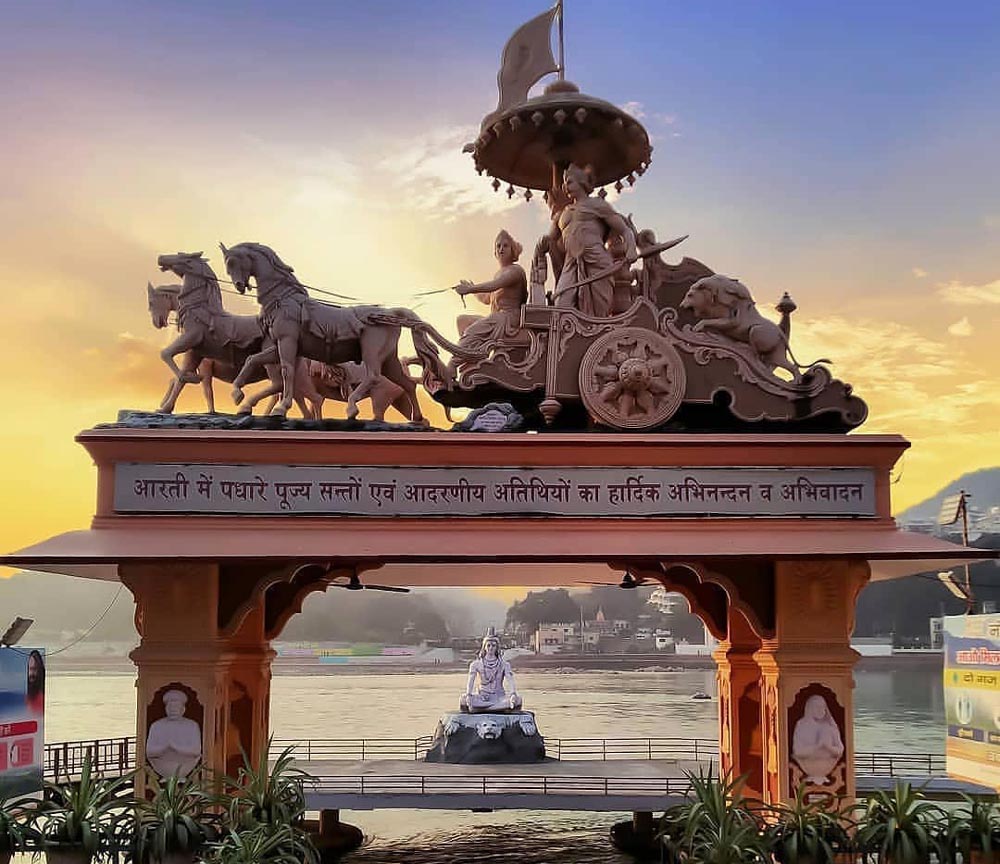
Perched on the sacred banks of the Ganga in Swargashram, Rishikesh, Parmarth Niketan is one of the best-known spiritual destinations in Uttarakhand. Surrounded by the Himalayan foothills, the ashram brings together yoga, meditation, prayer, spirituality, environmental awareness, education and charitable service in one setting. Its riverside location, daily Ganga Aarti and international yoga programmes have made it an important destination not only for Indian pilgrims but also for visitors from around the world.
Parmarth Niketan Ashram is located in Swargashram, near Ram Jhula, across the Ganga from the more urban parts of Rishikesh. The combination of the flowing river, forested Himalayan landscape, temples, ashrams and spiritual activities gives the area a distinctive atmosphere. For travellers interested in experiencing a quieter and more contemplative side of Rishikesh, Parmarth Niketan offers much more than a conventional sightseeing attraction.
The Meaning and History of Parmarth Niketan
The name Parmarth Niketan is generally translated as “an abode dedicated to the welfare of all.” This idea is central to the institution’s philosophy. Rather than focusing exclusively on individual spiritual practice, the ashram has historically combined spiritual development with service to society.
The story of Parmarth Niketan goes back to the early 1940s, when revered saint Swami Shukdevanandji began coming to the banks of the Ganga for meditation. What initially developed as a modest place for spiritual practice gradually expanded as devotees and seekers began gathering around the saint. Accommodation, a satsang hall and a dining facility were subsequently developed, and the institution came to be known as Parmarth Niketan. Over the decades, the small spiritual centre grew into a major ashram complex. Today, it welcomes pilgrims, yoga practitioners, spiritual seekers and travellers from India and abroad. The institution describes itself as an inclusive spiritual centre open to people regardless of nationality, gender, religion, caste or creed.
This development also reflects the broader transformation of Rishikesh itself. Once primarily associated with sages, temples and traditional pilgrimage, the city has become internationally recognised as a centre for yoga, meditation and spiritual tourism while retaining its religious importance.
Location and Natural Setting
One of the greatest attractions of Parmarth Niketan is its location. The ashram stands beside the Ganga in Swargashram, an area whose name itself means “heavenly abode.” The Himalayan environment provides an important part of the experience, with the river forming the spiritual and visual centre of the landscape.
The surroundings are particularly appealing in the early morning and evening. At sunrise, the river and surrounding hills create a peaceful setting for yoga and meditation. At sunset, the atmosphere changes as visitors gather beside the Ganga for the evening ceremony.
The location also places Parmarth Niketan close to several other important Rishikesh attractions. Ram Jhula, one of the city’s well-known suspension bridges, is nearby, while the wider Swargashram area contains temples, smaller ashrams, spiritual centres, shops and riverside ghats.
Because of this location, visitors can combine a stay at Parmarth Niketan with exploration of Rishikesh’s religious, cultural and natural attractions.
The Famous Ganga Aarti
For many visitors, the most memorable experience at Parmarth Niketan is the Ganga Aarti held at sunset. The ceremony takes place at the ashram’s riverside ghat and combines devotional singing, prayers, sacred fire rituals and lamps offered in reverence to the Ganga.
Parmarth Niketan states that the Aarti attracts visitors from different cultures, languages, religions and backgrounds. The ceremony is held daily, although the exact timing changes according to the season.
The experience begins to build before sunset as people gather along the river. The changing colours of the sky, sound of devotional music and chanting, movement of the flames and sight of the Ganga create an atmosphere quite different from ordinary sightseeing.
Visitors who are unfamiliar with Hindu rituals can still appreciate the ceremony as a cultural and spiritual experience. Participation does not necessarily require an extensive knowledge of Sanskrit or Hindu philosophy. Observing respectfully is enough for most visitors.
The Ganga Aarti also demonstrates how the river functions simultaneously as a geographical feature, sacred symbol and cultural institution in Rishikesh. It is therefore more than a visual spectacle; it represents an important element of the religious identity of the city.
Yoga at Parmarth Niketan
Yoga is another major part of life at Parmarth Niketan. The ashram conducts yoga and meditation activities throughout the year and describes its approach as rooted in traditional yogic disciplines.
A typical day may include morning prayer followed by an asana session, meditation, spiritual talks and evening activities. The precise schedule can change, so visitors staying at the ashram are advised to confirm the current timetable with reception. The ashram’s published schedule, for example, includes morning prayer, morning yoga, meditation, afternoon yoga and meditation, followed by Ganga Yagya and Aarti and an evening satsang.
The yoga environment at Parmarth Niketan differs from a conventional commercial fitness studio. Yoga is presented as part of a broader spiritual discipline involving meditation, self-reflection, prayer and service. Consequently, visitors looking only for physical exercise may experience the setting differently from those interested in traditional or spiritually oriented yoga.
The ashram also hosts specialised programmes and courses involving yoga, meditation, pranayama and related Indian traditions.
International Yoga Festival
Parmarth Niketan is particularly significant in the international yoga community because it hosts the International Yoga Festival, one of its most prominent annual events.
The festival has a history stretching back to 1989, while Parmarth Niketan has hosted it annually since 1999. The event brings together yoga practitioners, teachers, spiritual leaders and visitors from numerous countries.
The 2026 festival illustrates the international scale of the event. Parmarth Niketan reported participants and yoga enthusiasts from nearly 80 countries, along with a large programme of yoga practices, meditation, spiritual discussions, cultural performances and traditional practices.
The festival is not limited to physical yoga postures. Its programmes can encompass meditation, pranayama, philosophy, Ayurveda, spiritual teachings, music, chanting, cultural traditions and discussions about conscious living.
For Rishikesh, such events have reinforced the city’s reputation as an international destination for yoga. For Parmarth Niketan, the festival represents an extension of its long-standing emphasis on yoga as a holistic way of life.
Daily Spiritual Life
A significant feature of Parmarth Niketan is the structured daily routine. Visitors can participate in prayers, yoga, meditation, satsang, kirtan and other spiritual activities.
The published daily schedule includes morning prayer, yoga, a sacred yagya, meditation, afternoon yoga, Ganga Yagya and Aarti, followed by an evening satsang and meditation programme. The ashram also notes that schedules may change and recommends checking with reception.
This routine gives visitors an opportunity to experience ashram life rather than simply visit the site for an hour or two. Early mornings are particularly important because traditional Indian spiritual practices often place emphasis on beginning the day with prayer, meditation and disciplined activity.
Satsang is another important component. The word broadly refers to gathering for spiritual discourse and association with spiritual teachings. Depending on the programme, visitors may encounter lectures, devotional music, stories from Hindu traditions or discussions about yoga and spiritual philosophy.
Accommodation and Ashram Experience
Parmarth Niketan has extensive accommodation facilities and describes its rooms and facilities as a combination of modern amenities and traditional simplicity.
However, an ashram stay should not necessarily be approached in exactly the same way as staying at a conventional hotel or resort. The primary purpose is spiritual practice, reflection, participation in activities and a disciplined environment.
The ashram’s own guidelines indicate that accommodation is intended for pilgrims who come with an interest in sadhana, meditation, seva and satsang.
This makes it particularly suitable for people who want to experience a spiritual retreat. Travellers seeking nightlife, luxury resort facilities or a purely recreational holiday may find the atmosphere quite different from what they expect.
Those planning to stay should check current accommodation rules, availability, meal arrangements, identification requirements, programme schedules and seasonal conditions directly with the ashram before travelling.
Food and Ashram Lifestyle
Food is an important part of traditional ashram life, where meals are generally approached as part of a disciplined daily routine rather than simply as restaurant dining.
Parmarth Niketan also maintains bhandara activities through which large numbers of people, including rishikumars, brahmacharis, sadhus and others in need, are fed.
The broader atmosphere encourages simplicity and mindful living. Visitors can use their time for prayer, meditation, reading, yoga, walking beside the Ganga and participating in community activities.
This slower rhythm can be particularly valuable for travellers who normally spend their holidays moving rapidly from one attraction to another.
Education and Social Service
Parmarth Niketan’s activities extend beyond spirituality. The institution describes several charitable and humanitarian initiatives covering education, healthcare, environmental protection and community welfare.
One of these initiatives is Parmarth Gurukul, which provides academic education along with Sanskrit and study of ancient Vedic texts to disadvantaged boys. The ashram also describes a free children’s school associated with Prakash Bharti.
Healthcare is another area of service. Parmarth Niketan reports that the Swami Shukdevanand Charitable Hospital provides free healthcare and that medical camps are organised for Himalayan communities.
These initiatives help explain the broader meaning behind the word “Parmarth.” The institution presents spiritual practice and social responsibility as interconnected rather than separate activities.
Environmental Awareness and the Ganga
Because Parmarth Niketan is situated directly beside the Ganga, environmental awareness is naturally an important part of its public activities.
The institution’s programmes include initiatives described as Clean, Green & Serene, aimed at encouraging environmental awareness and supporting the restoration of natural balance. Its stated mission also includes efforts related to restoring and protecting the Ganga.
For visitors, this environmental dimension adds another layer to the experience. The Ganga is simultaneously a sacred river and an ecosystem facing the pressures associated with urbanisation, tourism and pollution. Spiritual reverence for the river can therefore be accompanied by practical questions about cleanliness, conservation and responsible tourism.
Travellers can contribute by avoiding litter, using designated waste facilities, reducing unnecessary plastic use and treating the river and surrounding areas respectfully.
Ayurvedic and Wellness Activities
Parmarth Niketan also provides opportunities connected with Ayurveda and natural wellness. The ashram states that Nature Cure and Ayurvedic treatment facilities are available on its premises, along with a charitable clinic or dispensary.
These facilities complement the yoga and meditation programmes and reflect the traditional Indian concept of approaching wellbeing through multiple dimensions.
Visitors interested in treatments or health services should obtain current information directly from the institution about available practitioners, services, fees, schedules and suitability.
Best Time to Visit Parmarth Niketan
Rishikesh can be visited throughout much of the year, but the experience changes considerably with the seasons.
The cooler months from approximately October to March are generally comfortable for walking, sightseeing and participating in outdoor spiritual activities. Winter mornings can be chilly, particularly beside the river, so warm clothing is useful.
Spring can be particularly pleasant for yoga and outdoor activities, while the annual International Yoga Festival makes March an especially significant period for yoga enthusiasts.
The summer months can become hot, although mornings and evenings can still be enjoyable. The monsoon season brings heavier rainfall and increased river-related caution, and weather conditions can affect travel plans and outdoor activities.
Anyone planning a pilgrimage or retreat should check current weather and local travel conditions before departure.
How to Reach Parmarth Niketan
Rishikesh is well connected with major cities of northern India. The nearest major airport is Jolly Grant Airport near Dehradun, while Haridwar is an important railway connection for travellers arriving by train.
From central Rishikesh, visitors can travel towards the Swargashram area. Parmarth Niketan is situated near Ram Jhula, making the location relatively easy to identify once visitors reach the riverside area.
Because traffic, bridge access and local transportation arrangements can vary, travellers should check current local conditions, particularly during major religious festivals and peak tourist periods.
Places to Visit Around Parmarth Niketan
A visit to Parmarth Niketan can easily be combined with other attractions in Rishikesh. Ram Jhula is one of the most recognisable nearby landmarks and provides views of the Ganga and surrounding landscape.
The wider Swargashram area contains numerous temples and spiritual institutions. Visitors can also explore the riverside ghats, local markets and other ashrams.
Rishikesh is also associated with adventure activities such as rafting, trekking and nature excursions. However, visitors staying at an ashram should balance these recreational activities with the institution’s spiritual schedule and guidelines.
For travellers interested primarily in spirituality, spending time simply walking along the river, attending Aarti and joining meditation sessions can be more meaningful than attempting to cover a large number of attractions in a single day.
What Makes Parmarth Niketan Different?
The distinctive character of Parmarth Niketan comes from the way several aspects of Indian spiritual culture are brought together. It is simultaneously an ashram, yoga centre, pilgrimage destination, educational institution, charitable organisation and venue for international spiritual and cultural events.
Its location beside the Ganga is fundamental to this identity. The river is not simply scenery outside the buildings; it forms the setting for prayer, meditation, ritual and reflection.
At the same time, the international character of modern Rishikesh is clearly visible here. Visitors from different countries participate in yoga programmes, meditation courses and spiritual events, creating an environment where traditional Indian practices interact with contemporary global interest in wellbeing and conscious living.
Responsible Visiting and Practical Tips
Visitors should approach Parmarth Niketan with respect for its religious and spiritual character. Modest clothing is appropriate, especially when attending prayers, ceremonies or visiting temple areas.
Silence or a relatively quiet manner is preferable during meditation and prayer sessions. Photography should be undertaken sensitively, particularly during religious ceremonies and when photographing individuals.
The Ganga should be treated respectfully. Visitors should avoid throwing plastic, food packaging or other waste into the river. During periods of strong current or high water, people should also follow local safety instructions and avoid entering the river in unsafe locations.
It is also worth remembering that an ashram is not simply another tourist attraction. Participation in its activities and observance of its guidelines can make the experience considerably more rewarding.
Final Summary
Parmarth Niketan is one of Rishikesh’s most important places for experiencing the spiritual, cultural and environmental traditions associated with the Ganga and the Himalayas. From its origins as a modest spiritual centre established around the meditation practice of Swami Shukdevanandji to its present role as a major international destination for yoga and spirituality, the institution has developed while retaining its emphasis on service and spiritual practice.
Its daily yoga and meditation sessions, satsangs, prayers and evening Ganga Aarti provide visitors with opportunities to participate rather than simply observe. Its educational, healthcare, charitable and environmental initiatives extend the institution’s activities beyond the boundaries of a conventional pilgrimage centre.
For travellers exploring Uttarakhand, Parmarth Niketan offers a different kind of experience from mountain viewpoints, waterfalls and adventure destinations. Here, the attraction is the atmosphere itself: the sound of the Ganga, the Himalayan surroundings, the rhythm of prayer and yoga, and the opportunity to slow down and spend time in contemplation.
Whether visited for a few hours to attend the Ganga Aarti or as part of a longer spiritual retreat, Parmarth Niketan provides an important window into the living spiritual culture of Rishikesh and the wider Uttarakhand Himalayas.

