Hidden amid the greenery of Rishikesh in Uttarakhand, on the eastern bank of the Ganga, lies a place where Indian spirituality and global popular culture became unexpectedly intertwined. Known today as the Beatles Ashram, this fascinating destination was originally called Chaurasi Kutia, or the “Ashram of 84 Cottages.” It was established as a meditation centre associated with Maharishi Mahesh Yogi and became internationally famous when The Beatles travelled to Rishikesh in 1968 to study Transcendental Meditation.
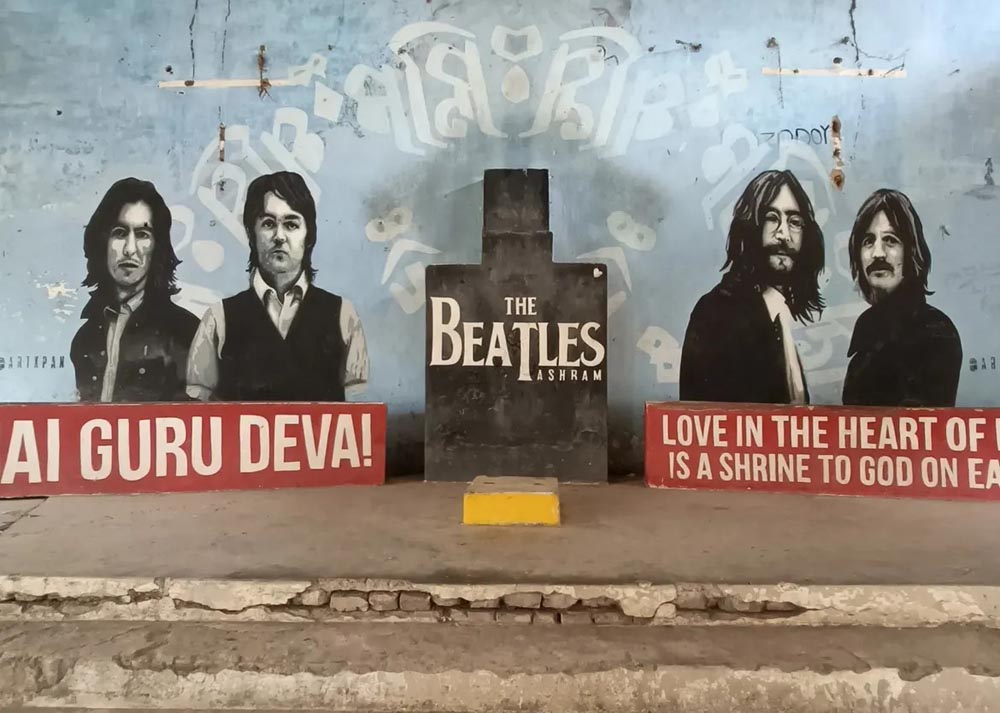
Today, the site is very different from a conventional functioning ashram. Weathered meditation structures, abandoned buildings, forest paths, murals, graffiti and colourful artwork coexist with the peaceful atmosphere of the surrounding landscape. This unusual combination gives the Beatles Ashram an identity of its own. For music enthusiasts, it represents an important chapter in the history of The Beatles. For travellers interested in spirituality, it offers an insight into the meditation movement that attracted international attention during the 1960s. For photographers and art lovers, its walls and domes have become an open-air gallery.
The Beatles Ashram is therefore much more than a place associated with a famous band. It is a destination where the cultural history of the 1960s, Indian spiritual traditions, architecture, art and the natural environment of Rishikesh come together.
The Origins of Chaurasi Kutia
Before it became known worldwide as the Beatles Ashram, the property was associated with Maharishi Mahesh Yogi and his International Academy of Meditation. Maharishi Mahesh Yogi became internationally known for promoting Transcendental Meditation, a technique that attracted followers in India as well as Europe, North America and elsewhere.
The Rishikesh centre was intended to provide students with a secluded environment where they could concentrate on meditation and spiritual study. Its location was particularly suited to that purpose. Surrounded by forest and positioned near the Ganga, the property was separated from the busy parts of Rishikesh while still being accessible to visitors and students.
The name Chaurasi Kutia refers to the 84 meditation cottages or kutiyas associated with the complex. These small structures were designed to provide individual spaces for meditation and retreat. The unusual architecture of the meditation cells, particularly their rounded or dome-like forms, is one of the features that continues to distinguish the site today.
The ashram was established on forest land leased to Maharishi Mahesh Yogi’s organisation. Historical accounts differ somewhat on the exact acreage and administrative details, but sources agree that the property was situated within the forest area and that the lease eventually expired. The ashram subsequently declined and was eventually vacated, leaving the complex largely abandoned for years.
The Beatles Arrive in Rishikesh
The event that transformed Chaurasi Kutia into an international cultural landmark occurred in 1968.
The Beatles had already become one of the world’s most influential musical groups when their interest in Indian philosophy and meditation developed. Their association with Maharishi Mahesh Yogi began before their Rishikesh visit, following encounters with him in 1967. Their growing interest in meditation eventually led the band members to travel to India.
In February 1968, John Lennon, Paul McCartney, George Harrison and Ringo Starr arrived in Rishikesh to participate in a Transcendental Meditation course at Maharishi’s ashram. Their visit attracted enormous international attention. Other Western celebrities, including Mia Farrow, Donovan and Mike Love, were also associated with the retreat around this period.
The four Beatles did not remain for exactly the same length of time. Ringo Starr’s stay was relatively short, while Paul McCartney stayed for several weeks. John Lennon and George Harrison remained longer. Their individual experiences of the ashram were therefore not identical.
Nevertheless, the visit became one of the most memorable episodes in the band’s history. It also helped establish Rishikesh as a destination of international interest for people seeking yoga, meditation and Indian spiritual traditions.
A Remarkably Creative Period
One of the most fascinating aspects of the Beatles’ stay is the amount of music associated with their time in Rishikesh.
The period has often been described as one of the band’s most productive songwriting phases. During their retreat, members of the group wrote or developed numerous songs, many of which later appeared on their 1968 self-titled double album, popularly known as the White Album. India’s influence can be detected in different ways across the Beatles’ work, although the songs cannot all be understood simply as products of the ashram experience.
Songs such as “Dear Prudence” and other compositions from this period are frequently connected with the Rishikesh experience. The surroundings provided a dramatic contrast to the band’s life of international fame. Instead of recording studios, concert halls and constant media attention, the musicians found themselves in a secluded environment focused on meditation and spiritual study.
George Harrison’s interest in Indian music was particularly significant. His earlier association with the sitar and Indian classical music had already influenced his artistic development, and his relationship with Indian culture continued to be an important part of his musical journey.
The significance of Rishikesh in Beatles history is consequently not limited to the physical place. The ashram became part of a much broader story involving music, spirituality, creativity and the growing Western fascination with India during the 1960s.
The Ashram After the Beatles
The international attention generated by the Beatles did not prevent the ashram from eventually declining.
After the Beatles and other visitors departed, the site continued to exist as a spiritual centre for some time. However, the lease arrangements eventually came to an end, and the property was ultimately vacated. Accounts place the abandonment process in the 1990s and early 2000s, with the Forest Department eventually taking control of the site.
For years, Chaurasi Kutia remained largely neglected. Buildings deteriorated, vegetation grew around the structures and nature gradually reclaimed parts of the compound.
Ironically, this period of abandonment contributed to the site’s present character. Instead of becoming a heavily restored heritage complex, the property retained much of its weathered appearance. Visitors today can see old structures surrounded by vegetation, creating an atmosphere that is quite different from conventional museums and tourist attractions.
The ruins became particularly attractive to Beatles fans, photographers and artists. People continued to visit because of the site’s connection with the band even when it lacked the facilities of a conventional tourist destination.
Opening the Beatles Ashram to Visitors
A new chapter began when the site was opened to tourists as a heritage and eco-tourism destination. The Uttarakhand Forest Department developed the abandoned complex as a visitor attraction, and it was formally reopened to the public in December 2015.
This transformation gave the location a new identity. Rather than attempting to erase the evidence of abandonment, the destination retained many of its old structures and incorporated art into the experience.
The name “Beatles Ashram” became widely used, although Chaurasi Kutia and Maharishi Mahesh Yogi Ashram remain important names for the location.
The reopening also reflected Rishikesh’s growing reputation as an international tourism destination. The city already attracted visitors for yoga, meditation, rafting, temples, ashrams and the Ganga. The Beatles connection added another dimension to its appeal.
Architecture and the Famous Meditation Caves
One of the most memorable features of the Beatles Ashram is its architecture.
The small meditation huts are scattered across the grounds, often appearing almost like futuristic concrete or stone structures emerging from the vegetation. Their unusual forms create a visual contrast with the surrounding forest.
These spaces were designed for meditation rather than sightseeing. Their simplicity reflects the original purpose of the ashram: providing secluded environments for spiritual practice.
Another important building is the former lecture or meditation hall, which has become closely associated with the artistic identity of the site. The building and surrounding structures now contain murals, paintings and graffiti created during the site’s transformation into a cultural attraction.
The so-called meditation caves are particularly popular with photographers. Their compact interiors, curved walls and limited natural light create dramatic photographic opportunities. They also provide a tangible sense of how the ashram’s original residents may have experienced the secluded environment.
The Beatles Cathedral and Street Art
Perhaps the most visually striking aspect of the modern Beatles Ashram is its artwork.
The walls of several structures have become canvases for colourful murals, paintings and graffiti. Some artworks refer directly to The Beatles, while others depict spiritual themes, nature, abstract designs and contemporary interpretations of the ashram’s history.
The large former lecture hall is popularly known as the Beatles Cathedral. It has become one of the major attractions within the complex because of its large-scale artistic treatment.
This combination of ruins and street art gives the Beatles Ashram a distinctive atmosphere. A visitor might walk past a weathered meditation structure covered with vines and then encounter a brightly painted mural nearby. The contrast between decay and creativity is one of the reasons the site has become popular among photographers.
The artwork also illustrates how heritage can evolve. The original ashram was created for meditation, but its abandoned buildings have acquired a second life as spaces for contemporary artistic expression.
Spirituality and the Beatles Connection
It is important to remember that the Beatles connection is only one part of the site’s history.
The ashram was originally established around meditation and spiritual practice. Its association with Transcendental Meditation and Maharishi Mahesh Yogi existed independently of the band’s visit.
The Beatles’ presence, however, helped introduce millions of people around the world to the idea of travelling to India for spiritual exploration. Their visit became part of the broader cultural movement of the 1960s, when Western artists and young travellers increasingly explored Indian philosophy, yoga, meditation and music.
Rishikesh already had a long spiritual tradition before 1968. The Beatles did not create the city’s religious importance, but their presence significantly expanded its international cultural visibility. The Government of India’s tourism platform similarly describes the 1968 visit as an important moment in Rishikesh’s international reputation for yoga and meditation.
Nature Around the Ashram
The setting of the Beatles Ashram is almost as important as its history.
The property is located in the Rishikesh area amid forested surroundings and close to the Ganga. Its association with the forest landscape is particularly noticeable when walking between the meditation huts.
Bird calls, trees, natural vegetation and occasional wildlife encounters can make the site feel far removed from the urban environment. The combination of nature and abandoned architecture creates a distinctive atmosphere that appeals even to visitors who have little interest in The Beatles.
The location’s relationship with the forest also means that visitors should treat the environment respectfully. The ashram should not be viewed simply as an abandoned building complex; it forms part of a wider natural landscape associated with the Rajaji region.
Why Photographers Love Beatles Ashram
Photography is one of the most popular activities at the site.
The architecture offers unusual geometric shapes, while the graffiti introduces bright colours and dramatic compositions. The forest provides natural framing, shadows and changing light conditions.
Morning can be particularly attractive for photography because the light is generally softer, while different areas of the complex create opportunities throughout a visit. The contrast between old concrete surfaces and colourful murals is ideal for architectural, travel and street-art photography.
The meditation domes are especially distinctive subjects. Their unusual shapes can be photographed individually or framed against trees and the surrounding landscape.
However, visitors should avoid damaging walls, entering restricted areas or interfering with artworks. Preserving the site’s fragile structures is important if future generations are to experience its distinctive character.
How to Reach Beatles Ashram
The Beatles Ashram is located in the Swargashram area of Rishikesh, on the eastern side of the Ganga. It is relatively close to major attractions around Ram Jhula and the wider Swargashram area.
For travellers arriving by train, Rishikesh railway station is the main rail connection for the city. Visitors arriving by air generally use Jolly Grant Airport near Dehradun, while Delhi’s Indira Gandhi International Airport provides another major gateway for travellers coming from outside the region. Incredible India lists both Jolly Grant and Delhi airports among the nearest major airport options for Rishikesh.
Once in Rishikesh, local taxis, auto-rickshaws and other local transport options can be used to reach the surrounding Swargashram area. Depending on the exact route and the current access arrangements, visitors may need to walk part of the way.
Because access arrangements can change, checking current visitor information before travelling is sensible.
Visiting Hours and Entry Information
Published visitor information currently lists the site as generally open during daytime hours, with sources giving slightly different schedules. Incredible India’s listing gives opening hours of 10:00 AM to 4:00 PM, while another current Rishikesh tourism source lists 9:00 AM to 4:00 PM and Monday closure.
Similarly, published entry-fee information should be checked before visiting because charges can change. One current tourism listing gives ₹150 for Indian visitors and ₹600 for foreign visitors.
This is particularly important for travellers planning a fixed itinerary. Checking the latest local or official information before leaving for the attraction can help avoid inconvenience.
Best Time to Visit
Rishikesh can be visited in different seasons, but the experience at the Beatles Ashram varies with weather.
The cooler months are generally comfortable for walking around the open grounds. Winter mornings can be pleasant and offer good conditions for exploring the ruins. Spring can also be attractive because temperatures are usually manageable and the landscape can be especially pleasant.
Summer afternoons can become hot, making early visits preferable. The monsoon brings substantial rainfall to the region, and wet paths may make walking around the complex less comfortable.
For photography, morning is particularly useful because of the softer light and relatively comfortable temperatures. A visitor interested in exploring the entire complex should allow roughly one to two hours rather than rushing through the site.
Places to Visit Near Beatles Ashram
A visit to the Beatles Ashram can easily be combined with other attractions in Rishikesh.
Ram Jhula is one of the city’s well-known suspension bridges and provides access to areas on both sides of the Ganga. Nearby Swargashram contains numerous spiritual centres, temples and ashrams.
Parmarth Niketan is another important destination in the area and is associated with yoga, spirituality and the evening Ganga Aarti. Triveni Ghat, farther into Rishikesh, is another major place for experiencing the city’s spiritual atmosphere, particularly during the evening ceremony.
Travellers interested in adventure can also combine their visit with river rafting and other outdoor activities for which Rishikesh is famous.
Beatles Ashram as a Heritage Destination
The enduring appeal of the Beatles Ashram comes from its unusual combination of histories.
It is simultaneously a former meditation centre, a site connected with Maharishi Mahesh Yogi, a Beatles landmark, an architectural ruin, an art space and a nature-oriented tourist attraction.
Few destinations combine these themes so naturally. A Beatles fan may arrive primarily because of the band’s history but discover an interest in meditation and architecture. A traveller interested in spirituality may come for the ashram’s original purpose and discover its musical history. A photographer may be attracted by the murals and end up exploring the story behind the buildings.
This diversity is what makes the site particularly significant within Rishikesh’s tourism landscape.
Responsible Tourism at Beatles Ashram
Because the site combines historical structures with a natural setting, responsible tourism is especially important.
Visitors should avoid climbing fragile structures, carving names into walls, littering or disturbing wildlife. Graffiti that forms part of the site’s contemporary artistic identity should not be confused with permission for visitors to add their own marks.
Photography should also be undertaken respectfully. The atmosphere of the site remains relatively peaceful, and visitors interested in meditation or reflection should be given space.
Respecting the original character of the buildings and the surrounding environment ensures that the Beatles Ashram remains meaningful beyond its popularity as a photo destination.
The Lasting Legacy of Beatles Ashram
More than half a century after The Beatles travelled to Rishikesh, the connection between the band and the city remains remarkably strong.
The Beatles spent only a limited period at the ashram, but their visit became an important chapter in the cultural history of both the band and Rishikesh. Their interest in meditation contributed to a wider Western fascination with Indian spiritual traditions, while their songwriting during the period became part of the mythology surrounding one of the most influential bands in popular music.
Today, visitors encounter something very different from the functioning meditation centre that existed in 1968. The old buildings have weathered, the forest has reclaimed parts of the property, and colourful murals have transformed many walls. Yet that mixture of history, decay, creativity and spirituality is precisely what gives the Beatles Ashram its special atmosphere.
For anyone travelling through Uttarakhand, the site offers more than a celebrity-related attraction. It provides an opportunity to explore an unusual meeting point between Indian spirituality and Western popular culture, while also experiencing one of the more atmospheric heritage sites in Rishikesh.
Ultimately, the Beatles Ashram is best understood not merely as the place where a famous band once stayed, but as a living piece of cultural history. Its meditation huts recall its spiritual beginnings, its murals represent its modern artistic identity, and its connection with The Beatles preserves the memory of a remarkable moment when music, meditation and India captured the imagination of the world.

