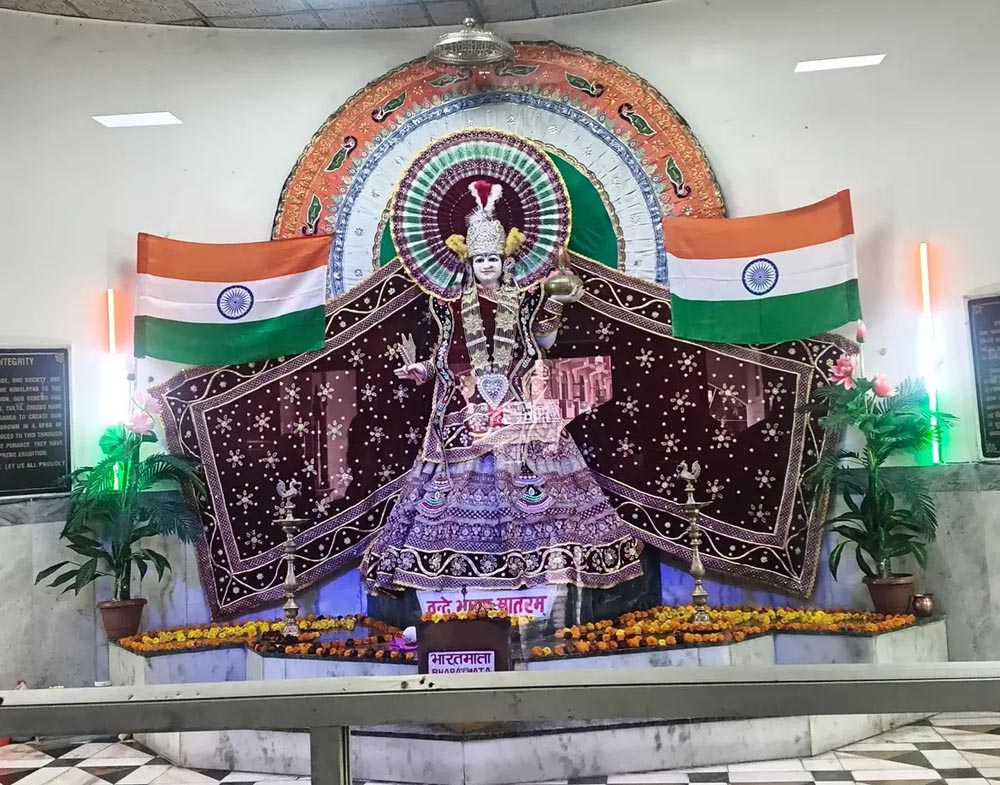
Among the many temples that make Haridwar one of India’s most important pilgrimage destinations, Bharat Mata Mandir occupies a particularly distinctive place. Located in the Sapt Sarovar area of Haridwar, Uttarakhand, this unusual multi-storey temple is dedicated not to one conventional deity, but to Bharat Mata, or Mother India. Its architecture and exhibits bring together ideas of patriotism, spirituality, Indian history, cultural diversity, heroic sacrifice and the contributions of saints and women.
Bharat Mata Temple, Haridwar stands close to the Ganga and is associated with Samanvaya Ashram. The temple rises approximately 180 feet and is generally described as an eight-storey structure, with different levels devoted to different themes.
Unlike temples whose principal attraction is a single presiding deity, Bharat Mata Mandir can be experienced almost like a vertical journey through India’s civilizational story. Visitors move from the symbolic representation of the nation to galleries and shrines associated with heroes, women, saints, divine traditions and the broader cultural landscape of India.
The History of Bharat Mata Mandir
The story of Bharat Mata Mandir is closely connected with Swami Satyamitranand Giri, who envisioned a temple where the motherland itself could be represented as a sacred presence. The temple was inaugurated in 1983 by the then Prime Minister Indira Gandhi. Uttarakhand Open University’s tourism material records the inauguration date as 15 May 1983 and describes the temple as an eight-storey, 180-foot structure beside the Ganga.
The concept was different from that of a conventional Hindu shrine. Rather than limiting the temple’s narrative to a particular god or goddess, its different floors were planned around aspects of India’s national, cultural and spiritual heritage. Freedom fighters, revered women, saints belonging to different traditions and manifestations of Hindu divinity all find a place within the building.
This concept also explains why Bharat Mata Mandir attracts more than people looking for a conventional religious experience. For many visitors, the temple functions simultaneously as a place of prayer, remembrance, education and reflection.
Its location in Haridwar adds another layer to its character. Haridwar is one of India’s major pilgrimage centres and is particularly associated with the River Ganga, temples, ashrams and religious gatherings. In such an environment, Bharat Mata Mandir’s combination of national history and spirituality gives it a character that is different from many of the city’s better-known shrines.
Where Is Bharat Mata Mandir Located?
The temple is located in the Motichur/Bhoopatwala area of Haridwar, close to the Ganga and the Sapt Sarovar region. It is approximately 6–7 km from Haridwar Junction according to commonly cited travel references, although the exact distance can vary depending on the route used.
Its location makes it relatively convenient to combine with other Haridwar attractions. Travellers staying in central Haridwar can generally reach the temple by auto-rickshaw, taxi or local transport. The road journey also allows visitors to experience a different side of Haridwar away from the busiest central ghats.
For travellers arriving by air, Jolly Grant Airport near Dehradun is the principal airport serving the Haridwar-Rishikesh region. Haridwar is also a major railway destination, making the temple accessible to visitors arriving from Delhi, Uttar Pradesh and other parts of India.
Architecture and Design
The most immediately noticeable feature of Bharat Mata Mandir is its vertical design. Rising to roughly 180 feet, the temple is organised around several floors, each with its own theme.
This design is significant because the building itself becomes part of the storytelling. Instead of presenting everything within one large hall, the temple encourages visitors to ascend gradually and encounter different dimensions of Indian heritage.
The lower levels introduce the visitor to Bharat Mata and national identity, while successive floors explore heroes, women, saints and religious traditions. Higher levels move further into the spiritual and mythological dimensions of Indian culture.
Another important feature is the representation of India’s geographical identity. Sources describing the temple mention a large marble map of India associated with the Bharat Mata shrine.
Consequently, the architecture is not merely ornamental. It is intended to communicate an idea: that India’s geographical territory, historical memory, spiritual traditions and people can all be understood as interconnected parts of a larger whole.
First Floor: Bharat Mata
The first principal level is dedicated to Bharat Mata, the symbolic Mother India. Her image is the central expression of the temple’s concept.
A large representation of India is also associated with this level. The map is particularly meaningful because it transforms geography into something symbolic. Instead of looking at the country simply as a collection of states, regions and landscapes, visitors are encouraged to contemplate it as a shared homeland.
The Bharat Mata concept has a long association with Indian cultural and nationalist imagery, particularly during the freedom movement. At this temple, that idea is given a physical architectural form.
For visitors, this floor is often the natural starting point for understanding the temple. The remaining floors can then be seen as different chapters expanding upon the idea of India introduced here.
Second Floor: Shoor Mandir
The second level is known as Shoor Mandir, a space associated with India’s heroes and warriors. It recognises people remembered for courage, sacrifice and contributions to the country’s history.
The floor has particular relevance for understanding the temple’s patriotic dimension. India’s freedom struggle involved people from different regions, communities and backgrounds, and memorialising such figures within the temple reinforces the theme of collective national memory.
For visitors interested in Indian history, this section can be especially engaging. It provides an opportunity to move beyond the familiar religious character of Haridwar and encounter representations of people associated with political and social history.
The emphasis on courage and sacrifice also complements the spiritual themes elsewhere in the building. The temple effectively places devotion, service and sacrifice within the same larger narrative.
Third Floor: Matru Mandir
The third level, commonly called Matru Mandir, celebrates India’s revered women. Among the figures associated with this section are women remembered in religious tradition, mythology, literature and Indian cultural history. Sources mention figures such as Meera, Savitri, Gargi, Draupadi and others.
This floor is important because it broadens the temple’s representation of Indian heritage. The contribution of women is not treated as a secondary theme but receives an entire level within the building.
The women represented here come from different periods and traditions. Some are remembered as spiritual personalities, some as exemplary figures in sacred narratives, and others for their intellectual or cultural contributions.
For modern travellers, this floor provides an interesting perspective on the way Indian civilisation has remembered influential women across different traditions.
Fourth Floor: Sant Mandir
The fourth floor is known as Sant Mandir and focuses on India’s saints and spiritual teachers. What makes this section particularly noteworthy is its representation of saints associated with different religious traditions. References to Jain, Buddhist and Sikh traditions are included in descriptions of the floor.
This contributes strongly to one of the temple’s central themes: the coexistence of multiple spiritual traditions within India.
India’s religious history is exceptionally diverse. Hindu traditions exist alongside Buddhism, Jainism, Sikhism, Islam, Christianity and numerous regional and philosophical traditions. The Sant Mandir reflects at least part of this broader landscape by bringing revered spiritual personalities into the same architectural narrative.
For visitors, therefore, the floor can be interpreted as a reminder that India’s spiritual identity cannot be reduced to a single tradition or historical period.
Fifth Floor: Assembly Hall and Cultural Representations
The fifth floor contains an assembly hall and artistic representations associated with India’s history and cultural diversity. Sources describe paintings and murals depicting different aspects of Indian history and the coexistence of religious traditions.
This section provides a transition between the historical and spiritual themes of the lower floors and the explicitly theological themes encountered higher up.
Art plays an important role here. Instead of relying entirely on written explanations, the temple uses visual storytelling to communicate ideas about India’s regions, communities and cultural traditions.
For travellers who enjoy heritage architecture and traditional art, spending some time observing the murals and visual details can add depth to the visit.
Sixth Floor: Shakti Mandir
The sixth floor turns towards the concept of Shakti, the divine feminine power in Hindu traditions. Various manifestations of the Goddess are represented here.
Shakti has an enormous place in Indian religious thought. Different manifestations of the Goddess are associated with power, knowledge, protection, compassion and transformation. The representation of Shakti therefore connects the temple’s earlier celebration of women with a deeper theological concept of divine feminine energy.
This floor also demonstrates how Bharat Mata Mandir moves between national symbolism and traditional Hindu spirituality. The temple is not exclusively a patriotic memorial; it incorporates established religious concepts into its larger narrative.
Seventh Floor: Vishnu and His Avatars
The seventh floor is associated with Lord Vishnu and his various incarnations. Descriptions of the temple mention representations connected with Vishnu’s avatar traditions, including Rama and Krishna.
For visitors familiar with Hindu mythology, this level provides an opportunity to encounter one of the most influential theological traditions in Hinduism.
Vishnu’s avatars are traditionally understood as manifestations associated with restoring cosmic order under particular circumstances. Their stories have shaped Indian religious literature, art, theatre, festivals and popular culture for centuries.
The inclusion of this floor demonstrates another dimension of the temple’s design: after taking visitors through national history, heroic figures, women and saints, the journey eventually reaches major themes within Hindu cosmology.
Eighth Floor and the Panoramic Experience
Descriptions of the highest floor vary somewhat in how they identify its principal shrine, with several travel sources associating it with Lord Shiva.
The height of the building is itself an attraction. From the upper levels, visitors can gain views over parts of Haridwar and the surrounding landscape, including the Himalayan foothills and areas around Sapt Sarovar.
The experience of reaching the top provides an interesting conclusion to the temple visit. After moving through galleries and representations of India’s history and spirituality, visitors can look outward over the landscape of Haridwar.
The contrast is striking: inside, the temple presents a highly concentrated representation of Indian cultural memory; outside, the landscape provides the geographical setting in which the city and its religious traditions have developed.
Religious and Cultural Significance
The significance of Bharat Mata Mandir goes beyond ordinary pilgrimage. Its central idea is the symbolic personification of India as a mother. This makes patriotism and spirituality part of the same narrative.
At the same time, the temple’s various floors demonstrate that Indian identity has many dimensions. Heroes represent courage and sacrifice; women represent social, spiritual and cultural contributions; saints represent India’s philosophical and religious traditions; while the upper shrines connect the visitor with Hindu theological traditions.
This combination makes the temple particularly interesting from a cultural-tourism perspective.
It can be visited by pilgrims, history enthusiasts, students, families, photographers and travellers interested in unusual religious architecture. Someone unfamiliar with Haridwar’s temple culture may also find it a useful introduction to the way history, mythology and spirituality overlap in Indian cultural spaces.
Best Time to Visit
Haridwar experiences substantial seasonal variation. The cooler months, particularly from October to March, are generally more comfortable for sightseeing than the hottest summer period. Visitors should nevertheless check current opening arrangements before travelling because temple timings can change.
Different travel sources currently publish somewhat different schedules. One local listing reports daily hours of approximately 6:00 AM to 8:00 PM, while other travel references give longer or split-day schedules.
Because of these discrepancies, it is sensible to confirm the day’s timings locally before planning a tightly scheduled itinerary.
Early morning can be a pleasant time to visit because temperatures are generally more comfortable and the surrounding pilgrimage areas may be quieter.
How Long Should You Spend Here?
Bharat Mata Mandir does not necessarily require an entire day. Travel references commonly estimate roughly 30 minutes to two hours, depending on how thoroughly visitors explore the different floors.
A quick visit may be enough for travellers who simply want to see the building and principal shrine. Those interested in history, sculpture, paintings and the individual themes of each floor should allow more time.
It also makes sense to combine the temple with nearby Haridwar attractions rather than treating it as an isolated destination.
Bharat Mata Mandir as a Family and Educational Visit
One of the temple’s strengths is that it can appeal to different generations simultaneously. Older visitors may connect with the patriotic and historical themes, while younger visitors may find the multi-level design, sculptures and representations of historical personalities interesting.
For students, the temple can serve as a visual introduction to subjects such as Indian history, mythology, religious traditions, national movements and cultural diversity.
Parents visiting with children can use the different floors as opportunities to discuss historical personalities, freedom fighters, women in Indian history and India’s religious traditions.
The educational value, however, depends greatly on how visitors approach the temple. Rather than rushing through every floor, taking time to understand the themes can make the experience considerably more meaningful.
Nearby Places to Include in a Haridwar Itinerary
Bharat Mata Mandir can easily be included in a wider Haridwar sightseeing programme. Har Ki Pauri remains one of the city’s best-known attractions and is strongly associated with the Ganga and evening Ganga Aarti. Other important destinations in the broader Haridwar area include Mansa Devi Temple, Chandi Devi Temple and Daksha Mahadev Temple.
Travellers interested in nature can also consider destinations around the Haridwar-Rishikesh region, while those staying longer can explore Rishikesh and nearby Himalayan destinations.
The temple’s location near the Sapt Sarovar area makes it particularly suitable for travellers who want to explore some of the less central religious and spiritual sites of Haridwar.
Things to Keep in Mind While Visiting
Visitors should treat Bharat Mata Mandir as a religious and cultural site rather than simply a sightseeing attraction. Modest clothing, respectful behaviour and maintaining a reasonable noise level are appropriate.
Shoes may need to be removed in designated areas, and visitors should follow instructions given by temple staff. Photography rules can vary between areas, so it is better to ask before photographing shrines or interior displays.
The upper floors may involve considerable movement, although travel references report lift facilities within the temple.
Elderly visitors and people who have difficulty climbing should check the available access arrangements when they arrive.
Why Bharat Mata Mandir Is Different
The uniqueness of Bharat Mata Mandir lies in the way it brings together themes that are normally encountered in separate places. It is simultaneously a temple, memorial, cultural centre and visual account of Indian heritage.
Its eight-storey structure effectively turns a visit into a journey. The visitor begins with the symbolic figure of Mother India, encounters heroes and revered women, moves through India’s saintly traditions, observes artistic representations of cultural diversity and finally enters the world of major Hindu theological traditions.
The temple therefore offers something different from the conventional Haridwar pilgrimage experience. It encourages visitors to think about India not only as a sacred geographical landscape but also as a historical and cultural inheritance shaped by countless individuals and traditions.
Final Thoughts
Bharat Mata Mandir in Haridwar is one of Uttarakhand’s most distinctive cultural landmarks. Its importance comes from the unusual idea at the heart of its design: representing India itself through a combination of national memory, spirituality, history and cultural heritage.
Established by Swami Satyamitranand Giri and inaugurated in 1983 by Indira Gandhi, the temple has developed into an important stop for visitors exploring Haridwar. Its approximately 180-foot structure, eight thematic levels, representations of historical personalities and religious figures, and elevated views over the surrounding landscape give it a character that is difficult to reproduce elsewhere.
For travellers interested only in conventional temple rituals, Bharat Mata Mandir may offer a somewhat different experience. But for those who want to explore the intersection of Indian history, patriotism, spirituality, art and cultural diversity, it provides a fascinating destination.
A visit here is best approached slowly. Instead of simply moving from one floor to another, take time to understand what each level is attempting to represent. Seen in that way, Bharat Mata Mandir becomes more than a tall temple beside the Ganga—it becomes a carefully constructed journey through different ideas of what India means and how its history, traditions and people have shaped its identity.

