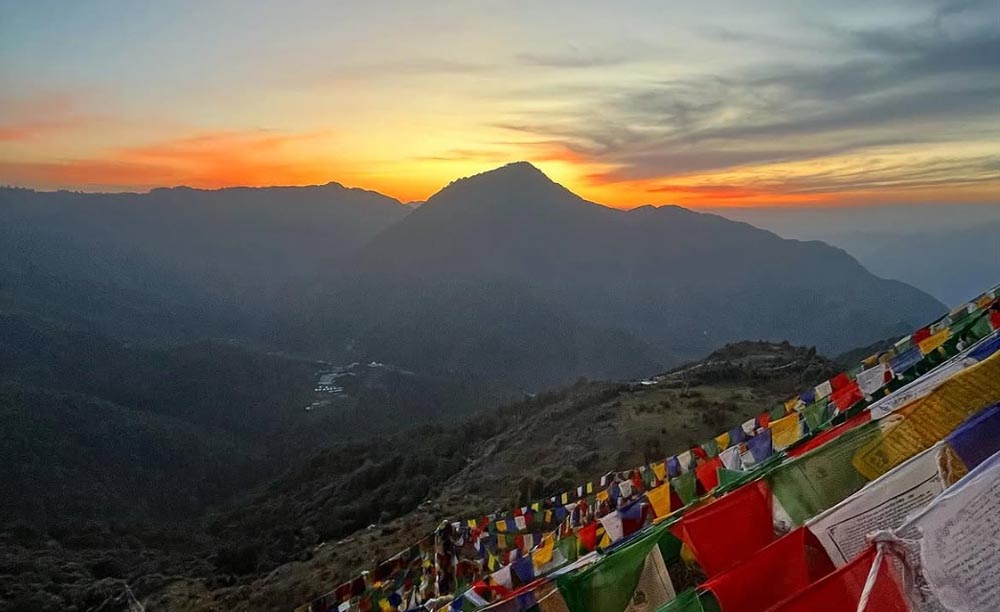
Mussoorie is often introduced through its famous Mall Road, colonial architecture, misty viewpoints, waterfalls and Himalayan scenery. Yet beyond the busy tourist centre lies a quieter and culturally fascinating part of the hill station: Happy Valley. Located on the western side of Mussoorie near Library Point, Happy Valley is much more than another sightseeing stop. It is a place where Himalayan landscapes, Tibetan Buddhist traditions, refugee history, education and the multicultural character of Mussoorie come together.
Happy Valley is particularly known for its Tibetan community, Buddhist monastery, prayer flags, mountain views and peaceful residential lanes. The area is also closely associated with the early history of the Tibetan community in India and the period when the 14th Dalai Lama stayed in Mussoorie after arriving in India in 1959. Today, the neighbourhood remains an important part of Mussoorie’s cultural identity.
For travellers who want to experience a side of Mussoorie away from its crowded commercial areas, Happy Valley offers a slower and more reflective experience. Its combination of history, spirituality, Tibetan culture and natural beauty makes it one of the more distinctive places to explore in Uttarakhand.
Where Is Happy Valley in Mussoorie?
Happy Valley is situated in the western part of Mussoorie, close to Library Point and the Lal Bahadur Shastri National Academy of Administration. It is roughly 2.5 to 3 kilometres from the Library Bus Stand, depending on the route used. The area extends toward the western outskirts of Mussoorie and is associated with attractions such as the Tibetan Buddhist temple, Dalai Hills and routes toward Cloud’s End.
The setting itself is part of the attraction. Unlike the intensely commercial portions of Mussoorie, Happy Valley has a more residential and peaceful atmosphere. Roads wind through forested slopes, houses sit among greenery, and Tibetan cultural influences can be seen in architecture, religious features and local establishments.
The valley is also elevated enough to provide impressive views of surrounding hills and, when atmospheric conditions are favourable, distant Himalayan landscapes.
The Fascinating History of Happy Valley
The importance of Happy Valley is closely connected with the history of Tibetans in India. In 1959, following the upheaval in Tibet, the 14th Dalai Lama came to India and spent approximately a year in Mussoorie before moving to Dharamshala in Himachal Pradesh in 1960. Happy Valley became associated with this important period in Tibetan history.
The Tibetan government-in-exile later established itself in Dharamshala, but a Tibetan community remained in Mussoorie. Over the decades, this community developed a lasting presence in Happy Valley. The settlement subsequently became an important centre for Tibetan education, culture and religious life in the region. Sources commonly describe several thousand Tibetans as living in the wider Mussoorie community, with Happy Valley at its heart.
The history gives Happy Valley a significance that goes well beyond ordinary sightseeing. Walking through the neighbourhood means moving through a landscape that preserves a chapter of modern Tibetan history in India.
Another interesting historical connection is with Mahapandit Rahul Sankrityayan, the renowned Hindi travel writer and scholar. Sources documenting Happy Valley note his connection with the area and his association with the Tibetan community and educational institutions there.
Tibetan Culture and the Identity of the Valley
One of the most memorable aspects of Happy Valley is its Tibetan cultural character. The neighbourhood is sometimes described as “Mini Tibet” because of its Tibetan population, Buddhist institutions and cultural atmosphere.
Visitors can notice prayer flags moving in the mountain breeze, Buddhist religious symbols, prayer wheels and Tibetan-style cultural influences. The atmosphere is noticeably different from the central commercial areas of Mussoorie.
However, Happy Valley should not be viewed simply as a tourist attraction designed around Tibetan culture. It is a living residential community. People live, work, study and worship here. Travellers therefore get a more authentic experience when they treat the neighbourhood respectfully rather than viewing every corner as a photo opportunity.
The local Tibetan community has played an important role in preserving language, religious traditions, food, handicrafts and cultural practices while becoming an integral part of Mussoorie’s broader social landscape.
Shedup Choephelling Temple: The Spiritual Heart of Happy Valley
One of the major attractions in Happy Valley is the Shedup Choephelling Temple, a Tibetan Buddhist religious centre situated in the valley. The temple is particularly important because of its connection with the Tibetan community and the early establishment of Tibetan religious institutions in India.
The temple’s architecture immediately distinguishes it from the colonial buildings for which Mussoorie is better known. Its colourful decorative details, Buddhist imagery, prayer wheels and religious artwork create a peaceful environment.
Inside and around the religious complex, visitors may encounter representations of Buddha, colourful paintings and other elements of Tibetan Buddhist tradition. The temple is not simply an architectural attraction; it remains a place of worship and spiritual practice.
Visitors should therefore maintain a quiet and respectful manner. If entering a prayer area, footwear may need to be removed, and photography should only be undertaken where permitted. Religious ceremonies should be observed without disturbing worshippers.
The elevated location of the temple also contributes to the experience. From around the temple area, the surrounding mountains and valleys create a dramatic Himalayan backdrop. On clear days, the combination of colourful prayer flags, Buddhist architecture and mountain scenery can be particularly beautiful.
Dalai Hills and the Golden Buddha
Happy Valley is also closely connected with Dalai Hills, a small scenic ridge that has become a popular viewpoint. The area is known for prayer flags, a large Buddha statue and open views across the surrounding landscape.
The walk toward the hilltop is part of the attraction. Rather than being a demanding mountain trek, it is generally a relatively short uphill walk, making it accessible to many visitors with reasonable fitness.
The ridge provides an excellent opportunity to pause and appreciate Mussoorie’s natural setting. Depending on weather and visibility, visitors can see the surrounding Himalayan foothills and the Doon Valley landscape. The changing light during early morning and late afternoon can give the hills dramatically different appearances.
The prayer flags are particularly striking. Their movement in the wind, combined with the mountain background, creates one of the most recognisable visual experiences around Happy Valley.
Natural Beauty and Mountain Views
Although Happy Valley is primarily associated with Tibetan heritage, nature is an equally important part of its charm.
The area is surrounded by the characteristic vegetation of the Mussoorie hills, including forested slopes and mountain greenery. During the monsoon and immediately afterward, the landscape can become exceptionally lush. Mist frequently moves through the hills, creating the atmospheric conditions for which Mussoorie is famous.
Clear days provide a completely different experience. Distant ridges become visible, the sky opens over the valleys, and viewpoints around Happy Valley and Dalai Hills can offer broad Himalayan vistas.
For photographers, the area offers several different subjects in a relatively small space. Buddhist architecture, prayer flags, mountain landscapes, forest paths and changing clouds can all become part of the same photographic journey.
What Can You Do in Happy Valley?
A visit to Happy Valley does not need to be rushed. One of the best ways to experience it is simply to walk around the neighbourhood and absorb its atmosphere.
Visiting the Buddhist temple is naturally one of the highlights. After spending time there, travellers can explore the surrounding lanes, observe the Tibetan cultural environment and continue toward Dalai Hills.
The area is also suitable for photography, particularly during the softer morning and late-afternoon light. The combination of prayer flags and mountain scenery makes the location especially attractive for landscape photography.
Another rewarding activity is simply sitting quietly at a viewpoint. Happy Valley does not necessarily require a long list of activities. Its appeal lies partly in its peacefulness.
Those interested in cultural tourism can also use the visit to learn about the history of Tibetan settlement in India. Reading about the 1959–60 period before visiting can make the landscape considerably more meaningful.
Tibetan Food and Local Shopping
Happy Valley also gives visitors opportunities to experience Tibetan influences through food and local products. Small eateries and shops in and around the settlement contribute to the cultural character of the neighbourhood. Travel sources specifically highlight Tibetan food and small local stalls as part of the visitor experience.
Depending on what is available during your visit, travellers may encounter Tibetan-style dishes and snacks. Trying local food can be a pleasant way to make the visit more than a sightseeing stop.
Small shops and stalls may also offer handicrafts, souvenirs and culturally inspired products. When purchasing something, supporting local businesses rather than treating the community simply as a tourist attraction helps contribute to the local economy.
Happy Valley and Mussoorie’s Colonial Heritage
One fascinating feature of Happy Valley is its proximity to other aspects of Mussoorie’s history.
Mussoorie itself developed as a colonial hill station in the nineteenth century. The town’s colonial heritage can still be seen in old churches, hotels, schools, cottages and institutional buildings. Happy Valley, meanwhile, represents a very different but equally significant historical layer.
This juxtaposition makes the area particularly interesting. Within a relatively compact part of Mussoorie, visitors can encounter British-era hill-station heritage, modern Indian institutions and Tibetan cultural traditions.
The nearby Lal Bahadur Shastri National Academy of Administration is another important institution in the vicinity, adding an educational and administrative dimension to the landscape. Happy Valley therefore sits at an interesting intersection of history, culture, education and tourism.
Best Time to Visit Happy Valley
Happy Valley can be visited during most of the year, but the experience varies considerably by season.
March to June is generally comfortable for exploring Mussoorie. Temperatures in the hills are pleasant compared with the plains, which makes walking around Happy Valley enjoyable. This is also a popular tourist period, so the broader Mussoorie area can become busy.
July to September brings the monsoon. The hills become beautifully green, and mist and clouds can create a dramatic atmosphere. However, rain can make walking paths slippery and may restrict mountain views. Travellers should keep weather conditions in mind.
October and November are among the most attractive months for clear mountain scenery. Post-monsoon skies can provide excellent visibility, while the landscape retains much of its greenery.
December to February brings colder weather. Winter mornings can be chilly, but the crisp atmosphere and occasional clear skies can make the season rewarding for travellers who enjoy quieter hill-station experiences.
For photography and mountain views, early morning or late afternoon is usually preferable to the harsh middle-of-the-day light.
How to Reach Happy Valley
Happy Valley is relatively easy to access from central Mussoorie. It is approximately 2.5 kilometres from the Library Bus Stand according to tourism sources.
From the main Mussoorie area, visitors can take a local taxi or other available local transport toward Happy Valley. Depending on the precise destination, the final section may involve walking.
Travellers arriving from Dehradun first need to reach Mussoorie by road. Dehradun is the nearest major city and transport hub. From Mussoorie’s central areas, Happy Valley can then be incorporated into a half-day sightseeing plan.
Because road conditions, traffic and local access can change, it is sensible to confirm the day’s local transport situation before setting out.
Entry Fees and Visiting Hours
The Happy Valley settlement itself is generally described by tourism sources as having no entry fee, although individual attractions or activities may have their own arrangements.
Reported timings vary between travel sources, particularly for the wider Happy Valley area and the monastery. Some sources give daytime visiting hours around 9 AM to 5 PM, while temple-specific sources report different prayer and opening periods.
Because religious institutions can adjust access around prayers, ceremonies, festivals or local circumstances, travellers should avoid relying on a single published timing when planning a tightly scheduled trip.
How Much Time Should You Spend?
A typical sightseeing visit can take around two to three hours, especially if it includes the temple, surrounding settlement and Dalai Hills.
However, the ideal duration depends on the type of traveller. Someone interested mainly in photography may want more time to wait for good light. A traveller interested in Tibetan culture and history may want to explore more slowly.
Happy Valley works particularly well as part of a half-day itinerary rather than as an isolated destination requiring an entire day.
Places to Visit Near Happy Valley
The location makes it convenient to combine Happy Valley with several other Mussoorie attractions.
Cloud’s End is an excellent option for travellers interested in forests, quiet walking routes and panoramic scenery. Happy Valley is also associated with the western side of Mussoorie leading toward this area.
Mall Road and Library Bazaar can be visited before or after Happy Valley, providing a contrast between the commercial heart of Mussoorie and the quieter Tibetan settlement.
Camel’s Back Road is another popular option for a scenic walk, while Gun Hill offers a more conventional Mussoorie viewpoint experience.
Travellers interested in gardens can also consider the Company Garden/Municipal Garden, which is listed among attractions associated with the Happy Valley side of Mussoorie.
Those looking for more natural experiences can extend their itinerary toward places such as George Everest and other western Mussoorie viewpoints.
Responsible Tourism in Happy Valley
Because Happy Valley is a living community rather than simply a tourist attraction, responsible behaviour is especially important.
Visitors should avoid photographing people without permission, particularly children, monks and residents. Religious ceremonies should not be interrupted for photographs. Loud music, littering and disruptive behaviour have no place in a residential or spiritual environment.
It is also worth remembering that Tibetan cultural traditions should be approached with curiosity and respect rather than treated merely as decorative elements for social-media photographs.
Buying locally produced goods, eating at local establishments and respecting community rules are simple ways of making tourism more responsible.
Is Happy Valley Worth Visiting?
Absolutely. Happy Valley offers something that many of Mussoorie’s better-known attractions cannot provide: a combination of living history, Tibetan culture, Buddhist spirituality and mountain scenery.
For first-time visitors, it provides a deeper understanding of why Mussoorie is culturally more diverse than its colonial image sometimes suggests. For returning visitors, it can be a welcome escape from the crowded tourist centre.
The most memorable part of Happy Valley may not be a single monument or viewpoint. It is the overall atmosphere—the sound of prayer wheels, colourful flags moving in the mountain breeze, forested slopes, distant ridges and the quiet rhythm of a community that has made Mussoorie home for generations.
Final Thoughts
Happy Valley is one of those places that rewards travellers who slow down. It may not have the commercial excitement of Mall Road or the dramatic spectacle of Kempty Falls, but its significance is much more layered.
Its Tibetan settlement reflects an important chapter in modern South Asian history. Its Buddhist institutions preserve spiritual and architectural traditions. Its connection with the Dalai Lama gives it international historical importance, while its mountain setting keeps the experience firmly rooted in the Himalayan landscape.
For anyone exploring Mussoorie and wanting to move beyond the standard tourist circuit, Happy Valley deserves a place on the itinerary. Combine the temple and Tibetan settlement with a walk toward Dalai Hills, spend some time appreciating the surrounding scenery, sample local Tibetan influences and approach the community respectfully. The result is a quieter, more meaningful side of the Queen of the Hills—one where history, spirituality and nature exist together.
In many ways, Happy Valley’s greatest attraction is precisely what its name suggests: a peaceful corner of Mussoorie where the pace is slower, the surroundings are beautiful and the cultural story is remarkably rich.

