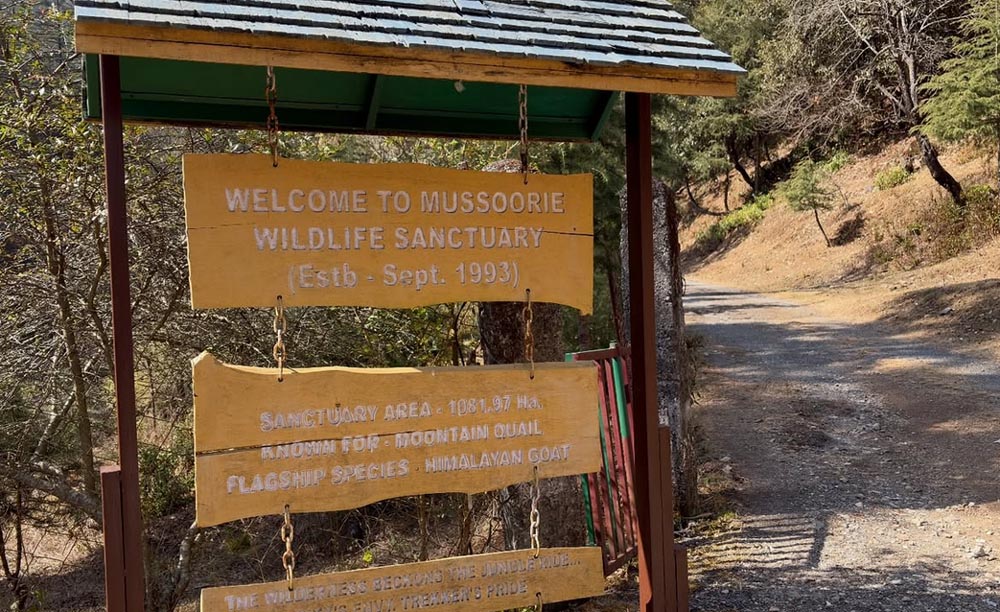
Just beyond the busy streets, viewpoints and tourist attractions of Mussoorie lies a quieter world of oak forests, pine-covered slopes, mountain trails and birdsong. Benog Wildlife Sanctuary, also known as the Benog or Vinog Mountain Quail Sanctuary, is one of the most rewarding natural escapes in the Mussoorie region of Uttarakhand. Located roughly 10–11 km from central Mussoorie, the sanctuary offers a very different experience from the crowded Mall Road and the more commercial attractions of the hill station. The sanctuary is particularly attractive to birdwatchers, photographers, hikers and travellers who want to experience the Himalayan landscape at a slower pace. Its forest trails lead toward Benog Hill and the Benog Tibba area, where visitors can enjoy expansive mountain and valley views. On clear days, distant Himalayan peaks such as Chaukhamba and Bandarpunch add an extraordinary backdrop to the experience.
Where Is Benog Wildlife Sanctuary?
Benog Wildlife Sanctuary is situated on the western side of Mussoorie in the Mussoorie forest range of Uttarakhand. The approach is associated with the Cloud’s End and Hathipaon area, away from the busiest parts of the hill station. From Mussoorie’s Library Point, the sanctuary is generally described as being around 11 km away, although the precise distance depends on the starting point and route used.
Benog Wildlife Sanctuary is a protected forest landscape rather than a conventional wildlife park. There are no safari vehicles carrying visitors deep into the forest, and the principal attraction is the opportunity to explore the environment on foot. The combination of forest trails, mountain scenery and birdlife makes the sanctuary particularly suitable for a half-day excursion from Mussoorie.
Its location is also important because it allows visitors to combine a nature walk with other western-Mussoorie attractions such as Cloud’s End, Hathipaon and George Everest. This makes Benog particularly convenient for travellers who want to explore a less commercial side of the region without travelling a great distance from town.
History and Conservation Significance
Benog Wildlife Sanctuary is a relatively small protected landscape compared with major national parks in Uttarakhand, but its conservation importance is considerable. The protected area was established in the early 1990s, with records commonly giving 2 September 1993 as the date of notification. It is also widely associated with the broader Rajaji National Park landscape and the forests around Mussoorie.
The sanctuary’s alternative name, Mountain Quail Sanctuary, comes from the Himalayan mountain quail, a bird that has become part of the area’s natural history and mystery. The Himalayan mountain quail was historically recorded in the Mussoorie region, but the species has not been reliably confirmed there for well over a century. A historical record from 1876 is frequently cited as the last confirmed sighting in the region.
This uncertainty has given Benog a special place among bird enthusiasts. The possibility of rediscovering a bird that has become extremely difficult to document adds an element of mystery to the sanctuary, although visitors should not expect to see the mountain quail during an ordinary trip.
The sanctuary’s broader conservation value, however, does not depend on finding this elusive species. Its forests provide habitat for numerous birds, mammals and plant species while contributing to the ecological health of the Mussoorie hills.
Landscape and Natural Beauty
The landscape of Benog is distinctly Himalayan. Instead of manicured gardens or developed viewpoints, visitors encounter forest paths, slopes, rocky sections, old trees and natural clearings. The vegetation changes subtly as the trail climbs, creating different moods throughout the walk.
Oak, pine, deodar, rhododendron and other Himalayan trees are associated with the sanctuary and surrounding forests. Medicinal plants also occur in the area.
The forest canopy is particularly beautiful during spring and summer when the vegetation is fresh and vibrant. Rhododendrons can add seasonal colour to the landscape, while autumn brings a different atmosphere as the forests gradually change character.
One of Benog’s greatest attractions is that the forest experience is combined with elevated viewpoints. From suitable clearings and higher portions of the trail, visitors can look across valleys and towards the Himalayan ranges. When atmospheric conditions are favourable, peaks such as Chaukhamba and Bandarpunch can be visible in the distance.
For photographers, this combination of forest foregrounds and distant mountains is especially appealing. Morning light can create particularly dramatic conditions, while clouds and mist can transform the landscape during the monsoon and early winter periods.
Flora of Benog Wildlife Sanctuary
The vegetation of Benog reflects the Himalayan environment around Mussoorie. Oak is an important component of the forest, while pine and deodar contribute to the characteristic appearance of the landscape. Rhododendron is another notable Himalayan plant found in the region.
The importance of these forests extends far beyond their appearance. Trees provide nesting and feeding habitats for birds, cover for mammals and help stabilize mountain soils. Forest vegetation also plays a role in regulating water movement through the slopes and maintaining the ecological balance of the surrounding valleys.
For visitors, the forest itself becomes part of the attraction. Rather than treating the trees simply as scenery, a slow walk allows travellers to notice the changing vegetation, bird calls, insects, fallen leaves, moss-covered surfaces and the varying light beneath the canopy.
During spring, rhododendron flowering can make parts of the surrounding Himalayan landscape particularly attractive. In wetter months, the forest becomes greener and more atmospheric, although trails can become slippery and visibility can deteriorate.
Wildlife and Birds
Wildlife is one of the reasons Benog attracts nature lovers, but it is important to approach the sanctuary with realistic expectations. This is not a destination where large animals are guaranteed to appear on demand.
The sanctuary and surrounding forests support a range of mammals, with sources mentioning animals such as leopard, Himalayan goat or goral, barking deer, bear, langur and flying squirrel.
Leopards are naturally elusive, and encountering one should never be treated as a tourist attraction. Most visitors will experience the forest without seeing a large predator. Evidence such as animal movement, tracks or sounds can sometimes be more realistic signs of wildlife than a direct sighting.
For this reason, Benog is arguably more rewarding for birdwatching than for conventional mammal spotting. Birds associated with the area include the red-billed blue magpie and white-capped water redstart, along with various Himalayan forest birds.
Birdwatchers should move slowly and avoid unnecessary noise. Carrying binoculars can make a substantial difference because many birds remain high in the canopy or move rapidly between trees.
The sanctuary’s connection with the Himalayan mountain quail gives birdwatching here an additional historical dimension. Although the bird is not something visitors should expect to find, its story is an important part of Benog’s identity.
Benog Tibba and the Forest Trek
For many visitors, the walk toward Benog Tibba is the highlight of the entire excursion. The trail provides an opportunity to experience the sanctuary rather than simply arriving at a viewpoint by vehicle.
Routes and distances vary according to the starting point and the route selected. Some trekking descriptions place the round trip from the Cloud’s End side in the range of several kilometres, while longer versions can extend considerably farther.
The walk generally passes through forested terrain with sections of gradual ascent. It is often described as easy to moderate for reasonably fit hikers, but visitors should not assume that every section will feel effortless. Rocky surfaces, uneven ground and slippery patches after rain can make the journey more demanding.
The attraction is not simply reaching the summit. The journey itself is part of the experience. The changing views, forest sounds, occasional clearings and possibility of seeing birds make the trail much more interesting than a straightforward road journey.
Near the upper area of Benog Hill is the small Jwala Devi shrine, which is another point of interest for trekkers. The higher terrain provides opportunities for broad views over the surrounding mountains and valleys.
What Makes Benog Different from Mussoorie’s Popular Attractions?
Mussoorie is famous for places such as Mall Road, Gun Hill, Kempty Falls, Lal Tibba and Camel’s Back Road. These attractions have their own appeal, but many can become busy during weekends, holidays and peak tourist seasons.
Benog provides a contrasting experience.
There are no rows of shops, amusement attractions or dense commercial development inside the forest. Instead, the experience revolves around walking, observing nature and appreciating the landscape. This makes it particularly appealing to travellers who have already explored the conventional Mussoorie itinerary and want something quieter.
The sanctuary can therefore be thought of as a transition between the developed hill station and the wilder Himalayan landscape beyond it.
Best Time to Visit Benog Wildlife Sanctuary
The best time to visit depends on what you want to experience.
Spring is attractive because the weather is generally pleasant and vegetation begins to become more colourful. Rhododendron flowering can make the forest particularly scenic during the appropriate period.
Summer provides comfortable conditions compared with India’s plains, although afternoons can become warmer and mountain views may vary with atmospheric haze. Early morning is preferable for hiking and birdwatching.
Autumn is one of the most appealing seasons for photographers and hikers. After the monsoon, the landscape can remain green while clearer atmospheric conditions may improve Himalayan visibility. September through November is often considered a particularly rewarding period for mountain views.
Winter can offer crisp mornings and excellent visibility on clear days, but temperatures can fall significantly, particularly early and late in the day.
The monsoon creates a lush and atmospheric forest but also introduces practical challenges. Heavy rain can make trails muddy and slippery, while clouds can obscure mountain views. Visitors should check local conditions before undertaking longer hikes during periods of heavy rainfall.
Timings and Entry Information
The sanctuary is commonly listed as operating approximately from 7:00 AM to 5:00 PM.
However, published information about entry fees is inconsistent. Different travel sources currently report different charges, including figures ranging from no listed fee to several hundred rupees depending on nationality, gate and the particular permit or activity.
For that reason, visitors should verify the applicable fee with the forest checkpost or local authorities on the day of travel rather than relying exclusively on an old online figure.
The same principle applies to trail access and temporary closures. Mountain weather, forest management requirements and monsoon conditions can affect access.
How to Reach Benog Wildlife Sanctuary
The most convenient starting point for visitors staying in Mussoorie is generally the western side of town toward Cloud’s End and Hathipaon.
From Mussoorie, visitors can use a private taxi or local transport where available. The road journey takes travellers away from the busiest central areas and toward the forested western side of the hill station.
Travellers arriving from outside Mussoorie generally first reach Dehradun or another nearby city and then travel by road into the hills. Dehradun is the nearest major transport hub, with road connections to Mussoorie.
Once near the sanctuary, the experience becomes primarily pedestrian. This is an important distinction: Benog is best experienced as a forest walk rather than a conventional sightseeing stop.
Things to Do at Benog Wildlife Sanctuary
Trekking is the principal activity. The forest trails offer a satisfying outing for people who enjoy walking without necessarily wanting a technical Himalayan expedition.
Birdwatching is another major attraction. The quieter the visitor, the greater the chance of noticing birds moving through the trees. Binoculars, a field guide and patience are more useful here than loud conversations or hurried walking.
Photography is equally rewarding. Forest textures, old trees, mountain ridges, clouds, birds and distant snowy peaks can all provide subjects. Early morning light is particularly useful for landscape photography.
Nature observation is perhaps the simplest and most rewarding activity. Spending time listening to bird calls and observing small details can make a visit memorable even when no large animal is seen.
What to Carry
Because facilities inside the protected forest are limited, visitors should arrive prepared. Drinking water is essential, particularly if undertaking the longer Benog Tibba route. Snacks should also be carried because visitors should not expect regular food stalls inside the sanctuary.
Comfortable shoes with good grip are strongly recommended. A light jacket can be useful even in warmer months because weather conditions can change quickly in the hills.
Birdwatchers should carry binoculars, while photographers should consider lightweight equipment rather than heavy camera bags that make hiking unnecessarily tiring.
A small first-aid kit, personal medicines, sunscreen and rain protection are also sensible additions.
Safety and Responsible Tourism
Benog may appear peaceful, but it remains a natural forest environment. Visitors should therefore behave differently from how they might behave at a conventional tourist attraction.
Stay on established trails wherever possible and avoid entering dense forest vegetation simply to look for wildlife. Do not attempt to approach animals, feed birds or leave food behind.
Noise should be kept low, especially during birdwatching. Loud music and shouting reduce the quality of the experience and disturb wildlife.
Plastic waste should never be left behind. Everything brought into the forest should be carried back out.
Solo visitors should exercise additional caution, particularly on longer or less-travelled trails. Starting early is preferable because it allows sufficient time to complete the hike before evening. During periods of poor weather, visitors should be willing to shorten their route rather than forcing themselves to continue.
Most importantly, a wildlife sanctuary should not be treated as a place where visitors are entitled to photograph every animal they encounter. Wildlife has priority.
Nearby Places to Explore
Benog can easily form part of a broader western-Mussoorie itinerary. Cloud’s End is particularly natural to combine with a visit because of its proximity and forest setting.
Hathipaon is another nearby attraction associated with the western side of Mussoorie. George Everest House and Peak can also be incorporated into a broader nature-and-mountain itinerary, while central Mussoorie attractions can be visited separately.
Travellers who enjoy walking can therefore dedicate a full day to the quieter western side of Mussoorie instead of spending the entire trip around Mall Road.
A Suggested Day at Benog
A good itinerary begins early in the morning. Leave central Mussoorie after breakfast and travel toward the Cloud’s End side. Reaching the forest entrance early provides cooler walking conditions and better opportunities for birdwatching.
Spend the morning walking through the sanctuary and, depending on fitness and trail conditions, continue toward Benog Tibba. Take time to stop at viewpoints rather than treating the walk as a race.
After reaching the upper viewpoint or completing the chosen trail, begin the return journey well before late afternoon. The rest of the day can then be spent exploring Cloud’s End, Hathipaon or another nearby Mussoorie attraction.
This slower approach allows Benog to be experienced as a natural landscape rather than simply another item on a sightseeing checklist.
Why Benog Wildlife Sanctuary Deserves a Place on Your Uttarakhand Itinerary
Benog Wildlife Sanctuary represents a side of Mussoorie that many visitors never experience. While the hill station is known for shopping streets, colonial-era architecture, viewpoints and waterfalls, Benog offers something fundamentally different: silence.
Its forests shelter birds and other wildlife, its trails provide accessible Himalayan hiking, and its higher viewpoints can reveal spectacular mountain scenery. Its association with the mysterious Himalayan mountain quail adds a fascinating conservation story, while the surrounding oak, pine, deodar and rhododendron forests demonstrate the ecological richness of the Mussoorie hills.
Perhaps the greatest appeal of Benog is that it does not require an extreme adventure. A traveller can reach the western edge of Mussoorie, put on a pair of comfortable walking shoes and gradually leave the sounds of the town behind. With every step, shops and traffic give way to trees, birds and mountain air.
For nature lovers, photographers, birdwatchers and hikers, that transformation is the real attraction. Benog is not a place to rush through. It is a place to walk slowly, look carefully and allow the Himalayan forest to become the destination itself.

