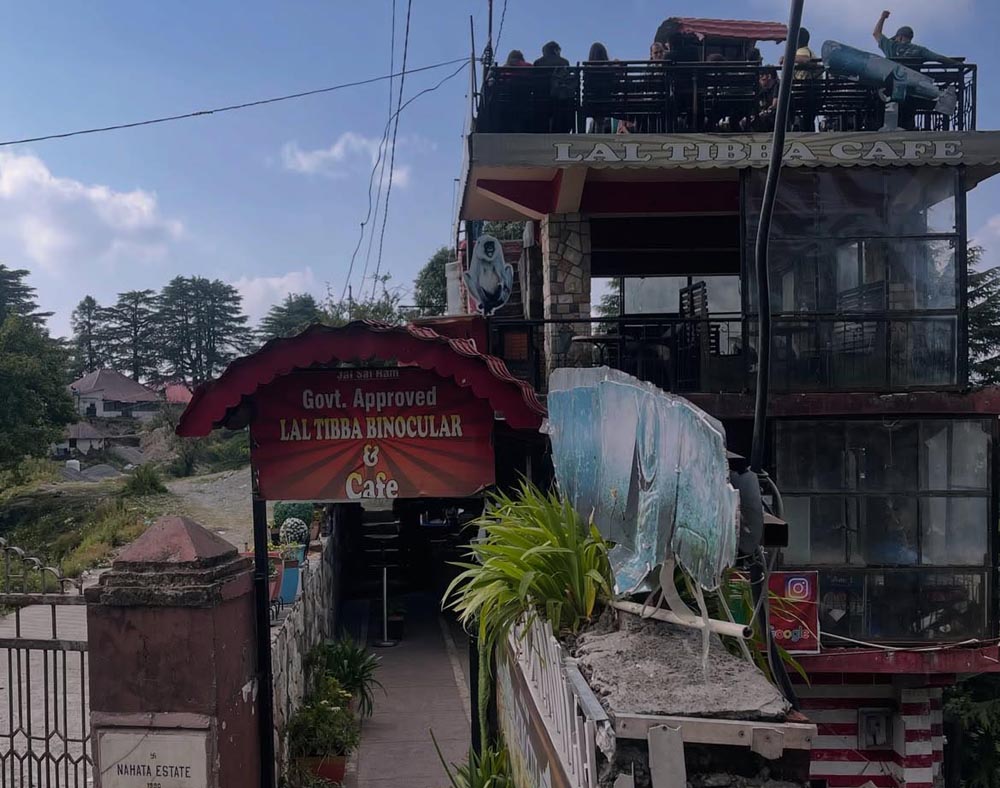
High above the busy streets of Mussoorie, where winding mountain roads give way to quiet lanes, pine forests and old colonial buildings, lies a destination that captures the timeless charm of the Himalayas. Lal Tibba, meaning “Red Hill,” is one of the most celebrated viewpoints in Uttarakhand and the highest point of Mussoorie. Situated in the peaceful Landour area, Lal Tibba is known for its spectacular Himalayan panoramas, crisp mountain air, colonial heritage and relaxed atmosphere. On a clear day, the distant snow-covered peaks appear almost close enough to touch, while the valleys below unfold in layers of green and blue.
Unlike some of Mussoorie’s busier attractions, Lal Tibba offers an experience that is as much about the journey and atmosphere as it is about the viewpoint itself. Visitors come here to look at the mountains through telescopes, walk along picturesque roads, enjoy a cup of coffee in a hillside café, explore nearby colonial landmarks and simply spend time surrounded by nature. Its location in Landour also gives Lal Tibba a distinctive character, combining Himalayan scenery with the quiet charm of an old cantonment settlement.
Where Is Lal Tibba?
Lal Tibba is located on Depot Hill in Landour, an area adjoining Mussoorie in Dehradun district of Uttarakhand. It stands at roughly 2,275–2,290 metres above sea level, or around 7,500 feet, making it the highest point of the Mussoorie area. Government and tourism sources identify Lal Tibba as Mussoorie’s highest point and highlight its extensive views of the Himalayan ranges.
The viewpoint is approximately 6–7 kilometres from central Mussoorie, depending on the starting point and route. The drive from the main town gradually takes visitors away from the more crowded sections of Mussoorie and into the quieter surroundings of Landour. The road itself becomes part of the experience, with tall deodar and pine trees, old houses, mountain slopes and occasional glimpses of distant valleys.
Landour is particularly famous for its peaceful atmosphere. The settlement developed as a British cantonment and retains much of its historic architectural character. The name “Landour” is associated with Llanddowror, a village in Wales, reflecting the British practice of giving familiar names to places during the colonial era. The cantonment developed in the nineteenth century and became associated with military establishments, churches, cottages and sanatoriums.
The Story Behind the Name Lal Tibba
The name Lal Tibba literally translates into “Red Hill,” with “Lal” meaning red and “Tibba” referring to a hill or elevated mound. The name has been associated with the distinctive appearance of the hill and its surroundings. One official tourism account also connects the name with the reddish hues produced by rhododendron blooms on the slopes during their flowering season.
The hill has been part of the wider history of Landour and Mussoorie since the colonial period. The high altitude and comparatively cool climate made the region attractive to British officials and military personnel seeking relief from the heat of the plains. Landour subsequently developed as a cantonment and retreat, leaving behind an architectural and cultural legacy that can still be experienced today.
This history is one reason Lal Tibba feels different from a conventional tourist viewpoint. The destination is not simply a platform overlooking mountains. It forms part of a much older hill settlement where forests, churches, military history, cottages and winding roads coexist.
The Himalayan Views from Lal Tibba
The biggest attraction of Lal Tibba is undoubtedly its panoramic view of the Himalayas. When the weather is clear, visitors can see several impressive Himalayan peaks and ranges stretching across the horizon. The Dehradun district’s official tourism information mentions views of Badrinath, Kedarnath, Bandar-poonch, Sri Kantha and Nanda Devi from the Lal Tibba area.
The scenery changes dramatically according to the weather and season. On exceptionally clear mornings, the snow-covered mountains stand sharply against the blue sky. During the monsoon, clouds can surround the hills and create an entirely different atmosphere. In winter, the landscape may become cold and misty, while occasional snowfall adds another layer of beauty.
The best views generally depend more on atmospheric clarity than on a particular month. A sunny day does not always guarantee distant mountain visibility because haze can obscure the Himalayan peaks. Early mornings are often preferred by photographers and sightseers because the air may be clearer and the sunlight creates beautiful contrasts on the mountains.
The experience becomes particularly memorable around sunrise and sunset. At dawn, the first rays of sunlight gradually illuminate the distant peaks. At sunset, the mountains and surrounding clouds can turn shades of orange, pink and gold. Lal Tibba therefore appeals not only to travelers looking for a sightseeing stop but also to photographers and anyone interested in Himalayan landscapes.
The Famous Telescope Experience
One of Lal Tibba’s most recognizable attractions is its telescope viewpoint. Powerful telescopes allow visitors to examine distant Himalayan peaks and surrounding landscapes that would otherwise appear as tiny shapes on the horizon. Tourism sources specifically mention telescopic views of peaks such as Badrinath, Kedarnath and Bandarpoonch.
The telescope adds another dimension to the visit. Rather than simply looking at a distant mountain range, visitors can identify individual peaks and observe ridgelines, valleys and settlements in greater detail. For first-time visitors, this can make the Himalayan landscape easier to understand and appreciate.
A binocular viewpoint is also associated with the area, providing another way to observe the mountains. However, visitors should remember that visibility is highly weather-dependent. Fog, clouds and atmospheric haze can significantly reduce the range of the view.
Lal Tibba and the Colonial Heritage of Landour
A visit to Lal Tibba is incomplete without exploring the wider Landour area. Landour is one of the most atmospheric parts of the Mussoorie region, with old churches, colonial-era buildings, narrow roads and tall forests.
The area was developed in connection with the British Indian Army, and its military history remains visible in the character of the settlement. According to Incredible India, the first sanatorium in Landour was established in 1827, while Mullingar, associated with Captain Frederick Young, is regarded as the first house built in the area.
Walking through Landour provides a different experience from exploring Mussoorie Mall Road. Instead of shops and heavy tourist activity, travelers encounter quiet lanes, old stone structures, forested slopes and traditional mountain homes. The combination of history and landscape gives the area an almost storybook quality.
The nearby St. Paul’s Church is another significant landmark. Its historic setting and architecture complement the colonial character of Landour. The area around Char Dukan, meanwhile, has become a popular stop for visitors looking for snacks, tea, coffee and casual mountain dining. What began as a small group of shops has developed into one of Landour’s best-known visitor areas.
Char Dukan and the Café Culture of Landour
One of the pleasures of visiting Lal Tibba is combining sightseeing with a leisurely food stop. Char Dukan has become synonymous with Landour’s relaxed café culture. The name literally means “four shops,” reflecting its historical origins when a small number of shops served visitors and residents.
Today, the area is popular for simple mountain snacks, tea, coffee, pancakes, Maggi and other casual foods. The attraction is not necessarily fine dining; instead, it is the combination of food, cool weather, old-world surroundings and a slow-paced mountain atmosphere.
For many travelers, sitting at a café after exploring Lal Tibba becomes one of the most enjoyable parts of the trip. The experience encourages visitors to slow down rather than rush from one attraction to another.
Nature Around Lal Tibba
The natural surroundings are another major reason to visit. Lal Tibba and Landour are surrounded by forested hills, with deodar, pine and other Himalayan vegetation contributing to the area’s cool and peaceful environment.
Walking through the surrounding roads can be rewarding even when the Himalayan peaks are hidden by clouds. The forest itself becomes the attraction. Birds, mountain flowers, mist and the scent of trees create a sensory experience that is quite different from the crowded center of Mussoorie.
Nature lovers and photographers can find plenty to explore without undertaking a demanding expedition. The surrounding trails and roads provide opportunities for leisurely walks, landscape photography and quiet observation.
Visitors should nevertheless remember that the forests and hills are fragile ecosystems. Littering, loud music, damaging plants and disturbing wildlife can negatively affect the environment. Responsible tourism is especially important in mountain destinations where waste management and natural resources are more limited than in urban areas.
Best Time to Visit Lal Tibba
Lal Tibba can be visited throughout much of the year, but the ideal period depends on what travelers want to experience.
March to June is popular for pleasant weather and relatively comfortable sightseeing conditions. Spring brings greenery and flowers, while summer offers an escape from the intense heat of the plains. This is also one of the busier tourism periods in Mussoorie.
September to November can be particularly attractive for travelers interested in mountain views. After the monsoon, the landscape may appear fresh and green, while clearer atmospheric conditions can provide excellent Himalayan visibility.
December to February offers a colder and more atmospheric experience. Winter can bring frost, mist and, during suitable weather, snowfall in the Mussoorie-Landour region. Travelers visiting in winter should be prepared for very cold conditions and should check local weather and road conditions before traveling.
The monsoon season, generally associated with July and August, brings lush landscapes but also frequent cloud cover and rain. Mountain roads can become slippery, and landslides may occasionally affect travel routes. For travelers whose primary purpose is seeing distant Himalayan peaks, the rainy season is usually less predictable.
Lal Tibba Timings and Entry Information
Published visitor information is not completely consistent regarding Lal Tibba’s opening hours and fees. Incredible India currently lists opening hours of 6:00 AM to 6:00 PM, while other travel sources give different hours and report varying entry or telescope charges.
Because local operating arrangements can change, travelers should verify the current timing and any applicable viewpoint or telescope fee shortly before visiting rather than relying on an old travel guide. The telescope experience may involve a separate charge even when access to the general area is not heavily restricted.
A visit typically takes around one to two hours, although travelers who want to explore Landour, Char Dukan and nearby heritage sites should allow considerably more time.
How to Reach Lal Tibba
The most convenient way to reach Lal Tibba is by road from Mussoorie. Travelers arriving by air can generally use Jolly Grant Airport near Dehradun, while Dehradun Railway Station is the nearest major railway connection mentioned by Incredible India.
From Dehradun, travelers can reach Mussoorie by road and then continue toward Landour. Taxis and local transport are commonly used for the final journey. Visitors staying in Mussoorie may also hire a local taxi for a sightseeing trip covering Lal Tibba and other Landour attractions.
The road into Landour can be narrow and winding. During busy tourist periods, traffic and parking can become challenging. Travelers should therefore avoid treating Lal Tibba as a quick stop that can always be reached without delays.
For those who enjoy walking, exploring parts of Landour on foot can be particularly rewarding. The combination of slopes, forests and historic buildings makes walking an important part of the experience.
Places to Visit Near Lal Tibba
Lal Tibba works particularly well as part of a larger Mussoorie itinerary. Char Dukan and St. Paul’s Church are nearby and can easily be combined with a visit to the viewpoint. Landour’s quiet roads are themselves worth exploring.
Visitors can then return toward central Mussoorie to explore attractions such as Gun Hill, Camel’s Back Road, the Mall Road and other viewpoints. The official Mussoorie tourism information also highlights attractions including Kempty Falls, Bhatta Falls and Camel’s Back Road.
For travelers interested in colonial history and literature, Landour has an additional connection with author Ruskin Bond, whose long association with the area has contributed to its literary identity. Incredible India also highlights Bond’s longstanding connection with Mussoorie and Landour.
This makes the Lal Tibba trip particularly suitable for travelers who enjoy combining natural scenery with history, architecture, food and literature.
Photography at Lal Tibba
Lal Tibba is a dream destination for landscape photography. The wide Himalayan horizon provides an opportunity for panoramic photographs, while the forests and colonial buildings offer contrasting subjects.
Early morning is particularly suitable for mountain photography. Soft sunlight can illuminate the peaks without creating the harsh contrasts associated with midday. Sunset offers a different mood, with warm light and dramatic skies.
A telephoto lens or good-quality smartphone zoom can be useful for photographing distant mountain peaks. However, travelers should not become so focused on taking photographs that they overlook the atmosphere of the place itself. Some of Lal Tibba’s most memorable moments are simply watching clouds move through the valleys or listening to the wind in the trees.
Why Lal Tibba Is Different from Other Mussoorie Attractions
Mussoorie has numerous popular tourist attractions, but Lal Tibba has a distinct personality. Mall Road is energetic and commercial, Gun Hill is a famous urban viewpoint, and Kempty Falls is known for its dramatic waterfall scenery. Lal Tibba, by contrast, combines a high-altitude viewpoint with the quieter character of Landour.
Its appeal lies in the balance between scenery and atmosphere. The mountains are obviously the main attraction, but the old roads, forests, cafés and heritage buildings create an experience that continues even when clouds obscure the view.
Lal Tibba is also a reminder that mountain tourism does not always require an extreme trek. A traveler can enjoy extraordinary Himalayan scenery while staying relatively close to Mussoorie and using a road-accessible viewpoint.
Responsible Tourism at Lal Tibba
The growing popularity of Lal Tibba brings an important responsibility for visitors. Mountain destinations are particularly vulnerable to litter, traffic congestion, water shortages and unplanned development.
Travelers can help by carrying reusable water bottles, avoiding single-use plastic, disposing of waste properly and respecting local residents. Visitors should also avoid making excessive noise, particularly around residential and cantonment areas.
Supporting local cafés, shops and small businesses can help ensure that tourism benefits the local economy. At the same time, travelers should remember that Landour is not simply a tourist attraction but a living community with residents who value its peaceful character.
Final Thoughts
Lal Tibba is much more than a viewpoint on a hill. It is a meeting point of Himalayan scenery, colonial history, forests, literature and mountain culture. From its elevated position above Mussoorie, it provides some of the most memorable views of the distant Himalayas, while the surrounding Landour area offers an entirely different pace of travel.
The telescopes, panoramic viewpoints and snow-covered peaks may be what initially attract visitors, but the quiet roads, old churches, deodar forests, Char Dukan cafés and historic atmosphere are what make the destination memorable. On a clear morning, the Himalayan panorama can be breathtaking; on a cloudy afternoon, the misty forests can be equally beautiful.
For anyone planning a trip to Mussoorie, Lal Tibba deserves more than a hurried stop for photographs. Give yourself enough time to explore the viewpoint, walk through Landour, enjoy a warm drink at a local café and simply absorb the mountain atmosphere. The result is not just a sightseeing experience but a glimpse into the quieter, more timeless side of Uttarakhand.

