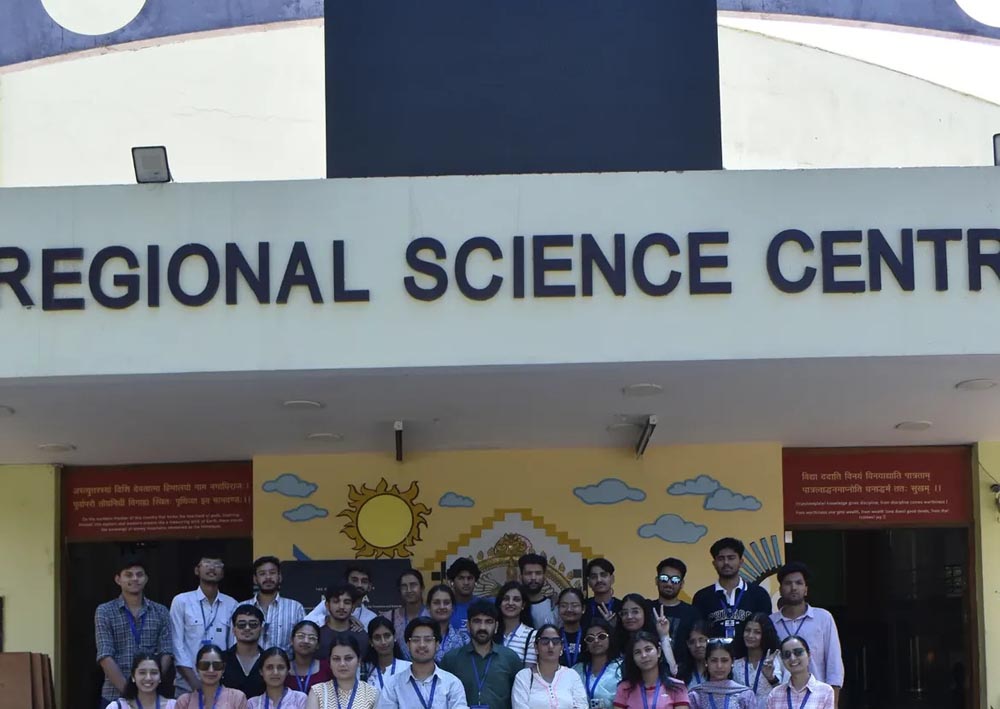
In the picturesque surroundings of Dehradun, Uttarakhand, where the Himalayan foothills meet a city known for education, forests and natural beauty, the Regional Science Centre (RSC) Dehradun offers a very different kind of attraction. Instead of simply displaying objects behind glass, the centre encourages visitors to touch, experiment, observe and question. It is a place where science becomes an experience rather than just a subject studied in textbooks.
Located at Vigyan Dham, Jhajra, Prem Nagar, the Regional Science Centre is particularly popular with school students, families, educators and anyone interested in science and technology. Developed by the National Council of Science Museums (NCSM) in collaboration with the Uttarakhand State Council for Science and Technology (UCOST), the centre was inaugurated on February 3, 2016. It was established with the broader objective of promoting scientific temper and making science accessible and engaging to the public.
Where Is Regional Science Centre Dehradun?
The Regional Science Centre is situated within the Vigyan Dham campus at Jhajra in the Prem Nagar area of Dehradun. Its location makes it accessible as a day outing from different parts of the city, while its spacious campus provides enough room for both indoor galleries and outdoor science exhibits.
The official address is Vigyan Dham, Jhajra, Prem Nagar, Dehradun, Uttarakhand. The centre is located away from the busiest central areas of Dehradun, giving it a relatively spacious setting that complements its science-park concept.
For visitors staying in central Dehradun, the centre can be incorporated into an itinerary that includes other attractions in and around the city. Dehradun is also well connected by road and rail, while Jolly Grant Airport serves as the city’s principal airport.
History and Development of the Centre
The Regional Science Centre was created as a collaborative initiative between NCSM and UCOST. According to the National Council of Science Museums, the Dehradun centre became part of its network of Regional Science Centres on February 3, 2016. At the time of its opening, it was described as Uttarakhand’s first Regional Science Centre and the country’s sixteenth Regional Science Centre.
The original project was developed through shared financial participation by the National Council of Science Museums and the Government of Uttarakhand. The present campus covers approximately 30,450 square metres, with the main Regional Science Centre building occupying around 5,500 square metres. The combination of a substantial outdoor science park and an extensive indoor exhibition building allows the centre to offer different styles of learning in one location.
The philosophy behind the centre is important. Science museums and centres are designed not merely to provide information but to create opportunities for visitors to discover scientific principles themselves. Instead of telling a child how a particular physical phenomenon works, an interactive exhibit can allow the child to operate it and see the result. This approach helps transform abstract scientific concepts into memorable experiences.
What Makes Regional Science Centre Dehradun Special?
The biggest attraction of the centre is its interactive character. Visitors are encouraged to participate rather than simply observe. This makes it particularly suitable for children and teenagers, although adults can also find plenty to explore.
The centre combines several different experiences: an outdoor science park, dinosaur models, indoor galleries, a Himalayan-themed exhibition, technology displays, an Innovation Hub, a 3D theatre and a portable planetarium known as Taramandal. There is also an auditorium, exhibition space, student activity areas and meeting facilities.
This variety means that a visit does not feel like a conventional museum tour. A family might begin by experimenting with an outdoor physics exhibit, move indoors to learn about Himalayan geology and culture, explore modern technology and then finish the visit with a 3D or planetarium experience.
The Science Park: Learning Science Outdoors
One of the most appealing sections of the centre is its outdoor Science Park. The official centre describes it as a garden of science containing about 30 interactive exhibits based on subjects such as vibrations, mathematics, perception, gravity, sound and music.
The Science Park demonstrates how scientific learning can be incorporated into an outdoor environment. Visitors can interact with the installations and discover scientific principles through direct experience. For children especially, this makes learning feel more like play.
Among the notable installations are the Gravity Chair, Whispering Garden, Musical Bar, Sympathetic Swing, Bird-in-the-Cage, Eco Tube and Perspective House. Each is designed around a scientific phenomenon or principle.
The Gravity Chair, for example, provides an entertaining way of thinking about forces and body movement, while the Whispering Garden demonstrates how sound can travel in surprising ways. The Musical Bar introduces visitors to the relationship between vibration and sound. The Perspective House, meanwhile, plays with visual perception and demonstrates how what we see is not always an accurate representation of physical reality.
These exhibits are particularly valuable for school groups because they can turn concepts learned in physics or mathematics classes into practical experiences.
Dinosaur Park: A Favourite Among Children
Another popular part of the outdoor area is the Dinosaur Park. The park features models representing prehistoric animals and adds an element of natural history to the science-centre experience. The centre’s information describes the dinosaur section as part of its outdoor science park.
Dinosaur exhibits are particularly effective at attracting younger visitors because they combine entertainment with an introduction to subjects such as palaeontology, prehistoric life, evolution and Earth’s geological history.
For parents, the dinosaur section can also provide an opportunity to turn a simple family outing into an educational conversation. Children can be encouraged to think about when dinosaurs lived, how scientists reconstruct prehistoric animals from fossils and how Earth’s environment has changed over millions of years.
Fun Science Gallery
The Fun Science Gallery brings interactive scientific exploration indoors. Its central idea is that scientific principles do not have to be difficult or intimidating. They can be understood through demonstrations, visual experiences and hands-on interaction.
Such galleries are especially useful for students who may find textbook explanations difficult to visualise. Physics, mathematics, perception and other scientific ideas can become much easier to understand when visitors can actually manipulate an exhibit and immediately see its effect.
The gallery also reflects one of the fundamental purposes of science centres: encouraging curiosity. Instead of simply providing answers, interactive displays can make visitors ask new questions.
Himalaya Gallery: Connecting Science with Uttarakhand
The Himalaya Gallery gives the Regional Science Centre a distinctly Uttarakhand-focused character. Rather than presenting science as something disconnected from local surroundings, this gallery explores the Himalayan region through themes including geology, geography, tourism, culture and traditional knowledge systems.
This is particularly relevant in Dehradun because the city serves as an important gateway to the Himalayan region. Visitors can therefore explore scientific ideas connected with the mountains that form such an important part of Uttarakhand’s identity.
The gallery also contains a replica of the Amarnath Cave, adding a cultural and geographical dimension to the experience.
The Himalayan section can help visitors appreciate how geology, climate, biodiversity, human settlement and traditional knowledge are interconnected. It is also an opportunity to understand the mountains not simply as scenic landscapes but as complex natural systems.
Frontiers of Technology Gallery
For visitors interested in modern science and emerging technologies, the Frontiers of Technology Gallery is one of the most significant attractions.
The gallery covers subjects including intelligent materials, smart agriculture, nuclear power generation, cloud computing, robotics, carbon nanotubes and graphene, augmented reality, virtual reality, medical technology and space technology.
The breadth of these subjects demonstrates how quickly science and technology are changing. Visitors can encounter concepts that are increasingly relevant to modern life, from robotics and artificial intelligence-related technologies to advanced materials and immersive digital experiences.
For students, such displays can also provide inspiration when considering future fields of study. A child interested in robotics, for example, may discover an entirely new interest in engineering. Another visitor may become curious about space science, medical technology or advanced computing.
Innovation Hub: Encouraging Young Minds
One of the most important educational facilities at the centre is its Innovation Hub. Unlike a traditional exhibition, the Innovation Hub is intended to give young people opportunities to develop ideas, experiment and work with scientific tools and instruments.
The Government of Uttarakhand describes it as a multidisciplinary laboratory designed to nurture creativity and innovation among young people. Students can receive resources and technical input while developing innovative ideas and engaging in practical learning.
This aspect of the Regional Science Centre is particularly significant because scientific education is not only about memorising established facts. Scientific progress depends on asking questions, testing ideas, solving problems and learning from unsuccessful experiments.
The Innovation Hub therefore extends the role of the centre beyond museum education. It can serve as a bridge between classroom learning and experimentation, helping students understand how scientific and technological ideas are developed.
The centre has also hosted workshops and programmes for students and teachers. Its activities have included science camps, teacher-oriented laboratory skill workshops and technology-focused programmes. The centre’s website records programmes involving subjects such as artificial intelligence and science education.
3D Theatre and Taramandal
The Regional Science Centre also provides audiovisual and astronomical experiences through its 3D Theatre and Taramandal portable planetarium.
A 3D theatre can make scientific subjects more immersive by presenting them through three-dimensional visual experiences. For children, this can be an enjoyable way of learning about natural phenomena, animals, space or technology.
Taramandal, meanwhile, introduces visitors to astronomy and the night sky. Planetarium experiences are particularly useful for people living in urban areas, where artificial lighting can make it difficult to observe many celestial objects naturally.
Together, these facilities expand the centre’s educational approach from physical exhibits to visual storytelling and astronomy.
Science Education Programmes and Camps
The Regional Science Centre is not limited to permanent exhibits. It also conducts special programmes and educational activities throughout the year. These have included science camps, workshops, lectures and astronomy-related events.
Such programmes can be especially valuable for students because they provide opportunities to learn outside the normal classroom environment. Summer science camps, for example, can combine experiments, demonstrations, group activities and discussions.
The centre has also organised events connected with astronomical phenomena. Its recorded activities include programmes related to a total lunar eclipse and science camps.
Teacher-oriented activities are another important component. Workshops can help educators introduce practical science activities into their own classrooms, potentially extending the impact of the centre beyond visitors who physically enter the campus.
Importance for School Students
For school students, Regional Science Centre Dehradun can function as an extension of the classroom. Textbooks explain scientific principles, but interactive exhibits provide opportunities to experience them.
A physics lesson about sound can be complemented by a visit to the Musical Bar or Whispering Garden. Discussions about forces and motion can be reinforced through interactive outdoor exhibits. Astronomy lessons can become more engaging through the planetarium, while geography and earth-science topics can be connected to the Himalaya Gallery.
This practical dimension is especially valuable because children often remember experiences more strongly than definitions. A student who physically interacts with an exhibit may develop a deeper understanding of the concept behind it.
A Destination for Families and General Visitors
Although the Regional Science Centre has a strong educational focus, it is not exclusively for school groups. Families can also enjoy the centre as a recreational and educational destination.
Parents can allow children to explore the Science Park while discussing what they are seeing. Older students can spend more time in the technology and innovation sections, while adults may appreciate the Himalayan exhibits and scientific demonstrations.
The centre’s visitor numbers indicate its broad appeal. According to the Uttarakhand government’s information, more than 3.5 lakh visitors had visited the centre since its establishment up to December 2024, while 62,778 people visited during 2024 alone.
These figures illustrate the centre’s continuing role as an important public science-education destination in Uttarakhand.
Timings and Ticket Information
According to the centre’s current official information, the Regional Science Centre is open from 10:00 AM to 5:00 PM, with ticketing available until 4:00 PM. Monday is the weekly closing day, and the centre also lists national holidays among its closures.
Current listed prices are ₹50 for general entry for individual visitors, ₹40 for groups of 25 or more, ₹25 for government/municipal school groups of 25 or more and ₹40 for private school or college groups of 25 or more. Separate charges apply for the 3D Theatre and Taramandal. Because timings, programmes and ticket arrangements can change, visitors should check the centre’s official website before travelling. The centre also provides an online booking facility, while payment is indicated as being made offline at the ticket counter after booking confirmation.
How Much Time Should You Spend There?
A visitor interested only in the major attractions may be able to see the centre in a couple of hours, but families and school groups can easily spend longer exploring the campus.
A good visit should ideally allow enough time for the Science Park, dinosaur section, indoor galleries and at least one of the special audiovisual or astronomical experiences. Students interested in technology and innovation may want additional time for the Frontiers of Technology Gallery and Innovation Hub.
It is also worth avoiding an overly rushed itinerary. The centre’s greatest strength is its interactive nature, and rushing from one exhibit to another can reduce the educational value of the visit.
Why Regional Science Centre Matters to Uttarakhand
The Regional Science Centre is important not simply because it is a tourist attraction, but because it contributes to science communication in the state.
Uttarakhand has a distinctive relationship with science. The state contains fragile Himalayan ecosystems, complex geological formations, rivers, forests, glaciers and communities with long-established traditional knowledge. Issues such as climate change, water management, biodiversity conservation, disaster preparedness and sustainable development all require scientific understanding.
A public institution that encourages young people to question, experiment and think scientifically can therefore have significance far beyond entertainment.
The centre’s emphasis on the Himalayas is particularly appropriate. By combining modern scientific concepts with regional geography, culture and traditional knowledge, it provides a setting in which visitors can think about both the scientific and human dimensions of Uttarakhand.
Nearby Attractions
A visit to the Regional Science Centre can also be combined with other Dehradun attractions. The city’s well-known destinations include the Forest Research Institute, Clock Tower and other cultural and natural attractions. Incredible India also lists attractions such as Rajaji National Park, Mindrolling Monastery and Asan Barrage among places visitors can explore around Dehradun.
This makes the Regional Science Centre a useful addition to a broader Dehradun itinerary rather than a destination that necessarily has to be visited in isolation.
Final Thoughts
The Regional Science Centre Dehradun offers something that many conventional museums struggle to provide: an opportunity to experience science. Its combination of an outdoor Science Park, dinosaur models, interactive galleries, Himalayan exhibits, advanced technology displays, an Innovation Hub, 3D theatre and planetarium creates an unusually diverse educational environment.
Its greatest strength is its ability to make science approachable. A child can learn about sound by playing with an exhibit, understand visual perception through an optical experience, explore the history of prehistoric life through dinosaur models, discover Himalayan science and culture through dedicated displays, and encounter technologies that may shape the future.
For families, it is an educational day out. For school students, it can bring textbook concepts to life. For teachers, it offers additional resources for science education. For curious adults, it provides a chance to rediscover the pleasure of asking how and why things work.
Located amid the educational and natural landscape of Dehradun, the Regional Science Centre is therefore much more than a museum. It represents an effort to build curiosity, scientific thinking and innovation among the public—and especially among young people. If you are looking for an attraction in Dehradun that combines education, entertainment, technology, astronomy, Himalayan knowledge and hands-on discovery, the Regional Science Centre at Vigyan Dham is certainly worth including in your itinerary.
Practical note: The centre’s official website currently lists its opening hours as 10:00 AM–5:00 PM, with Monday as the weekly off day.

