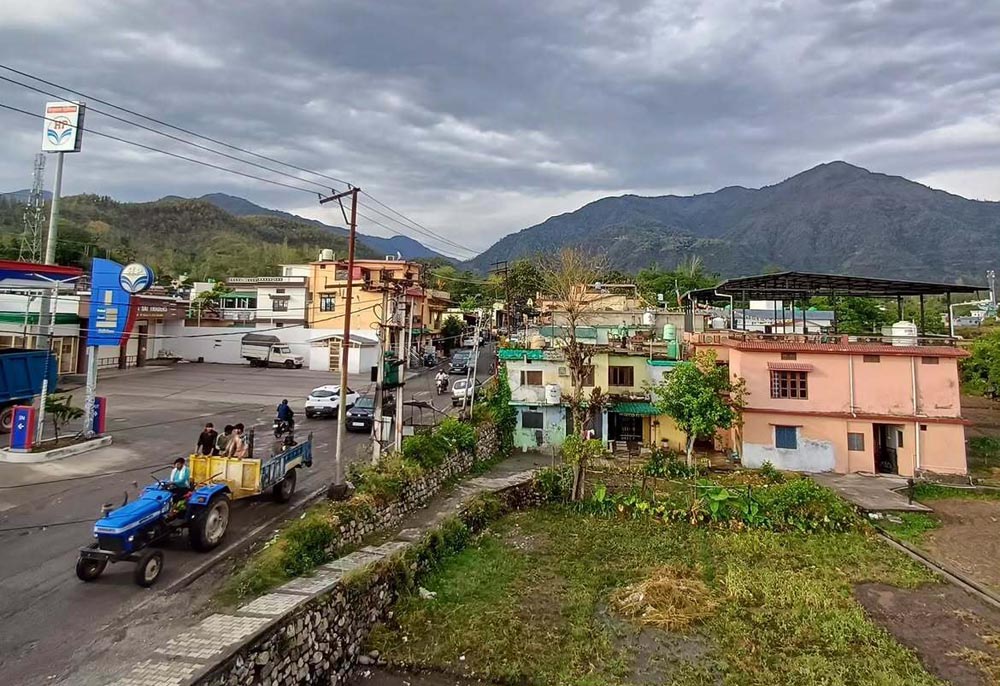
Nestled in the western part of Dehradun district, Kalsi is one of Uttarakhand’s lesser-known destinations, yet it possesses an extraordinary combination of history, rivers, forests, mountain landscapes and local culture. Located along the Yamuna and close to the confluence region of the Yamuna and Tons rivers, Kalsi is particularly famous for the Ashokan Rock Edict, an ancient monument that gives the town enormous historical significance. The settlement lies on the route toward Chakrata and can serve as an interesting stop for travelers exploring the quieter side of the Dehradun and Jaunsar-Bawar region.
Unlike crowded hill stations where tourism is largely centered on viewpoints, markets and hotels, Kalsi offers a different experience. Here, the landscape and history are closely connected. A traveler can spend part of the day examining a Mauryan-era inscription and then continue toward rivers, forests and scenic countryside. This combination makes Kalsi particularly appealing to travelers interested in heritage, archaeology, nature and relatively peaceful road trips.
Where Is Kalsi Located?
Kalsi is a town in Dehradun district of Uttarakhand, situated on the Dehradun–Chakrata route. It is approximately 43–44 kilometers from Dehradun, depending on the route and starting point, and lies near Dakpatthar. The town occupies an important geographical position between the plains around Dehradun and the higher landscapes toward Chakrata.
The surrounding region is characterized by forested hills, agricultural land, river valleys and winding roads. The Yamuna is an important geographical feature of the area, while the Tons River and its valley contribute to the distinctive landscape around Kalsi. The setting becomes increasingly scenic as travelers move away from the busier urban areas toward the hills.
Because of its location, Kalsi can be incorporated into a longer trip covering Chakrata, Dakpatthar, Lakhamandal and other attractions of western Uttarakhand. It is also suitable for travelers who want to experience a quieter destination without going deep into the higher Himalayas.
The Historical Importance of Kalsi
The greatest attraction of Kalsi is undoubtedly its connection with Emperor Ashoka and the Mauryan Empire. The Ashokan Rock Edict at Kalsi is one of the most important archaeological monuments in Uttarakhand and is protected by the Archaeological Survey of India.
The Archaeological Survey of India describes Kalsi as the only place in North India where the great Mauryan emperor’s complete set of fourteen Major Rock Edicts was inscribed. The inscriptions are written in Prakrit using the Brahmi script and communicate Ashoka’s ideas about ethical conduct, compassion, social responsibility and restraint from violence.
The inscriptions date to the 3rd century BCE, making the monument more than two thousand years old. The Kalsi inscription is especially significant because it preserves the complete sequence of Ashoka’s fourteen Major Rock Edicts. The site therefore provides an exceptional opportunity to see an original example of Mauryan imperial communication in its geographical setting.
For anyone familiar with Indian history, Ashoka is particularly important because his reign represents a major transformation in the political and moral history of ancient India. Following the Kalinga War, Ashoka became associated with a policy emphasizing Dhamma, compassion, responsible governance and non-violence. The Kalsi inscription reflects these principles and discusses appropriate conduct toward people and living beings.
Ashoka Rock Edict: The Main Attraction
The Ashoka Rock Edict at Kalsi is the centerpiece of any visit. Ashoka Rock Edict The inscription is carved onto a natural quartz rock and contains Ashoka’s Major Rock Edicts. According to the ASI, the monument’s inscriptions reflect his concern for the moral and spiritual welfare of his subjects, his emphasis on non-violence and his approach toward ethical administration.
One of the fascinating aspects of visiting the monument is realizing that the writing is not a reproduction or a modern memorial. The visitor is looking at an ancient inscription carved into stone more than two millennia ago. Although the Brahmi characters cannot be easily understood by the average visitor today, their presence gives the site an extraordinary sense of connection with India’s distant past.
The monument also contains an important representation of an elephant on the rock. The Kalsi site has attracted archaeological and historical attention partly because of this distinctive feature. The inscription’s content and location provide valuable evidence about the political and cultural environment of the Mauryan period.
The monument was formally protected by the archaeological authorities, and the ASI Dehradun Circle continues to have responsibility for its conservation. The site was notified as a protected monument in 1909.
Why the Kalsi Edict Is So Significant
The importance of Kalsi goes beyond the age of the stone. The inscriptions offer insight into how a powerful ancient ruler attempted to communicate a moral and administrative philosophy across a large empire.
The edicts discuss ideas such as compassion, self-control, respect for parents and elders, generosity, appropriate treatment of servants and other people, and religious tolerance. They also discourage unnecessary killing of animals and excessive attachment to practices that could lead to social conflict.
Another fascinating aspect is the geographical information contained in the famous 13th Rock Edict. It refers to several Hellenistic rulers, demonstrating that Ashoka’s political and diplomatic awareness extended beyond the Indian subcontinent. This makes Kalsi relevant not only to Indian history but also to the study of ancient international relations.
For students of history, archaeology, Buddhism, ancient languages and political thought, Kalsi therefore represents considerably more than a sightseeing stop.
Kalsi and the Spread of Buddhism
Kalsi also has an association with the historical spread of Buddhist ideas. Ashoka’s transformation and his promotion of Dhamma are central themes in understanding the Mauryan period. The Kalsi edicts provide direct evidence of this ideological transformation.
Historical accounts have suggested that the wider Kalsi region had strategic importance because of its location along routes connecting different parts of the Himalayan foothills. Older trade and movement routes helped connect communities across the region, making such locations important for the circulation of people, goods and ideas. Historical discussions have also associated Kalsi with the wider transmission of Buddhist thought.
This historical dimension gives the destination a distinctive character. A trip to Kalsi can be approached not simply as sightseeing but as an opportunity to explore how political ideas, religion and trade interacted in ancient India.
Natural Beauty Around Kalsi
Although the Ashokan inscription is the main historical attraction, Kalsi’s natural surroundings provide another reason to visit. The region sits amid the lower Himalayan landscape, where rivers, forests and hills create a peaceful environment.
The Yamuna valley is particularly important to the character of the area. The nearby Tons River adds another dimension to the landscape, and the surrounding countryside changes considerably with the seasons. During periods when the vegetation is lush, the hills and river valleys become particularly attractive for photography and leisurely drives.
Kalsi does not have the commercial atmosphere associated with popular hill stations. Instead, visitors encounter village landscapes, roadside settlements, agricultural areas and stretches of forest. This makes the destination appealing to people who prefer slow travel and scenic exploration.
Dakpatthar and the River Landscape
One of the attractions that can easily be combined with a Kalsi visit is Dakpatthar, a scenic area associated with the Yamuna and the surrounding river landscape. The region is popular for its open views, greenery and peaceful atmosphere.
Travelers often combine Kalsi with Dakpatthar because the two destinations complement each other. Kalsi provides history and archaeology, while Dakpatthar provides an opportunity to enjoy the natural surroundings.
For photographers, the changing light over the river valley can be particularly attractive. Early morning and late afternoon generally provide softer light and more comfortable conditions for outdoor exploration.
Places to Visit Around Kalsi
Kalsi can also be used as a starting point for exploring several destinations in the broader western Dehradun and Chakrata region. Chakrata is one of the best-known nearby hill destinations and is surrounded by forests, mountain viewpoints and waterfalls.
Tiger Falls is another popular attraction associated with the Chakrata area. Visitors looking for a combination of a Kalsi heritage visit and a longer nature excursion can include the waterfall in their itinerary.
Lakhamandal is another culturally and historically interesting destination in the broader region. It is associated with ancient temples and local traditions and can add a spiritual and archaeological dimension to a road trip.
Other attractions in and around the Chakrata region include Kanasar, Deoban, Chilmiri Neck, Ram Tal Horticulture Garden, Moigad Fall, Kimona Fall and Budher Caves.
This makes Kalsi particularly useful for travelers planning a multi-day western Uttarakhand itinerary rather than a destination visited in isolation.
Local Culture and the Jaunsar-Bawar Region
Kalsi is also close to the culturally distinctive Jaunsar-Bawar region. The cultural landscape here differs from that of the major cities of Uttarakhand. Traditional architecture, local customs, food, clothing and village life reflect the area’s distinctive mountain heritage.
Travelers should approach local communities respectfully. Photography of people, homes and religious ceremonies is best done after asking permission. Visitors should also avoid treating local traditions simply as tourist spectacles. Taking time to understand the cultural background makes the experience considerably more meaningful.
The region’s food is another interesting part of the journey. Local Himalayan cooking tends to emphasize seasonal ingredients, grains, pulses and simple preparations. Travelers staying in local accommodations may have opportunities to sample regional dishes alongside familiar North Indian meals.
Accommodation in and Around Kalsi
Kalsi itself is relatively small, so accommodation choices are more limited than those available in Dehradun or major tourist centers. However, visitors can find hotels, resorts and guesthouse-style accommodation in the wider Kalsi, Dakpatthar and Vikasnagar area.
For example, Shri Bhagrith Resort pool and restaurant is located on the Chakrata Road in Kalsi. Travelers can also find accommodation options toward Katapathar and Dakpatthar, depending on whether they prefer a riverside setting, a resort environment or a convenient base for exploring the surrounding region.
Because facilities can vary considerably between properties, it is sensible to check current availability, road access, meals and amenities before traveling, particularly during quieter seasons.
Food and Dining
Kalsi is not primarily a culinary destination, but travelers can find simple local eateries and restaurants along the main roads. Rawat Hotel / Neeraj Sweets is one of the food stops listed in the Kalsi area, while other dining choices become more numerous around Vikasnagar and Dakpatthar.
Visitors should not expect the variety of restaurants available in central Dehradun. Instead, the appeal is in having simple food during a road journey through the hills. Travelers interested in regional cuisine can also look for local preparations at smaller eateries or accommodations.
It is advisable to carry drinking water and a few snacks when visiting the surrounding attractions, particularly if planning to continue toward Chakrata or more remote areas.
How to Reach Kalsi
Kalsi is relatively accessible by road from Dehradun. The distance from Dehradun is approximately 44 kilometers, and the journey generally takes around one and a half to two hours depending on traffic, road conditions and the exact starting point.
The easiest option for most visitors is to travel by private car or taxi. Buses and shared transport can also be available toward the Kalsi–Chakrata route, although schedules may be less convenient for tourists planning multiple sightseeing stops.
The nearest major railway station is Dehradun Railway Station, while Jolly Grant Airport serves as the nearest major airport. The airport is considerably farther away than the railway station, so travelers arriving by air generally need to continue by road.
A road journey is arguably the best way to experience Kalsi because it allows travelers to stop at viewpoints, villages and river areas along the way.
Best Time to Visit Kalsi
Kalsi can be visited throughout much of the year, but the best season depends on the type of experience a traveler wants.
Spring and early summer are pleasant for sightseeing and road trips, while the monsoon brings greener landscapes. However, heavy rainfall can sometimes affect road conditions in Uttarakhand, so travelers should check local weather and road updates before setting out.
Autumn is particularly attractive because the weather tends to be clearer and the surrounding landscape can offer excellent visibility. Winter can also be enjoyable during sunny days, although temperatures become cooler, particularly when traveling toward higher areas such as Chakrata.
For the Ashokan Rock Edict, comfortable daylight hours are preferable because the site is primarily a heritage attraction rather than an evening destination.
Things to Keep in Mind
Kalsi is best experienced at a relaxed pace. Visitors should avoid touching or climbing on protected archaeological structures. Since the Ashokan inscription is an irreplaceable historical monument, responsible behavior is essential.
Travelers should also avoid littering, especially around rivers, forests and rural areas. The relatively peaceful character of Kalsi is one of its greatest attractions, and preserving that environment benefits both residents and future visitors.
Mobile connectivity, transport availability and commercial facilities may be less predictable outside the main settlements. Anyone planning to explore remote attractions should therefore carry essentials and plan transportation in advance.
Why Kalsi Deserves More Attention
One of the most interesting things about Kalsi is the contrast between its historical importance and its relatively modest tourism profile. The town possesses a monument of national archaeological importance, yet it remains considerably quieter than Uttarakhand’s famous tourist destinations.
This can actually be an advantage. Instead of competing with crowds for photographs or spending an entire day moving through busy tourist markets, visitors can spend time appreciating the landscape and understanding the history of the place.
The Archaeological Survey of India has identified the Kalsi Ashokan Rock Edict as one of the most important monuments under its Dehradun Circle.
Earlier studies of Kalsi’s tourism potential have also noted that the site historically received relatively limited tourist attention despite its exceptional heritage value.
That combination of historical importance and relative tranquility makes Kalsi particularly attractive for travelers who want something different from conventional Uttarakhand tourism.
A Perfect Stop on a Dehradun–Chakrata Road Trip
Kalsi works particularly well as part of a road trip rather than as a destination requiring a long standalone holiday. A traveler can leave Dehradun in the morning, visit the Ashokan Rock Edict, explore the surrounding countryside and continue toward Dakpatthar or Chakrata.
Those with more time can extend the journey toward Tiger Falls, Kanasar, Deoban or Lakhamandal. This creates a balanced itinerary combining history, nature, photography and mountain culture.
The real charm of the journey lies in the transition. Dehradun’s urban environment gradually gives way to open countryside, river valleys and forested hills. By the time travelers reach the higher areas beyond Kalsi, the landscape feels distinctly more mountainous.
Final Thoughts
Kalsi is a destination that rewards curiosity. At first glance, it may appear to be simply a small town on the way to Chakrata, but its ancient stone inscription gives it a remarkable place in India’s historical landscape.
The Ashokan Rock Edict provides the strongest reason to visit, offering a rare opportunity to stand before an original Mauryan inscription associated with one of ancient India’s most influential rulers. Around it, the Yamuna valley, forests, villages and nearby attractions create a scenic setting that makes the journey worthwhile.
For history enthusiasts, Kalsi offers archaeology and the legacy of Ashoka. For nature lovers, it provides river valleys, greenery and access to the landscapes around Dakpatthar and Chakrata. For road-trip travelers, it is a convenient and fascinating stop between Dehradun and the western Himalayan foothills.
Ultimately, Kalsi’s appeal lies in its ability to connect India’s ancient past with the natural beauty of Uttarakhand. It may not have the fame of Mussoorie, Nainital or Rishikesh, but that relative quietness is precisely what makes it special. A visit here is less about ticking off a famous tourist attraction and more about discovering a place where history, landscape and local culture come together in an unusually intimate way.

