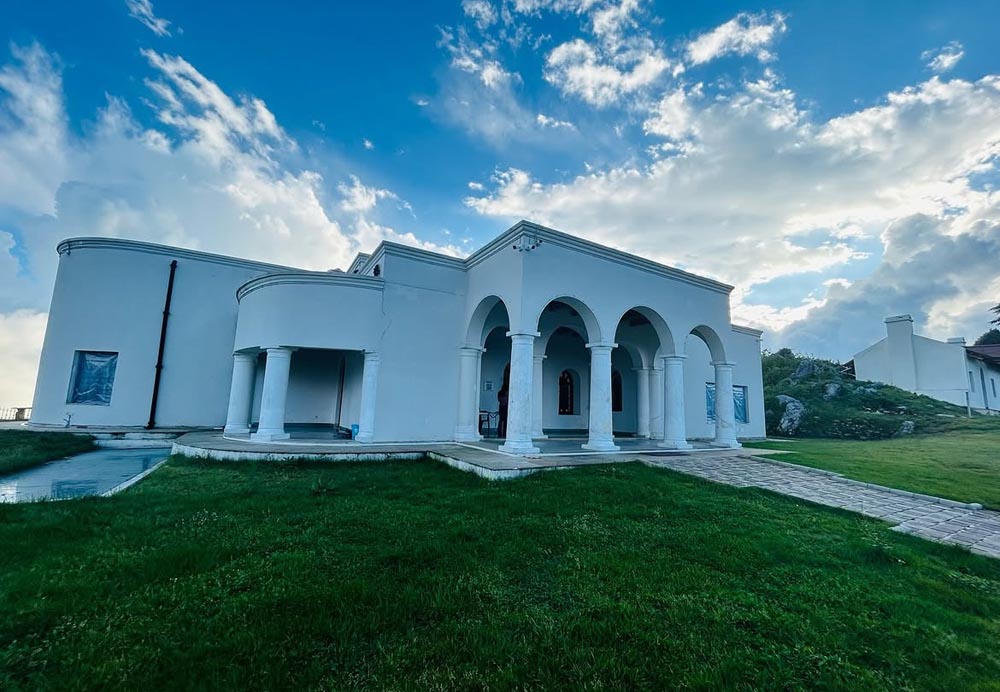
Nestled amid the quiet hills of Mussoorie in Uttarakhand, George Everest House is a destination where colonial history, scientific achievement and Himalayan scenery come together in a remarkable way. Located at Hathipaon, a short distance from the main tourist centre of Mussoorie, the historic property is associated with Sir George Everest, the British surveyor and geographer whose name eventually became attached to the world’s highest mountain. Far removed from the crowded streets and commercial atmosphere of central Mussoorie, the estate offers visitors an opportunity to experience a quieter side of the hill station.
Today, George Everest House is much more than an old colonial building. It is a heritage site, a reminder of the enormous surveying and mapping efforts undertaken in the Indian subcontinent during the nineteenth century, and a spectacular viewpoint overlooking the surrounding valleys and Himalayan ranges. The property has also become increasingly popular among travellers looking for photography, short hikes, picnics, sunsets and panoramic mountain views. The Government of India’s Incredible India tourism portal describes the house as a heritage attraction with views towards the Doon Valley, Aglar River valley and the Himalayan mountains.
The Historical Story Behind George Everest House
The story of George Everest House begins in the nineteenth century, when Mussoorie was developing into an important British hill station. The property, commonly known as Park Estate or Park House, dates to the early 1830s. Incredible India records the house as having been built in 1832, while historical accounts place George Everest’s association with the estate shortly afterward.
Sir George Everest was born in 1790 and eventually became one of the most important figures associated with surveying in British India. He served as Surveyor General of India from 1830 to 1843 and was closely involved with the Great Trigonometrical Survey of India, an enormous scientific undertaking intended to establish accurate geographical measurements across the subcontinent.
For Everest, surveying was not simply a matter of drawing lines on maps. The work involved mathematics, astronomy, geography, engineering and painstaking field measurements. Survey teams had to work across difficult terrain, often carrying sophisticated instruments over enormous distances. Mountains, forests, heat, disease and logistical difficulties made the task extraordinarily demanding.
George Everest House became closely connected with this scientific world. During the years he lived at the estate, the property functioned not only as a residence but also as a workplace associated with observation, calculations and surveying. Incredible India describes the house as having served as Everest’s home, observatory and laboratory during his residence there.
Who Was Sir George Everest?
Sir George Everest was a Welsh surveyor and geographer who spent a significant part of his professional life in India. His career coincided with a period when accurate geographical knowledge was becoming increasingly important to the British administration.
He became Surveyor General of India in 1830, succeeding William Lambton, who had initiated the Great Trigonometrical Survey. Everest continued the ambitious project and played a major role in improving the precision of India’s geographical measurements.
His work was technically demanding. Surveyors used triangulation, in which carefully measured baseline distances and angles between observation points were used to calculate the positions and distances of locations that could not easily be measured directly. Mountain peaks were observed from multiple locations, allowing their positions and elevations to be calculated.
The work associated with Everest eventually contributed to the measurements that identified the extraordinary height of Peak XV, the mountain that later became known throughout the world as Mount Everest. It is worth noting, however, that the naming and measurement story is more complicated than the popular version sometimes suggests. Everest himself had retired from the Surveyor General’s position before the final identification and naming of Peak XV. His successor, Andrew Scott Waugh, was Surveyor General when the peak was proposed to be named Mount Everest.
In 1865, the Royal Geographical Society officially adopted the name Mount Everest. The mountain had previously been known to the British survey as Peak XV. Thus, although George Everest did not personally stand on the summit or carry out a modern-style measurement of the mountain himself, his contribution to India’s surveying system and the Great Trigonometrical Survey was important enough that the world’s highest mountain eventually carried his name.
The Location and Natural Setting
One of the biggest attractions of George Everest House is its setting. The estate is situated at Hathipaon, several kilometres from the centre of Mussoorie, in an elevated area surrounded by forests and open mountain landscapes. Sources place it roughly 6–8 kilometres from central Mussoorie, depending on the starting point used.
The location provides a dramatically different atmosphere from busy Mall Road. Instead of shops, restaurants and crowds, visitors encounter open hills, mountain air and broad views.
From the estate, the landscape extends toward the Doon Valley on one side, while the Aglar River valley and Himalayan ranges can be seen from other directions. On clear days, the distant mountain scenery becomes particularly impressive. The combination of the historic building and the natural setting is one reason the site appeals to both history enthusiasts and nature lovers.
The views also change dramatically according to weather and season. During clear winter days, distant Himalayan peaks may appear sharply against the sky. During the monsoon, clouds and mist frequently transform the landscape into a much more atmospheric scene. Spring and autumn can offer pleasant conditions for walking and photography, while summer generally provides relief from the heat of the plains.
Architecture and Heritage Character
George Everest House is valuable not only because of its famous former resident but also because it represents the architectural character of an early colonial hill estate.
The building and surrounding structures were designed for practical living and scientific work rather than mass tourism. Its isolated position was particularly useful for observation and surveying. The estate included the main residence as well as associated structures connected with the work carried out there.
For many years, however, the property suffered from neglect. Sections of the old buildings deteriorated, and the estate lost much of its original appearance. Reports from before the restoration described the property as being in a seriously dilapidated condition.
The deterioration was particularly unfortunate because the site represented a rare combination of architectural, scientific and historical heritage. Eventually, efforts by heritage enthusiasts, officials and tourism authorities helped bring greater attention to the property.
Restoration of George Everest House
A major restoration project transformed the future of the estate. The Uttarakhand tourism department undertook a large-scale development project with Asian Development Bank assistance. Contemporary reports put the project cost at approximately ₹23.7 crore. The restoration began in 2019 and the renovated property was opened to the public in December 2021.
The project was intended to go beyond simply repairing the old house. Plans included improvements to the surrounding estate, pathways, tourism infrastructure and interpretation facilities. A heritage-style pathway was developed, while proposals also included a cartographic museum and facilities connected with astronomy and stargazing.
An especially interesting aspect of the restoration was the effort to preserve the character of the original structure. Reports stated that traditional materials and techniques were considered rather than simply treating the historic building like a modern concrete structure. One account noted the use of a traditional lime-based mixture incorporating materials such as fenugreek and urad dal instead of ordinary cement for parts of the restoration.
The restoration is significant because heritage conservation is not merely about making an old building look attractive. The objective is to preserve the relationship between the building, its history and its surroundings. At George Everest House, that relationship is particularly important because the landscape itself formed part of the scientific story.
George Everest House as a Scientific Heritage Site
Perhaps the most fascinating aspect of the destination is its connection with the history of science.
Modern travellers often associate Everest primarily with mountaineering. Images of climbers, icefalls and snow-covered Himalayan slopes dominate popular representations of Mount Everest. George Everest House presents a completely different story. It reminds visitors that before modern satellite mapping, digital elevation models and GPS, determining the shape and dimensions of the landscape required extraordinary patience and mathematical skill.
Surveyors depended on instruments, astronomical observations, carefully established reference points and complex calculations. The Great Trigonometrical Survey was one of the great scientific projects of nineteenth-century India.
The estate therefore provides an opportunity to understand the less familiar scientific history behind the famous name. Plans for a cartographic museum were part of the restoration vision, with the intention of displaying surveying equipment and explaining historical cartographic methods.
For students, researchers and anyone interested in geography, cartography or the history of science, this dimension makes the property particularly meaningful. It is a place where visitors can connect a famous geographical name with the actual human and technological work that stood behind it.
George Everest House as a Tourist Attraction
Today, the destination attracts a wide variety of visitors. Some come because of the historical connection with Mount Everest, while others are primarily interested in the scenery.
Photography is one of the most popular activities. The old house, mountain backdrop, open landscape and changing clouds create numerous opportunities for landscape and architectural photography. The site is also popular for short walks and relaxed outings.
The surrounding area has become associated with hiking, picnicking, camping and other outdoor activities. Incredible India describes George Everest House and the nearby peak as popular locations for camping, picnics and adventure outings.
The nearby George Everest Peak is particularly appealing to visitors who want to extend their outing beyond the heritage building. The ascent and surrounding terrain provide a more active experience, while the house itself offers the historical component of the trip.
The View from George Everest
The views are arguably the destination’s strongest natural attraction.
Looking across the landscape, visitors can appreciate the dramatic geography of the Mussoorie region. The Doon Valley stretches into the distance, while the Aglar side of the landscape and Himalayan ranges create a contrasting mountain panorama. On clear days, the distant peaks can become the centrepiece of the view.
Sunrise and sunset are especially attractive times for photographers. Early morning can bring soft light and clear atmospheric conditions, while evening often produces changing colours across the valleys. Clouds can add another dimension to the scenery, particularly during the monsoon.
However, mountain visibility is never guaranteed. Weather conditions, haze and seasonal cloud cover can dramatically affect what visitors see. Travellers should therefore visit for the overall experience rather than expecting a guaranteed panoramic view of snow-covered peaks.
Best Time to Visit
George Everest House can be visited throughout much of the year, but the ideal season depends on what kind of experience a traveller wants.
Spring is pleasant, with comparatively comfortable temperatures and greenery returning to the surrounding hills. Summer is also popular because Mussoorie provides a cooler escape from the plains, although weekends can become busy.
The post-monsoon period is particularly attractive because the landscape is often lush and fresh. October and November can bring clearer skies, making them good months for mountain views and photography.
Winter has its own charm. Temperatures can fall considerably, and cold mornings may produce a distinctly Himalayan atmosphere. On suitable days, visibility can be excellent. Travellers should carry warm clothing, especially if they plan to remain at the viewpoint around sunrise or sunset.
The monsoon can be beautiful but requires greater caution. Wet paths, slippery surfaces, fog and sudden rain can make walking more difficult. Anyone planning a hike should check local weather conditions before setting out.
How to Reach George Everest House
George Everest House is reached from Mussoorie by road toward the Hathipaon area. It is not located in the centre of the town, so visitors generally need a private vehicle, taxi or other local transport to reach the vicinity.
For travellers arriving from outside Uttarakhand, Dehradun is an important gateway. Incredible India lists Jolly Grant Airport as the nearest airport and Dehradun Railway Station as the nearest major railway connection. From Dehradun, travellers can continue by road toward Mussoorie and then proceed to Hathipaon.
The road journey itself is part of the experience. As the route moves away from central Mussoorie, the environment gradually becomes quieter and more rural. Visitors should allow enough time rather than treating George Everest House as a very quick stop.
Things to Do Around George Everest House
A visit does not have to be limited to looking at the historic building. Travellers can spend time exploring the surrounding landscape, photographing the old architecture, enjoying the mountain views and walking around the estate.
Those interested in adventure can explore the nearby George Everest Peak and surrounding trails. The area has also become associated with camping and outdoor recreation. Visitors who prefer a relaxed outing can simply enjoy the viewpoint and the atmosphere.
George Everest House can also be combined with other Mussoorie attractions during a longer day trip. Depending on the route and available time, travellers can explore places such as Kempty Falls, Bhatta Falls, Gun Hill Point, Mussoorie Lake, Lal Tibba and Landour. Incredible India lists several of these among the attractions around Mussoorie.
Practical Tips for Visitors
Visitors should wear comfortable shoes because the area involves walking on uneven surfaces. Anyone planning to explore the nearby trails should choose proper footwear rather than ordinary sandals.
Carrying drinking water is advisable, particularly during warmer months or when walking beyond the main visitor areas. Weather in the hills can change quickly, so a light jacket or rain protection can be useful even when the day begins with clear skies.
Photography enthusiasts should consider visiting early in the morning or later in the afternoon when the light is softer. Those interested in sunset photography should remember that mountain roads can become darker quickly after sunset.
The official Incredible India listing currently gives visiting hours of 9:00 AM to 6:00 PM, although local operating arrangements can change. It is sensible to verify opening conditions locally before making a dedicated trip.
Visitors should also treat the heritage structures respectfully. Historic buildings cannot easily be replaced, and avoiding littering, graffiti and damage is essential to preserving the site for future generations.
Why George Everest House Deserves a Place on Your Mussoorie Itinerary
Mussoorie has no shortage of scenic viewpoints, colonial buildings and popular tourist attractions, but George Everest House offers something different. Its appeal comes from the combination of history, science, architecture and landscape.
Standing near the old estate, it is fascinating to think about the scientific work that took place here more than a century ago. The mountains visible from the property are not simply a beautiful backdrop; they are connected to the very subject of the surveying work that made George Everest famous.
The destination also provides a valuable perspective on the history behind the name “Everest.” The world’s highest mountain is now an icon of adventure and mountaineering, but the story associated with its name is rooted partly in nineteenth-century surveying and cartography.
At the same time, the restored estate demonstrates how historical places can be brought back into public life. After years of deterioration, the restoration project helped turn George Everest House into a heritage and tourism destination while drawing attention to its scientific significance.
Final Thoughts
George Everest House is one of those places where the journey is about much more than reaching a viewpoint. It is a meeting point between the past and present, where an old colonial-era estate tells the story of surveying, geography and scientific exploration against the extraordinary backdrop of the Himalayas.
For history lovers, it offers a connection with Sir George Everest and the Great Trigonometrical Survey. For photography enthusiasts, it provides dramatic Himalayan and valley landscapes. For nature lovers, it offers quiet mountain surroundings away from the busiest parts of Mussoorie. For trekkers and adventure seekers, the nearby peak and trails add an outdoor dimension to the visit.
Most importantly, George Everest House encourages visitors to look beyond the famous name of Mount Everest and discover the complex history behind it. The property stands as a reminder that some of the world’s greatest geographical discoveries were achieved not with modern technology, but through years of observation, calculation, perseverance and painstaking fieldwork.
A trip to this historic estate therefore offers two experiences at once: the simple pleasure of standing on a beautiful Himalayan hillside and the deeper experience of stepping into a chapter of India’s scientific and colonial history. That combination makes George Everest House one of the most distinctive places to explore around Mussoorie, Uttarakhand.

