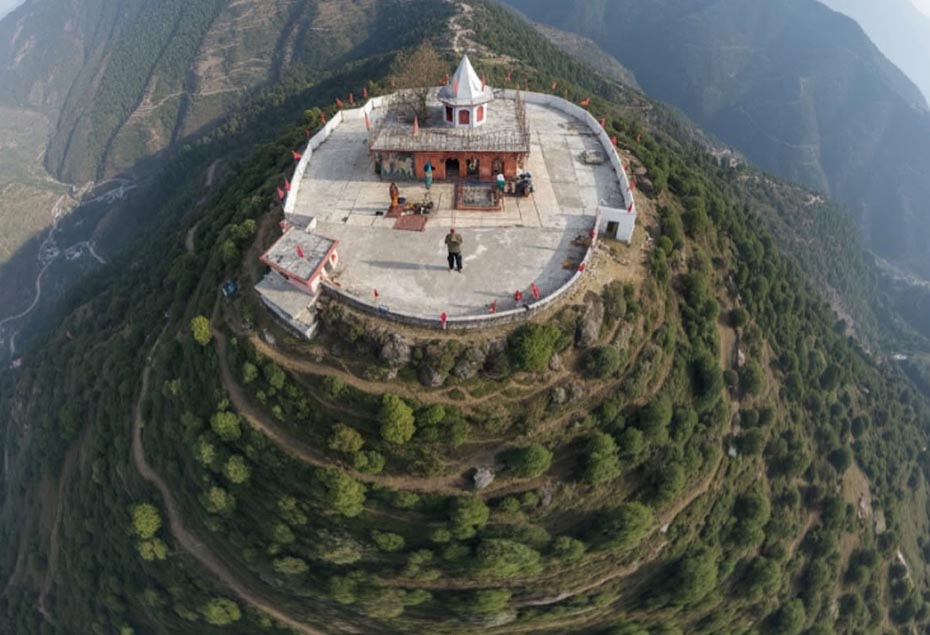
Nestled among the beautiful mountains of Kumaon in Uttarakhand, Malaynath Swami Mandir, also known as Sirakot Temple, is a fascinating blend of faith, folklore, history and Himalayan landscapes. Located near Didihat in Pithoragarh district, the temple occupies a hilltop associated with the old Sirakot fort and has long been revered as an important shrine of Malaynath Swami, a local deity worshipped particularly in the eastern Kumaon region.
Unlike some of Uttarakhand’s better-known pilgrimage destinations, Malaynath Swami Mandir remains deeply connected with the local community and its traditional religious practices. The importance of the shrine is not limited to the physical temple. Its identity is intertwined with oral traditions, village customs, devotional songs, fairs, drums and the distinctive folk-religious culture of Kumaon.
The District Pithoragarh administration describes Sirakot as a fort-cum-temple located about 2–3 km from Didihat and notes that the hilltop provides remarkably clear views of the Himalayan ranges. The official district tourism information also places Didihat about 55 km from Pithoragarh town.
Where Is Malaynath Swami Mandir Located?
Malaynath Swami Mandir is situated at Sirakot near Didihat in Pithoragarh district, Uttarakhand. The temple stands on a prominent hill, making it visually striking as well as spiritually significant. The wider Didihat region is known for its cultivated mountain slopes, valleys and views toward the Himalayan ranges.
The official district website identifies Sirakot as an ancient fort-cum-temple site approximately 2 km from Didihat, while other local accounts commonly describe the temple as around 3 km from the town depending on the approach and point of measurement.
For visitors, the location is one of the temple’s greatest attractions. Reaching a hilltop shrine provides an experience quite different from visiting a temple situated in a busy town. The journey gradually leaves behind the urban surroundings of Didihat and leads into the quieter mountain environment. From the upper slopes, visitors can appreciate the surrounding valleys, ridges and, on clear days, distant Himalayan peaks.
A current map listing also identifies Sirakot Malaynath Temple in the Didihat area, reflecting its continuing presence as a recognised local religious destination. Sirakot Malaynath temple
Historical Background of Sirakot Temple
The history of Malaynath Swami Mandir cannot be separated from the history of Sirakot. The hill is associated with an old fort, and the temple complex contains remnants that connect the religious site with the region’s medieval political history.
According to the District Pithoragarh administration, Sirakot was a fort-cum-temple built by the Reka Kings. The outer portion of the fort was used as residential accommodation by the ruler, while the inner part contained temples dedicated to Shiva and Bhairava. These older structures are now described as being in ruins.
Local traditions, however, connect the present temple more specifically with the Chand rulers and place important developments at the site during the medieval period. A traditional account says that the temple was established during the period of the Chand rulers and that Malaynath manifested at the location. Another version associates the establishment with Bahadur Chand and the settlement of people around the site.
Because much of the temple’s history survives through oral tradition rather than through extensive surviving written records, different accounts may give slightly different details. This is common with Himalayan folk shrines, where historical memory, mythology and community traditions have developed together over generations.
The ruins of Sirakot are therefore important not only to devotees but also to people interested in the architectural and cultural history of Kumaon.
Who Is Malaynath Swami?
Malaynath Swami is regarded as a local folk deity of Kumaon, particularly associated with the eastern areas around Sira and Askot. Local traditions often identify Malaynath with a powerful protective deity, and his worship remains deeply rooted in the cultural life of the surrounding communities.
Some traditions describe Malaynath as having connections with a warrior or royal lineage, while folk narratives surrounding his life have been preserved through jagar, the traditional devotional storytelling and singing tradition of Uttarakhand.
One local account describes Malaynath’s story as resembling the legends associated with other Kumaoni folk deities such as Golu/Gangnath and Bhairavnath. In this tradition, the deity’s story involves love, renunciation and transformation into a yogic figure.
These stories should be understood as part of the region’s oral religious heritage rather than treated simply as conventional historical biographies. In Kumaon, folk deities often occupy a special position between mythology, community memory and everyday religious life.
Malaynath as a Protective Deity
One of the most important aspects of Malaynath worship is the belief in the deity’s protective power. Devotees regard Malaynath Baba as a guardian or protector, and this belief contributes significantly to the temple’s popularity.
A report published by Amar Ujala notes that Malaynath Baba of Sirakot is worshipped as a protector and that soldiers and military families have traditionally maintained a connection with the temple. The report also describes the shrine as being associated with a self-manifested Shiva-lingam form and records significant attendance during Mahashivratri.
This protective dimension gives the temple a special emotional significance. For many devotees, visiting the shrine is not simply about sightseeing or performing a ritual. It represents an opportunity to seek blessings, protection, courage and spiritual reassurance.
The Connection with Lord Shiva
Malaynath Swami is also closely associated with Shiva traditions. Local sources describe Malaynath as a manifestation or form connected with Lord Shiva, while the Sirakot complex itself has long included Shiva worship. The official district description specifically mentions a Shiva temple within the older fort complex.
This connection explains why festivals associated with Shiva, particularly Mahashivratri, are important at the temple.
The relationship between local folk deities and major Hindu deities is a distinctive characteristic of Uttarakhand’s religious culture. A village or regional deity may have an individual legend and particular rituals while simultaneously being understood as a form or manifestation of Shiva, Devi or another widely worshipped deity.
Malaynath’s identity reflects precisely this interaction between mainstream Hindu traditions and the indigenous folk culture of Kumaon.
Jagar: The Living Voice of Kumaoni Devotion
One of the most fascinating aspects of Malaynath worship is the tradition of jagar.
Jagar is a distinctive ritual and musical tradition of Uttarakhand in which the stories and powers of local deities are invoked through singing, drumming and ritual performance. It is much more than ordinary devotional music. It acts as a form of oral cultural memory through which stories of gods, heroes, ancestors and legendary figures are passed from one generation to another.
According to local accounts concerning Malaynath Swami, the deity’s jagar can extend over several days. One source describes a four-day tradition known as Chauras.
During such traditions, the sound of the dhol and damau, the traditional drums of Uttarakhand, becomes an essential part of the religious atmosphere. The rhythm, singing and narration create a powerful communal experience.
For anyone interested in Himalayan culture, witnessing an authentic jagar tradition can provide a deeper understanding of Uttarakhand than simply visiting a temple building.
The Annual Fair and Cultural Celebrations
The annual fair associated with Sirakot/Malaynath Temple is another major attraction. Local accounts mention celebrations around Kartik Chaturdashi, while other descriptions associate the annual gathering with the traditional festival calendar and local religious observances.
The fair is not simply a religious gathering. It is also an expression of community identity.
One particularly interesting tradition associated with the fair is the dhol-nagada competition. Villages from the surrounding region participate with their traditional drums, transforming the festival into a lively celebration of Kumaoni musical heritage. Accounts mention participation from places and villages including Chaubati, Dunakot, Didihat, Borabunga, Bamangad and Adichoura.
The combination of worship, music and community participation makes the festival an important cultural event.
Mahashivratri at Malaynath Temple
Mahashivratri is particularly significant because of the temple’s strong connection with Shiva worship. Devotees visit the shrine to offer prayers, perform rituals and seek the blessings of Malaynath Swami.
According to local reporting, thousands of devotees may gather at Sirakot during Mahashivratri. The festival transforms the normally peaceful hilltop into a vibrant pilgrimage centre.
For visitors planning to attend during a major festival, it is worth remembering that the experience will be very different from visiting on an ordinary day. Crowds can be considerably larger, access can become more difficult and local arrangements may change according to the festival schedule.
The Sacred Water Source
Another interesting feature mentioned in local descriptions is an old naula, or traditional Himalayan water source, associated with the temple. One account states that the water source dates back to the period of the Chand rulers and has traditionally been used for temple-related purposes such as offerings and cleaning.
Traditional naulas are an important part of Uttarakhand’s heritage. Before modern water-supply systems became widespread, these carefully constructed springs served as vital sources of drinking and ritual water.
The presence of such a water structure adds another layer to the cultural history of Sirakot. It demonstrates how religious sites were traditionally connected with practical community infrastructure.
Architecture and the Sirakot Fort
Visitors should not expect Malaynath Swami Mandir to resemble a massive modern pilgrimage complex. Its significance comes partly from its setting and its connection with the old fort.
The Sirakot hilltop contains remnants of the earlier fortification and temple structures. The official Pithoragarh district website describes the Shiva and Bhairava temples within the fort as being in ruins, while highlighting the exceptional views from the hilltop.
This combination of ruins and active worship is particularly interesting. It creates a visible connection between the past and present. The stones and remains recall earlier political and religious history, while the continuing worship of Malaynath demonstrates that the sacred identity of the hill has survived.
The Himalayan Views from Sirakot
The landscape around Malaynath Swami Mandir is almost as memorable as the temple itself.
Sirakot rises above the surrounding countryside, providing expansive views across the mountainous terrain. The District Pithoragarh website specifically notes the remarkably clear Himalayan views from the hilltop.
Didihat itself is a picturesque mountain settlement. Uttarakhand Tourism describes the wider Didihat region as a hill town with cultivated ridges and views toward the snow-covered Panchachuli Himalayan range on clear days.
For photographers and nature lovers, early morning and late afternoon can be especially appealing because mountain light changes the appearance of the ridges and valleys. However, Himalayan visibility is weather-dependent, so visitors should not assume that distant snow peaks will always be visible.
How to Reach Malaynath Swami Mandir
The most practical starting point for a visit is Didihat. The town is connected by road with other important settlements of Pithoragarh district.
The official district tourism information places Didihat around 55 km from Pithoragarh, while Sirakot is approximately 2–3 km from Didihat.
From Didihat, visitors generally continue toward Sirakot and then make the final approach to the hilltop temple. Because roads and local access conditions can change, travellers should confirm the current route locally before beginning their journey.
For visitors arriving from outside the region, reaching Pithoragarh first and continuing by road toward Didihat is a common approach. Public and private transport options may vary by season and local conditions.
The final climb is part of the experience. Anyone visiting should wear comfortable footwear and allow enough time rather than treating the temple as a quick roadside stop.
Best Time to Visit
Malaynath Swami Mandir can be visited throughout much of the year, but the ideal season depends on what kind of experience a traveller wants.
For pleasant weather and mountain sightseeing, spring and autumn are generally attractive periods. Clearer skies can also improve Himalayan visibility.
The monsoon season can bring heavy rain, slippery roads and difficult walking conditions in the mountains. Travellers should therefore check weather and road conditions before setting out.
Those interested primarily in religious celebrations may prefer visiting during Mahashivratri or the annual fair. However, festival visits require greater preparation because crowds can be significantly larger.
A quiet weekday visit, by contrast, can provide a more peaceful opportunity to appreciate the temple, surrounding ruins and mountain scenery.
Things to Experience Around the Temple
A visit to Malaynath Swami Mandir should ideally not be limited to the main shrine. The Sirakot hill itself is historically significant because of its fort remains.
Visitors can explore the surroundings respectfully, observe the old structures and spend time taking in the mountain landscape. Didihat also makes a useful base for exploring other attractions in Pithoragarh district.
The region is particularly appealing to travellers interested in combining pilgrimage with Himalayan scenery. The district has numerous temples and cultural sites, and the official tourism information lists several destinations around Didihat and elsewhere in Pithoragarh.
Religious Etiquette for Visitors
Because Malaynath Swami Mandir is an active place of worship rather than merely a tourist monument, visitors should behave respectfully.
Simple clothing, quiet behaviour inside the sacred area and sensitivity toward local customs are advisable. Photography should be avoided wherever local devotees or temple authorities indicate that it is not permitted.
The temple’s traditions are rooted in local community practices, some of which may differ from customs visitors are familiar with. Rather than judging these traditions from outside, travellers can approach them as part of Kumaon’s rich cultural heritage.
Festival periods require additional patience because the temple may become crowded and normal visitor movement can be affected by rituals.
Why Malaynath Swami Mandir Is Special
What makes Malaynath Swami Mandir remarkable is the way several layers of Uttarakhand’s heritage come together at one location.
There is the ancient landscape, represented by the hilltop setting and Himalayan views. There is the medieval history, represented by Sirakot fort and its temple ruins. There is the religious tradition, represented by Malaynath Swami and Shiva worship. There is the oral heritage, preserved through jagar. And finally, there is the living community culture, visible during fairs, musical performances and traditional celebrations.
This is why the temple deserves attention beyond conventional pilgrimage tourism. It is a place where history has not been separated from living culture.
The official district administration itself places Sirakot among the important attractions of the Didihat area, particularly highlighting both its historical fort-temple character and the Himalayan panorama from the summit.
Final Thoughts
Malaynath Swami Mandir in Didihat is more than a hilltop temple. It is a living cultural landscape where faith, folklore, history and nature meet. The shrine’s association with Malaynath Swami, the old Sirakot fort, Shiva worship, traditional jagar performances and colourful village festivals gives it an identity that is distinctly Kumaoni.
For devotees, the temple is a place of prayer and protection. For history enthusiasts, the old Sirakot remains offer a glimpse into the region’s medieval past. For travellers, the hilltop provides an opportunity to experience the quieter side of Uttarakhand away from some of the state’s heavily visited pilgrimage centres. And for those interested in folk culture, the traditions surrounding Malaynath offer an exceptional window into the living religious heritage of the Kumaon Himalayas.
A visit to this sacred hill therefore becomes more than simply checking another temple off a travel list. It is an opportunity to understand how mountain communities preserve their stories, beliefs, music and memories across generations. With its combination of spiritual importance, historical associations and spectacular surroundings, Malaynath Swami Mandir remains one of the distinctive cultural treasures of the Didihat region of Uttarakhand.
Malaynath Swami Mandir is best experienced slowly—with time to appreciate not only the shrine itself, but also the old fort, the surrounding mountains and the traditions that continue to give Sirakot its sacred character.

