Nestled in the peaceful surroundings of Clement Town in Dehradun, Uttarakhand, Mindrolling Monastery is one of the most remarkable Buddhist landmarks in northern India. With its brilliant Tibetan architecture, enormous Great Stupa, beautifully landscaped gardens, intricate murals, prayer wheels and serene atmosphere, the monastery attracts spiritual seekers, history enthusiasts, architecture lovers and travellers from around the world. More than a sightseeing destination, however, Mindrolling is a living centre of Tibetan Buddhist learning and practice, carrying forward a centuries-old spiritual lineage.
The monastery is particularly significant because it represents the Nyingma tradition, the oldest of the four major schools of Tibetan Buddhism. Its story stretches back to 17th-century Tibet and continues today in India after the displacement of Tibetan religious communities following the events of 1959. The modern monastery in Dehradun therefore represents not only religious devotion but also the preservation of Tibetan culture, scholarship, art and traditions.
The Meaning and Origins of Mindrolling Monastery
The name Mindrolling is associated with the idea of a “place of perfect emancipation,” reflecting the monastery’s spiritual purpose. The original Mindrolling Monastery was established in 1676 in the Drachi Valley of Central Tibet by the great Nyingma master Terdag Lingpa, also known as Rigzin Terdak Lingpa. It became one of the important centres of study and practice within the Nyingma school and developed a distinguished reputation for Buddhist philosophy, ritual practice and scholarship.
Mindrolling was one of the major monasteries associated with the Nyingma tradition and became an important centre for the transmission of Vajrayana Buddhist teachings. The institution developed a broad intellectual and spiritual curriculum, helping preserve Buddhist scriptures, rituals, artistic traditions and other forms of Tibetan knowledge. Its influence extended well beyond the monastery itself, attracting practitioners and scholars from different parts of Tibet.
The history of Mindrolling cannot be separated from the wider history of Tibetan Buddhism. The Nyingma school traces its spiritual roots to the introduction of Buddhism into Tibet, particularly the teachings associated with the Indian master Padmasambhava. Among the teachings especially associated with the Nyingma tradition are the profound Dzogchen teachings, which focus on recognizing the nature of mind and attaining spiritual realization.
From Tibet to India
The modern history of Mindrolling is closely connected with the Tibetan exile that followed the upheavals of 1959. Tibetan religious leaders and monks were forced to leave their homeland, and many sought to preserve their religious traditions by establishing monasteries and educational institutions in India.
The Mindrolling lineage was among those that continued this work in exile. According to the monastery’s own history, the official enthronement of the XIth Mindrolling Trichen took place in 1962, and in 1976 he was able to establish the official monastic seat of Mindrolling in exile. The process of rebuilding, however, had begun earlier. In 1965, His Eminence Khochhen Rinpoche and a small group of monks began establishing Mindrolling in Dehradun.
Recreating a major monastery in a new country was a tremendous undertaking. The early community had to develop the physical infrastructure of the monastery while simultaneously rebuilding its educational and religious institutions. Over the decades, the Dehradun centre expanded from a modest settlement into a major Buddhist complex.
Today, the monastery stands as an example of how Tibetan religious traditions survived and adapted in exile. Its importance consequently extends beyond the physical buildings. It is a place where generations of monks have continued to study Buddhist philosophy, conduct religious practices and preserve aspects of Tibetan cultural heritage.
Location of Mindrolling Monastery
Mindrolling Monastery is situated in Clement Town, in the Dehradun district of Uttarakhand. Dehradun itself lies in the Doon Valley, surrounded by the Himalayan foothills, making it a natural setting for a monastery associated with Tibetan Buddhist traditions.
The monastery’s location in Clement Town is particularly significant because it is closely connected with the Tibetan refugee community in the area. The monastery’s own account describes the relationship between Mindrolling and the neighbouring Tibetan Refugee Colony as an important part of community life.
For travellers arriving in Dehradun, the monastery is relatively accessible compared with many remote Himalayan monasteries. Dehradun Railway Station provides an important rail connection, while Jolly Grant Airport serves the region. The Uttarakhand tourism portal also identifies Dehradun Railway Station and Jolly Grant Airport as the principal transport points for reaching the monastery.
The Great Stupa
The most recognisable feature of Mindrolling Monastery is undoubtedly the magnificent Great Stupa. Rising dramatically above the surrounding complex, it has become one of Dehradun’s most distinctive landmarks.
The Great Stupa was inaugurated in October 2002 and was conceived as a monument dedicated to world peace and the benefit of all beings. The monastery’s official website describes it as containing several shrine rooms, while the surrounding grounds include large prayer wheels.
Different tourism sources give slightly different measurements for the structure, generally placing its height at roughly 60 metres or more than 185 feet. Incredible India describes it as more than 200 feet tall, while other tourism references commonly give a figure of approximately 185 feet. Because published measurements vary, it is best to regard the Great Stupa as approximately 60 metres high rather than relying on a single figure.
Beyond its impressive scale, the Great Stupa is a sacred architectural space. Visitors encounter shrine rooms, Buddhist imagery and religious symbolism within the complex. Its design demonstrates how Tibetan Buddhist architecture uses physical structures to communicate spiritual concepts.
The stupa is surrounded by an atmosphere of quiet contemplation. Visitors can walk around the structure, observe the prayer wheels and appreciate the elaborate details without necessarily participating in formal religious activities. For many people, simply spending time around the stupa provides an opportunity to slow down and experience the peaceful character of the monastery.
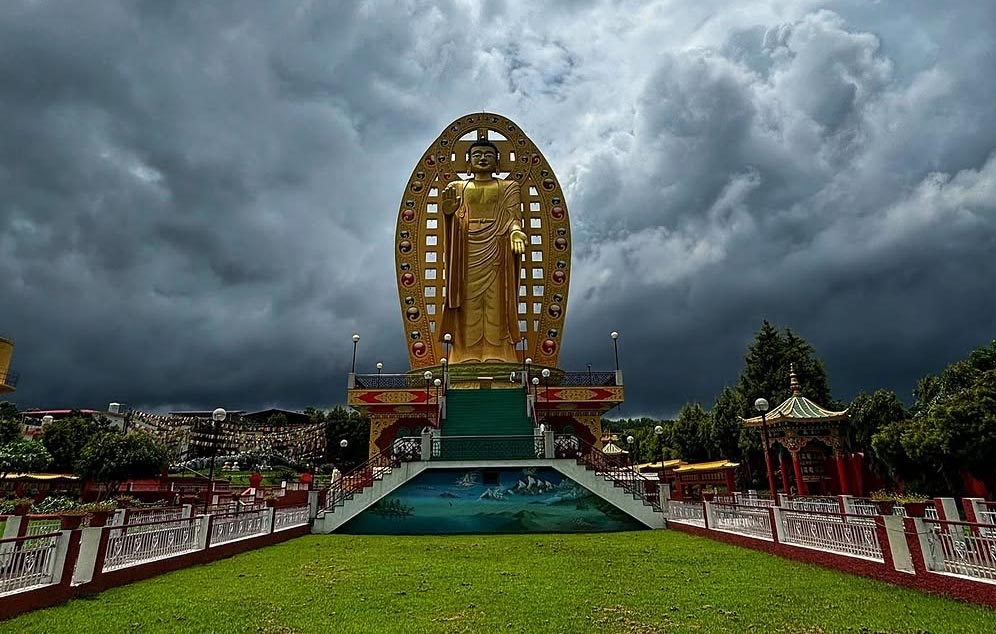
The Buddha Statue
Another major attraction is the enormous golden statue of Buddha associated with the monastery complex. The statue of Shakyamuni Buddha creates an imposing visual presence and is one of the most photographed features of Mindrolling.
Tourism sources commonly describe the statue as approximately 35 metres, or around 115 feet, high. Incredible India, meanwhile, describes a colossal Buddha statue of approximately 130 feet within the upper part of the temple complex.
Regardless of the minor differences in published measurements, its scale is extraordinary. The statue is especially striking when viewed against the relatively low-rise surroundings of Clement Town and the distant Himalayan landscape.
The Buddha image is not simply decorative. In Buddhist traditions, representations of the Buddha can function as objects of contemplation and reminders of the teachings. The visual grandeur of the statue therefore works together with the monastery’s broader spiritual purpose.
Tibetan Buddhist Architecture
One of the first things visitors notice at Mindrolling is its colourful and elaborate architecture. Tibetan Buddhist buildings frequently combine vivid colours, symbolic motifs, sculptural details and religious imagery, and Mindrolling provides an impressive example of this artistic tradition.
The monastery’s temple complex contains intricate murals, statues and decorative details. Incredible India notes the presence of vibrant murals depicting episodes from the life of Buddha and describes a blend of Tibetan spiritual elements with Japanese architectural influences.
The colours and patterns found throughout the complex are not merely intended to make the buildings attractive. Buddhist art frequently uses visual symbols to communicate teachings and ideas that might otherwise be difficult to express. Images of Buddhas, bodhisattvas, protective deities and teachers can serve as aids to contemplation and religious instruction.
For photographers and architecture enthusiasts, the monastery offers an abundance of visual details. Ornamental gates, painted walls, statues, prayer wheels, landscaped spaces and the towering stupa create a distinctive visual identity.
Murals, Shrine Rooms and Religious Art
Inside the monastery, visitors can encounter elaborate Buddhist artwork, including murals and statues. The interior spaces are particularly valuable for understanding the artistic traditions associated with Tibetan Buddhism.
The temple complex is spread across multiple levels, with shrine rooms and religious imagery occupying different areas. Incredible India describes five floors, with the first three featuring ornate golden wall paintings and upper levels offering views toward the surrounding valley.
The monastery’s Great Stupa also contains dedicated shrine rooms, including spaces associated with Buddha Shakyamuni, Padmasambhava and the Four Immeasurables. The monastery’s official website identifies these as significant components of the Great Stupa complex.
Visitors should remember that these are functioning religious spaces rather than museum exhibits. The artwork and statues remain part of an active spiritual environment, and respectful behaviour is therefore important.
Prayer Wheels and Buddhist Practice
Prayer wheels are another characteristic feature of Mindrolling. These cylindrical objects are traditionally inscribed with sacred mantras and are rotated as part of Buddhist devotional practice.
The monastery grounds contain several large prayer wheels around the Great Stupa. Visitors may see monks and laypeople engaging with these features as part of their spiritual practice.
For someone unfamiliar with Tibetan Buddhism, prayer wheels can initially appear to be simply decorative objects. In reality, they form part of a broader tradition in which physical actions, recitation, visualisation and meditation can be combined as methods of cultivating compassion and spiritual awareness.
Observing these practices can give visitors a deeper appreciation of the fact that Mindrolling is not merely a tourist monument. It continues to function as a religious institution where Buddhist traditions are actively practised.
Ngagyur Nyingma College
One of the most important aspects of Mindrolling is its educational role. The monastery is home to the Ngagyur Nyingma Institute, also referred to as Ngagyur Nyingma College, which provides advanced Buddhist education.
The institution is dedicated to studying and practising the teachings of Buddha according to the Nyingma lineage. The monastery’s official overview explains that the college teaches Buddhist philosophy and that its library houses commentaries by Indian and Tibetan masters on Buddhist teachings.
This educational dimension makes Mindrolling particularly important. Many visitors may come primarily to admire the architecture or Great Stupa, but behind the tourist-facing appearance is a functioning scholarly institution.
The preservation of religious texts, philosophical commentaries and traditional knowledge is especially significant in the context of Tibetan Buddhism in exile. Institutions such as Mindrolling help ensure that teachings can continue to be transmitted to new generations rather than becoming merely historical traditions.
Mindrolling as a Centre of Tibetan Culture
The monastery also plays an important cultural role. Tibetan Buddhist monasteries traditionally serve several functions at once: they are places of worship, education, artistic production, community gathering and preservation of cultural knowledge.
Mindrolling’s connection with Clement Town’s Tibetan community reinforces this role. The monastery’s campus includes facilities connected with the neighbouring community, and the official website describes classrooms and dormitories associated with schools for young monks.
This relationship between monastery and community makes a visit particularly meaningful. Visitors are not simply entering an isolated monument but encountering a living cultural environment shaped by migration, religious continuity and adaptation.
Gardens and the Peaceful Atmosphere
Although the Great Stupa and Buddha statue are the most dramatic attractions, the monastery’s landscaped surroundings contribute greatly to its appeal. Carefully maintained gardens, open spaces and quieter corners create an atmosphere that contrasts with the movement and noise of urban Dehradun.
For many visitors, the peaceful environment is one of the main reasons to spend time at Mindrolling. Even those who do not have a particular interest in Buddhism can appreciate the opportunity to sit quietly, observe the architecture and enjoy the surrounding greenery.
The experience is particularly different from conventional tourist attractions. There is no need to rush from one monument to another. The monastery encourages a slower pace, making it suitable for contemplation and quiet observation.
Best Time to Visit
Dehradun can be visited throughout much of the year, but the most comfortable periods for sightseeing are generally the cooler months. Autumn, winter and early spring can be especially pleasant for visitors who want to explore the monastery and other attractions around Dehradun.
The monsoon season can bring substantial rainfall to the region, so travellers visiting during this period should be prepared for wet weather.
Because Mindrolling is an active religious institution, visitors should also check the monastery’s official visitor information before travelling. The monastery states that visits to the Great Stupa do not require advance arrangements and that the stupa is open every day from 9:00 AM. Visitors planning overnight stays or extended visits for other purposes are asked to contact the monastery in advance.
What Visitors Should Expect
Mindrolling Monastery is best approached as a sacred and educational institution rather than simply a tourist attraction. Visitors should maintain a respectful and relatively quiet manner, particularly near prayer halls, shrine rooms and monks engaged in religious activities.
Modest clothing is appropriate, and visitors should be attentive to any signs or instructions regarding photography. Religious ceremonies may be taking place, and travellers should avoid interrupting or obstructing them.
The monastery can appeal to very different types of travellers. Spiritual visitors may appreciate its contemplative environment, history lovers can explore its connection with Tibet, architecture enthusiasts can study its artistic details, and photographers can find numerous striking subjects.
Why Mindrolling Monastery Is Important
The significance of Mindrolling lies in the combination of history, religion, education, architecture and cultural preservation. Its story begins in 17th-century Tibet but continues in modern India. It demonstrates how a religious institution can survive profound historical change while maintaining its identity.
The monastery’s continuation in Dehradun is also a reminder of the importance of cultural preservation in exile. Tibetan Buddhist traditions faced enormous disruption during the 20th century, yet institutions such as Mindrolling helped maintain religious education, texts, artistic traditions and monastic practices.
Its educational institutions make the monastery more than a beautiful architectural landmark. Monks continue to study and practise Buddhist teachings, while the monastery’s library, shrine rooms and religious ceremonies contribute to the continuation of a living tradition.
Mindrolling Monastery as a Dehradun Attraction
For travellers exploring Dehradun, Mindrolling can easily become one of the highlights of a broader sightseeing itinerary. The city and surrounding region offer a combination of natural landscapes, colonial-era history, religious sites and Himalayan culture.
A visit to Mindrolling is particularly rewarding when travellers take time to appreciate the details rather than limiting themselves to photographs of the Great Stupa. Walking through the grounds, observing the prayer wheels, studying the murals and learning about the monastery’s history creates a much richer experience.
The monastery also offers an interesting introduction to Tibetan Buddhist culture for visitors who have never previously visited a Tibetan Buddhist institution.
Final Thoughts
Mindrolling Monastery is much more than an impressive Buddhist monument in Dehradun. It is a story of survival, faith and cultural continuity. Founded in Tibet in 1676 and rebuilt in India following the Tibetan exile, it has grown into an important centre of Nyingma Buddhist learning and practice.
Its Great Stupa dominates the skyline, its Buddha statue provides an unforgettable visual landmark, and its murals, shrine rooms and prayer wheels reveal the richness of Tibetan Buddhist artistic traditions. Yet perhaps its greatest significance lies behind these visible attractions: monks continue to study, practise and transmit teachings that have been passed down through generations.
For travellers, Mindrolling offers a rare combination of spirituality, history, art and architecture. For the Tibetan Buddhist community, it represents something deeper—a living continuation of a lineage that survived displacement and found a new home in the Himalayan foothills of India.
A visit to Mindrolling is therefore not simply an opportunity to see a magnificent monastery. It is an opportunity to encounter a living tradition and to understand how faith, education, art and community can preserve cultural identity across centuries and continents.

