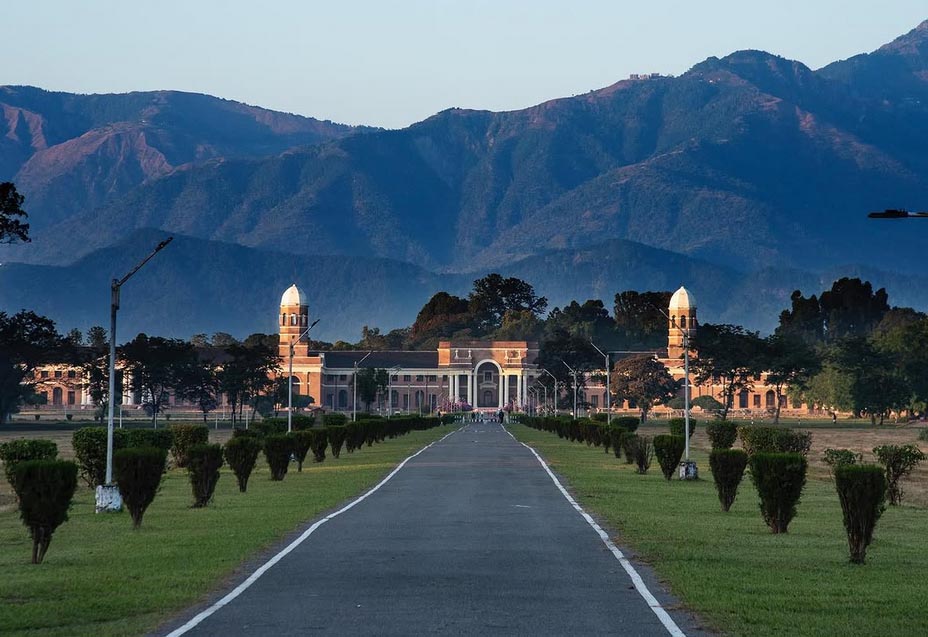
Nestled amid the green landscape of Dehradun in Uttarakhand, the Forest Research Institute (FRI) is far more than a beautiful colonial-era building. It is one of India’s most important centres for forestry research, education and scientific development, and its history is closely connected with the evolution of scientific forestry in the Indian subcontinent. Located against the backdrop of the Outer Himalayas, the institute combines research laboratories, educational facilities, museums, a vast library, experimental areas and an extraordinary architectural landmark within a large, tree-filled campus.
Today, Forest Research Institute is associated not only with forestry professionals and researchers but also with tourism in Dehradun. Its imposing main building, extensive lawns, museums and distinctive architecture make it one of Uttarakhand’s best-known institutional landmarks. At the same time, behind its tourist appeal is a serious scientific institution working on subjects ranging from biodiversity and forest management to climate change, forest products, tree improvement, pathogens and environmental restoration.
A Historic Beginning in 1906
The story of the Forest Research Institute goes back to 1906, when the Imperial Forest Research Institute was established with the objective of organizing and leading forestry research. The establishment of the institute was part of the wider development of scientific forestry in India. Its history subsequently became intertwined with the development of organized forestry research and training throughout the Indian subcontinent.
Dehradun already had an important connection with forestry education before FRI was established. A Forest School had been established in the city in 1878 for training forest rangers, while professional forestry education and training continued to develop in the region. The later establishment of FRI therefore strengthened Dehradun’s position as an important centre of forestry knowledge and professional training. After India’s independence, the institution evolved with the changing needs of the country’s forests. It came to be known as the Forest Research Institute and Colleges, reflecting its broader research and educational responsibilities. A major organizational change occurred in 1988, when FRI and its research centres were brought under the Indian Council of Forestry Research and Education, or ICFRE, under the Ministry of Environment, Forests and Climate Change, Government of India.
This transition helped integrate the institute into India’s modern national forestry research and education framework while preserving its historical role.
The Magnificent Architecture of FRI
One of the most striking features of the Forest Research Institute is its monumental main building. Completed in 1929, the building combines Greco-Roman, colonial and Oriental architectural influences and has become an architectural symbol of Dehradun. The imposing structure, surrounded by extensive greenery and backed by the Outer Himalayas, gives the campus an atmosphere that is quite different from an ordinary educational institution.
The scale of the building is particularly impressive. Official descriptions of FRI place the campus at roughly 450 to 500 hectares, depending on the institutional source and description, while the main building has an exceptionally large footprint. The extensive grounds include trees, experimental areas, gardens and other facilities associated with forestry research.
The architecture is not simply an ornamental backdrop. It represents an important period in the institutional history of forestry in India. Walking around the campus, visitors can see how an early twentieth-century scientific institution was designed to combine laboratories, administrative spaces, academic functions and research facilities within a large natural setting.
The red-brick appearance, monumental corridors, large arches, columns and carefully planned proportions contribute to the building’s heritage character. Its setting is equally important: instead of being surrounded by dense urban development, the main building sits within a remarkably green environment.
FRI as a Centre of Forestry Research
While the architecture attracts visitors, research remains the core purpose of the Forest Research Institute. FRI conducts research and educational activities covering many aspects of forestry and related sciences. Its geographical research jurisdiction includes Uttarakhand, Uttar Pradesh, Punjab, Haryana, Chandigarh and Delhi.
The institute’s research agenda reflects the fact that forests are not simply collections of trees. Forest ecosystems involve soil, water, biodiversity, insects, microorganisms, climate, human communities and numerous natural products. Consequently, modern forestry research requires expertise across several scientific disciplines.
FRI’s areas of research include biodiversity assessment and conservation, improvement of planting material, management of forest pathogens and insect pests, natural regeneration, invasive species management and sustainable forest management. It also works on environmental impact assessment, climate change and carbon sequestration, urban forestry, bioremediation, restoration of degraded forests, soil and water conservation, forest products and non-wood forest products.
This wide-ranging research portfolio demonstrates how forestry has expanded beyond traditional timber production. Contemporary forestry increasingly focuses on maintaining ecosystem services, restoring damaged landscapes, adapting forests to climate change and finding sustainable ways to use forest resources.
Education and Forestry Courses
Another important role of FRI is education. The Forest Research Institute operates as a deemed university and offers postgraduate education and doctoral research in forestry and allied disciplines. According to ICFRE’s institutional information, the FRI Deemed University conducts four master’s degree programmes and Ph.D. programmes across numerous forestry-related disciplines.
Its academic programmes are particularly relevant for students interested in forestry, wood science, environmental subjects, forest management and related scientific fields. The institute provides an environment where classroom learning can be connected with laboratories, field research and the broader practical requirements of forest management.
The academic side of FRI is significant because India’s forests require professionals capable of understanding both ecological processes and human demands. Forest managers today must consider conservation, livelihoods, climate change, forest products, biodiversity, restoration and the needs of communities that depend on forests.
The institute’s research environment also provides opportunities for doctoral scholars and scientists to work on specialized forestry questions. This connection between education and research is one of the characteristics that distinguishes FRI from a conventional tourist attraction.
The Museums of Forest Research Institute
For visitors, the museums are among the most interesting aspects of FRI. The institute has several specialized museum galleries that introduce the public to different dimensions of forestry. Official sources describe museums associated with subjects such as silviculture, forest pathology, timber, non-wood forest products and entomology, while FRI’s institutional materials also refer to a range of forestry-related displays.
The Silviculture Museum is particularly useful for understanding how forests grow and how different systems of forest management have developed. Its displays cover subjects including forest evolution and genesis, threats to forests, tropical and temperate forests, silvicultural systems, ecosystem services and sustainable forest management. It also presents samples of seeds, roots and bark alongside models explaining forestry operations. The Entomology Museum focuses on insects associated with forests. According to the Ministry of Culture’s Directory of Museums in India, it contains around 3,000 exhibits representing different stages of insect pests and examples of the damage they cause. Such exhibits help visitors understand that insects can have a major influence on forest health. The Forest Pathology Museum focuses on diseases affecting trees and timber. It contains approximately 900 exhibits illustrating economically important tree diseases and timber decay. This provides an unusual perspective for visitors because it demonstrates that maintaining a healthy forest involves much more than planting trees.
The Timber Museum introduces visitors to different types of commercial wood and their characteristics. Displays can help people understand the relationship between tree species, wood properties and the practical uses of timber.
There are also displays related to non-wood forest products, an increasingly important area because forests provide far more than timber. Products derived from plants and other forest resources can contribute to livelihoods while, when properly managed, supporting sustainable resource use.
The National Forest Library and Knowledge Resources
Another important but less visible part of FRI is its library and information infrastructure. The National Forest Library and Information Centre has a significant collection of forestry-related material, including reference works, rare books and other literature. Earlier institutional material describes it as one of the major forest libraries in the country and notes its extensive collection of forestry and related publications.
For researchers, such a collection is much more than a traditional library. Forestry research often requires access to historical records, scientific publications, technical reports and information about species, ecosystems and forest management practices. A specialized forestry library therefore acts as an important knowledge repository.
The library also reflects the long history of FRI. Because the institution has existed for more than a century, its documentary resources can help researchers trace changes in forestry science, forest management and environmental thinking over generations.
Laboratories, Herbarium and Experimental Facilities
FRI’s research infrastructure extends beyond books and museums. The campus has laboratories, a herbarium, arboreta and experimental areas used for forestry research. These facilities allow researchers to study plants, forest products, diseases, genetics, soil and other components of forest ecosystems.
A herbarium is particularly valuable to botanical and forestry research because preserved plant specimens provide references for identification and scientific study. Arboreta, meanwhile, can function as living collections of trees and woody plants, offering opportunities for observation, education and research.
Experimental plots and field facilities are equally important. Forestry cannot be studied entirely inside laboratories because tree growth, regeneration, forest structure and ecological processes unfold over long periods and across landscapes. The combination of field and laboratory research therefore gives FRI a particularly broad scientific base.
FRI and Environmental Challenges
The importance of institutions such as FRI has increased as environmental challenges have become more complex. Forests are central to biodiversity conservation, watershed protection, carbon storage, climate regulation and the livelihoods of many communities.
Climate change creates additional uncertainty for forests. Rising temperatures, changing rainfall patterns, extreme weather events, pests and forest fires can affect tree growth and forest health. FRI’s research areas include climate change and carbon sequestration, forest restoration, invasive species, biodiversity and environmental amelioration, making its work relevant to these contemporary challenges.
The institute’s work on sustainable forest management is equally significant. Sustainable management attempts to balance ecological protection with appropriate use of forest resources. This is particularly important in a country where forests support both environmental functions and the livelihoods of communities.
Research into non-wood forest products, forest-based materials and eco-friendly products can also contribute to reducing pressure on natural resources by identifying sustainable alternatives and improving the efficiency with which forest resources are utilized.
FRI as a Tourist Attraction in Dehradun
Although its primary purpose is scientific and educational, FRI has become an important attraction for visitors to Dehradun. The combination of monumental architecture, landscaped greenery, museums and Himalayan scenery makes it appealing to tourists, students, photographers and architecture enthusiasts.
The Government of India’s Incredible India tourism portal lists the institute among Dehradun’s attractions and describes its museums, library, laboratories and herbarium. It also provides visitor information, including opening hours and admission details.
The museum complex offers an educational experience that is different from a conventional sightseeing destination. Instead of merely looking at an old building, visitors can learn about trees, wood, insects, diseases, forest management and forest products.
This makes FRI particularly suitable for families and students. Children may find the insect and timber displays interesting, while students of biology, environmental science, forestry and geography can gain a more practical understanding of topics that they might otherwise encounter only in textbooks.
Location and How to Reach FRI
The Forest Research Institute is situated in the New Forest area of Dehradun, Uttarakhand. Dehradun is one of the major gateways to the Garhwal Himalayas and is well connected with other parts of northern India.
For air travellers, the nearest major airport is Jolly Grant Airport, while Dehradun Railway Station provides rail connectivity. The Government of India’s tourism information identifies both as the principal transport points for reaching the attraction.
Because the institute is within Dehradun, visitors can combine a trip to FRI with other attractions in and around the city. Depending on the length of their stay, travellers may also explore destinations such as Rajaji National Park and other parts of the Doon Valley.
Visitors should check the official FRI website before planning a trip because opening hours, entry rules, museum access and other visitor arrangements can change.
Best Time to Visit
Dehradun can be visited throughout much of the year, but the experience of exploring the expansive FRI campus can vary with the weather. The cooler months are generally comfortable for walking around the grounds and exploring the museums.
The monsoon brings greenery to Uttarakhand and can make the campus particularly lush, although heavy rainfall may make outdoor exploration less convenient. Summer can be warmer, so visitors who want to spend considerable time walking around the grounds may prefer morning or later afternoon hours.
Because FRI is both a working research institution and a tourist attraction, visitors should respect restricted areas, research facilities and institutional rules rather than treating the entire campus as an unrestricted sightseeing zone.
Why Forest Research Institute Matters Today
The lasting importance of FRI lies in the way it connects history, science, education and environmental stewardship. Its origins belong to the early twentieth century, but many of the questions it addresses remain extremely relevant today.
How can forests be restored after degradation? How can native species be conserved? How can forests withstand changing climatic conditions? How can forest products be used sustainably? How can biodiversity be protected while communities continue to depend on forest resources? These are contemporary questions that require scientific research as well as practical experience.
FRI’s institutional mandate specifically includes forestry research, education and extension aimed at scientific and sustainable management of forest resources. It also provides scientific advice and technical support to governments and other stakeholders and works on forest management, tree species, forest products and non-timber forest resources.
Its importance therefore extends beyond Uttarakhand. Through its research and educational activities, FRI contributes to India’s broader forestry knowledge system and supports professionals who may eventually work in forest departments, research organizations, universities, environmental institutions and related sectors.
A Unique Blend of Heritage and Science
Perhaps the most fascinating aspect of the Forest Research Institute is the contrast between its appearance and its purpose. At first glance, the grand Greco-Roman-style building, enormous lawns and mature trees can make FRI seem primarily like a heritage destination. Yet beneath that visual appeal is a living scientific institution.
Its museums preserve knowledge for the public, its laboratories support modern research, its library preserves generations of forestry literature, its academic programmes prepare new professionals, and its field facilities allow scientists to study forests in practical settings.
For tourists visiting Dehradun, FRI offers a chance to experience one of Uttarakhand’s most distinctive architectural landmarks. For students, it provides an introduction to the many dimensions of forestry. For researchers, it represents a major centre of specialized knowledge. And for anyone interested in the environment, it provides a reminder that forests are complex ecosystems requiring scientific understanding and responsible management.
Final Summary
The Forest Research Institute, Dehradun, stands as one of Uttarakhand’s most remarkable combinations of heritage and scientific achievement. Established in 1906, it has witnessed more than a century of transformation in forestry research and education. Its magnificent 1929 main building, extensive green campus, specialized museums, library, laboratories, herbarium and research facilities collectively make it much more than an architectural landmark.
Its greatest significance, however, lies in its continuing scientific mission. As India confronts climate change, biodiversity loss, forest degradation, invasive species and increasing pressure on natural resources, forestry research has become more important than ever. FRI’s work across forest management, biodiversity, tree improvement, climate change, restoration, forest products and environmental science places it at the intersection of India’s environmental past and future.
For a traveller, FRI is a memorable Dehradun attraction. For a student, it is a window into the world of forestry. For a researcher, it is a long-established centre of knowledge. And for the wider public, it offers an opportunity to understand why forests matter and why protecting them requires both scientific research and responsible human action.
In that sense, the Forest Research Institute is not simply a monument to India’s forestry history. It is a living institution where the legacy of the past continues to inform the science needed to protect the forests of the future.

