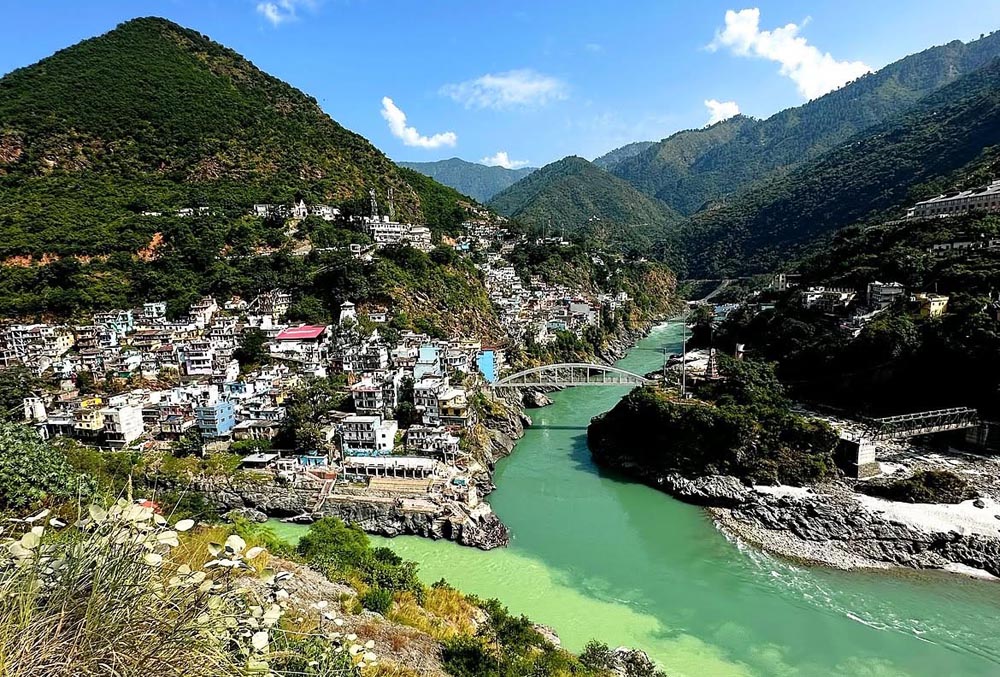
Nestled in the Garhwal Himalayas of Uttarakhand, Devprayag is a destination where geography, spirituality, history and mountain culture come together in an extraordinary way. The town is best known as the sacred confluence of the Alaknanda and Bhagirathi rivers, where the two streams merge and continue their journey as the River Ganga. This remarkable meeting of rivers has made Devprayag one of the most important pilgrimage destinations in northern India and the final confluence among the five celebrated Panch Prayag of Uttarakhand.
Yet Devprayag is much more than a religious stop on the way to Badrinath or other Himalayan destinations. Its steep mountain slopes, traditional settlements, ancient temples, riverfront ghats, legends associated with the Ramayana, astronomical heritage and surrounding forests give it a distinctive character. For travellers interested in spirituality, photography, culture, history, nature or simply a peaceful Himalayan escape, Devprayag offers an experience that is considerably deeper than a short roadside halt.
The Sacred Confluence of Alaknanda and Bhagirathi
The defining feature of Devprayag is its spectacular sangam, or confluence. The Alaknanda, flowing down through the Himalayan valleys, meets the Bhagirathi, which descends from the Gangotri region. From this point onward, the combined river is traditionally known as the Ganga. Uttarakhand Tourism describes Devprayag as the place where these two rivers merge and take the name Ganga.
The visual character of the confluence makes it particularly fascinating. Depending on water conditions, the two rivers can display noticeably different colours and textures before becoming one. Watching the separate streams converge between the surrounding hills is one of the most memorable experiences in the town.
For Hindus, however, the importance of the sangam goes far beyond its visual beauty. The meeting of sacred rivers is regarded as spiritually significant, and pilgrims come here to offer prayers, perform rituals and bathe at the appropriate riverfront locations. Devprayag’s importance is further strengthened by its position within the Panch Prayag pilgrimage tradition.
The five sacred confluences are Vishnuprayag, Nandaprayag, Karnaprayag, Rudraprayag and Devprayag. Devprayag is the final one in the sequence, where the Alaknanda meets the Bhagirathi.
A Town Shaped by Mythology
Devprayag has a rich mythological identity. According to local Hindu traditions, Lord Rama and King Dasharatha are associated with penance at this sacred location. These traditions contribute greatly to the spiritual atmosphere of the town and explain why many pilgrims consider a visit here an important part of their religious journey.
The name and identity of Devprayag are closely connected with ideas of divine confluence and sacred geography. Over centuries, the settlement developed around its temples, riverbanks and pilgrimage routes, creating a town in which everyday life and religious traditions remain closely connected.
The town also has an important relationship with the Badrinath Dham pilgrimage. Uttarakhand Tourism notes that Devprayag serves as the winter seat of the priests associated with Badrinath and lies along the route used by pilgrims travelling toward the Char Dham region.
Consequently, the town experiences a distinctive rhythm. At certain times of year it can feel like a quiet Himalayan settlement, while during pilgrimage periods the roads, temples and riverfront become considerably busier.
Raghunathji Temple: The Spiritual Heart of Devprayag
Among Devprayag’s many religious attractions, Raghunathji Temple holds a particularly prominent position. Dedicated to Lord Rama, the temple is traditionally believed to be more than a thousand years old. It stands close to the sacred confluence and is built using large stone blocks, reflecting the architectural character of historic Himalayan temples.
The temple’s connection with Lord Rama gives it special significance for devotees. According to local tradition, Rama performed penance here after returning from his victory in Lanka. Whether approached from a religious or historical perspective, the temple provides an important window into the traditions that have shaped Devprayag for generations.
Visitors should approach the temple respectfully, particularly during prayer and ritual times. The experience is less about simply checking an attraction off a sightseeing list and more about observing the living traditions of the town.
Dashrathshila and the Legends of King Dasharatha
Another important religious site is Dashrathshila, located along the Shanta River. It is associated with King Dasharatha, the father of Lord Rama in the Ramayana tradition. Uttarakhand Tourism identifies the site as one of the ancient shrines in the Devprayag area and describes the nearby Dashrathachal Peak as the location traditionally associated with the king’s seat.
The attraction of places such as Dashrathshila lies in the way mythology is embedded into the physical landscape. Mountains, rivers, caves, peaks and temples are not treated merely as scenery; they are often connected to stories that have been passed from generation to generation.
Kyunkaleshwar Mahadev Temple
Devprayag is not exclusively associated with Lord Rama. Kyunkaleshwar Mahadev Temple provides another important dimension to the religious heritage of the town. The temple is associated with Lord Shiva and Goddess Parvati and is traditionally connected with an early medieval period of Hindu temple development. Uttarakhand Tourism describes it as reflecting the Hindu renaissance of the eighth century and notes the presence of deities including Kartikeya and Ganesha.
For visitors interested in Himalayan architecture and religious history, the temple is worth including in a Devprayag itinerary. Its setting also demonstrates how temples in Uttarakhand are often closely integrated with the surrounding mountain environment.
Chandrabadani Temple and the Wider Sacred Landscape
Travellers with additional time can explore the Chandrabadani Temple, associated with Goddess Sati and regarded as one of the Shakti Peethas in Hindu tradition. The temple sits on Chandrakoot mountain and provides expansive views over the surrounding Garhwal landscape.
The journey to such mountain temples is itself part of the experience. Roads and paths wind through hills, forests and villages, revealing a side of Uttarakhand that is very different from the larger pilgrimage centres.
Devprayag’s Fascinating Astronomical Heritage
One of the most unusual aspects of Devprayag is its connection with astronomy. The town is home to the Nakshatra Vedh Shala Observatory, established in 1946 by scholar Pt. Chakradhar Joshi. Uttarakhand Tourism describes it as one of India’s earliest astronomical observatories and notes that it contains telescopes, astronomical instruments and old manuscripts.
This makes Devprayag particularly interesting because its cultural identity extends beyond temples and mythology. The observatory represents a tradition of observing and understanding the heavens and adds an intellectual dimension to the town’s heritage.
For travellers fascinated by astronomy, traditional knowledge and the history of science in India, the observatory can be an unexpected highlight.
Natural Beauty and Himalayan Scenery
Devprayag is situated at an elevation of roughly 830 metres, according to Uttarakhand Tourism. Its location gives it a pleasant combination of Himalayan scenery and relatively accessible terrain compared with much higher mountain destinations.
The town stretches along mountainous slopes, while the rivers cut dramatically through the surrounding landscape. From elevated viewpoints, visitors can see the settlement spread across the hills with the river systems below.
The landscape changes considerably with the seasons. Summer brings clearer, warmer days, while winter can be cold. Monsoon transforms the vegetation and gives the hills a lush appearance, although heavy rainfall can also affect mountain travel.
For photographers, early morning and late afternoon can be particularly rewarding. The changing light across the river, temples and mountains creates constantly shifting scenes.
Activities to Enjoy in Devprayag
Although pilgrimage remains central to Devprayag’s identity, visitors can enjoy several outdoor experiences.
River viewing and photography are perhaps the simplest activities. Spending time near the sangam allows travellers to appreciate the scale and force of the rivers rather than simply photographing the meeting point and leaving.
Trekking and walking provide another way to explore the area. Uttarakhand Tourism notes that shorter treks can be undertaken around Devprayag, while the surrounding mountains contain forest paths and routes leading toward nearby peaks and settlements.
Camping can also be enjoyed in suitable areas around the region. The combination of mountain scenery, forests and relatively quiet surroundings makes the area appealing to travellers looking for a slower Himalayan experience. For adventure enthusiasts, white-water rafting is another possibility. Uttarakhand Tourism specifically highlights rafting between Devprayag and Rishikesh, where river conditions can range from medium to rough rapids. Such activities should always be undertaken with established operators and according to seasonal safety conditions.
Teen Dhara and Nearby Stops
Travellers approaching Devprayag from Rishikesh can also stop at Teen Dhara, situated roughly 10 kilometres from Devprayag toward Rishikesh. The area is named after three small springs and has developed as a popular roadside stopping point with eateries and mountain scenery.
Such places are useful for understanding the broader travel culture of the Garhwal region. Mountain journeys are often as much about roadside viewpoints, small eateries and village landscapes as they are about major monuments.
Local Culture and Everyday Life
One of Devprayag’s charms is that it remains a living Himalayan town rather than a destination created exclusively for tourism. Traditional religious practices, small markets, local businesses and pilgrimage-related services continue to shape everyday life.
The town’s culture reflects the broader heritage of Garhwal. Local food, mountain architecture, religious festivals and traditional practices all contribute to the atmosphere. Visitors should remember that the riverbanks and temples are places of religious significance, so responsible behaviour is particularly important.
Avoiding litter, respecting temple rules, following photography restrictions and keeping the river environment clean are simple ways travellers can help preserve the character of the destination.
Food and Accommodation
Food options in Devprayag generally include North Indian and simple vegetarian meals, snacks, tea and dishes suited to pilgrims and road travellers. The town is not primarily a culinary destination, but its small restaurants and roadside eateries can be useful stops during a Himalayan journey.
Accommodation ranges from modest hotels and guesthouses to more comfortable properties in and around the wider Devprayag area. Travellers can find establishments such as The Tattva Devprayag and Hotel US Tower, while resort-style accommodation is also available in the surrounding region.
For meals, local options include Divine Ganges Cafe & Restaurant and My Kitchen. Availability and operating hours can vary, particularly outside peak travel periods.
Best Time to Visit Devprayag
Devprayag can be visited throughout much of the year, but the ideal period depends on the purpose of the journey. Uttarakhand Tourism identifies March to May and mid-September to December as particularly suitable periods for visiting.
Spring and early summer can offer pleasant weather for sightseeing, temple visits and outdoor exploration. Autumn is particularly attractive because the post-monsoon landscape can be fresh and visibility is often better.
Winter brings colder temperatures but can appeal to travellers who enjoy quieter mountain destinations. The monsoon months bring greenery and atmospheric landscapes, but travellers should monitor weather and road conditions because Himalayan rainfall can affect transportation.
Anyone travelling during the Char Dham season should also expect increased traffic on major routes.
How to Reach Devprayag
Devprayag is primarily accessed by road. Uttarakhand Tourism states that the town is connected by motorable roads with important destinations in Uttarakhand and neighbouring northern states.
For air travellers, Jolly Grant Airport near Dehradun is the nearest airport identified by Uttarakhand Tourism, at approximately 91 kilometres from Devprayag. For rail travellers, Rishikesh is the nearest railway station mentioned by the state tourism authority.
Because Devprayag lies along important Himalayan routes, it is often incorporated into larger journeys involving Rishikesh, Badrinath, Rudraprayag, Srinagar and other Garhwal destinations.
A Good Base for Exploring the Garhwal Region
Devprayag works particularly well as part of a broader Uttarakhand itinerary. Travellers coming from Rishikesh can stop here before continuing toward the higher Himalayan regions. Those travelling toward Badrinath can combine the town with other Panch Prayag locations, while visitors interested in river landscapes can explore routes along the Alaknanda and Bhagirathi valleys.
Its geographical position makes Devprayag more than an isolated attraction. It is a gateway between the relatively accessible lower Himalayan areas and the more rugged high-altitude pilgrimage landscape farther north.
Responsible Tourism in Devprayag
The increasing popularity of Himalayan destinations makes responsible tourism increasingly important. Devprayag’s rivers are not simply tourist attractions; they are sacred waterways and an important part of the ecological system of the region.
Visitors should avoid throwing plastic or other waste into the rivers, should use designated waste facilities where available and should avoid damaging vegetation or disturbing wildlife. Travellers undertaking rafting, trekking or camping should follow local safety instructions and environmental guidelines.
Respect for religious traditions is equally important. Dress and behaviour should be appropriate around temples and bathing areas, and visitors should ask before photographing people engaged in private religious rituals.
Why Devprayag Deserves More Than a Quick Stop
Many travellers first encounter Devprayag as a point on the road toward another destination. Yet stopping for only a few minutes can mean missing much of what makes the town special.
Its significance comes from the combination of elements: two great Himalayan rivers becoming the Ganga, ancient temples connected with Rama and Shiva, sacred bathing sites, mountain landscapes, traditional settlements, an unusual astronomical heritage and its place within the Panch Prayag pilgrimage circuit.
The Devprayag Sangam and nearby viewpoints provide the visual centrepiece, while the temples and observatory reveal the deeper cultural story behind the landscape.
Devprayag is ultimately a destination where nature and belief are inseparable. The rivers explain the geography of the town, while centuries of mythology and pilgrimage have given those rivers an even greater cultural meaning. The mountains provide the setting, but the temples, legends, rituals and communities give the place its identity.
For anyone exploring Uttarakhand, Devprayag offers an opportunity to experience a quieter and more contemplative side of the Himalayas. It is a place to watch rivers meet, walk through an ancient pilgrimage town, explore mountain temples, learn about traditional astronomy and simply spend time surrounded by the dramatic landscape of Garhwal.
In that sense, Devprayag is not merely the place where the Alaknanda and Bhagirathi become the Ganga. It is a meeting point of rivers, mythology, history, spirituality, science and Himalayan culture—a destination whose importance becomes clearer the longer one stays.

