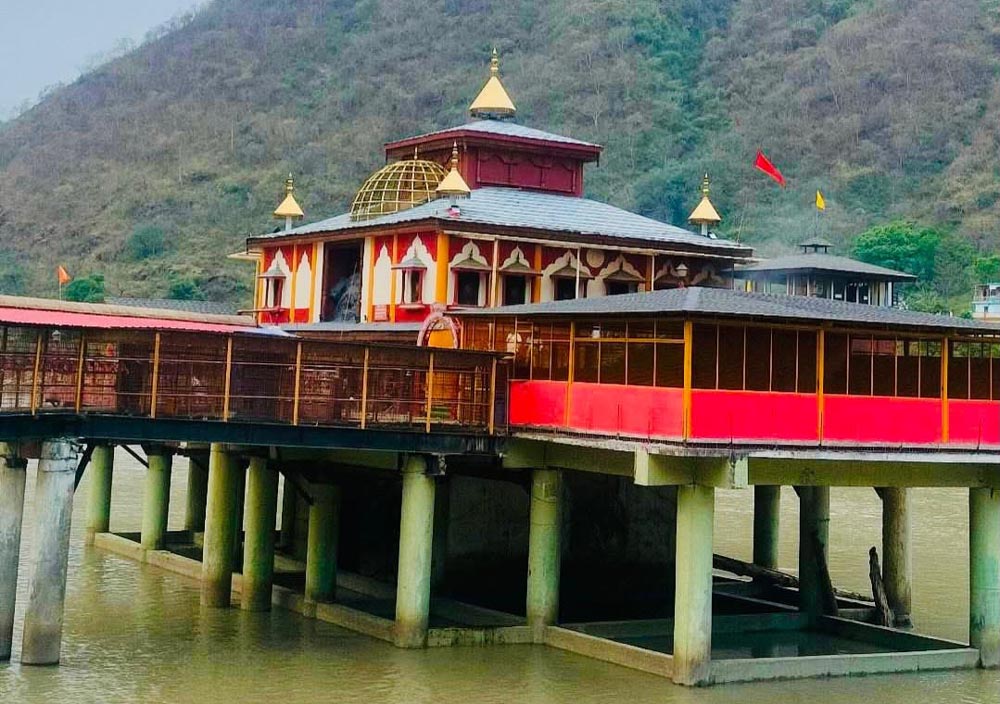
Nestled beside the powerful Alaknanda River in the Garhwal Himalayas, Dhari Devi Temple is one of the most revered shrines of Uttarakhand. Surrounded by steep green mountains, rushing Himalayan waters and the spiritual atmosphere of the Char Dham route, the temple is much more than an ordinary pilgrimage destination. It is a place where mythology, faith, nature and modern history come together in a remarkable way.
Dedicated to Goddess Dhari, traditionally regarded as a manifestation of Goddess Kali, the temple is located in the Kalyasaur area between Srinagar and Rudraprayag. The Government of Uttarakhand describes Dhari Devi as a much-worshipped goddess of the region and notes that devotees traditionally associate the deity with changing appearances resembling a girl, woman and elderly woman during the course of the day. The shrine is also visited particularly during Navratri, when special worship is performed.
For pilgrims travelling toward Badrinath and other important Himalayan shrines, Dhari Devi is an important spiritual stop. Its position beside the Alaknanda gives the temple a distinctive setting, while its fascinating mythology and the events surrounding its relocation during the construction of a hydroelectric project have made it one of Uttarakhand’s most discussed temples.
Where Is Dhari Devi Temple Located?
Dhari Devi Temple is situated in Uttarakhand’s Garhwal region on the banks of the Alaknanda River. It lies approximately 15 kilometres from Srinagar and around 20 kilometres from Rudraprayag, making it relatively accessible for pilgrims travelling through this part of the state. The Government of Pauri Garhwal states that the temple can be reached from the highway through a roughly one-kilometre cement pathway leading toward the shrine on the riverbank.
The temple’s location is one of its most memorable characteristics. Unlike many mountain temples situated on a hilltop or deep inside a forest, Dhari Devi is closely associated with the river itself. The sound of flowing water, surrounding Himalayan slopes and the changing light of the mountains create a distinctive environment for worship.
The shrine is positioned along the important route connecting Srinagar with the higher Himalayan pilgrimage region. Consequently, many travellers heading toward Badrinath and other religious destinations include Dhari Devi Temple in their pilgrimage itinerary.
The Religious Importance of Goddess Dhari Devi
Dhari Devi is traditionally worshipped as a fierce manifestation of Shakti, with strong associations with Goddess Kali. Uttarakhand government material describes the deity as the guardian goddess of the state and as a protector associated with the Char Dham pilgrimage route.
For devotees, the goddess represents strength, protection and divine feminine power. The temple is particularly significant because of the unusual form in which the deity is worshipped. Religious tradition holds that the upper portion of the divine image is associated with Dhari Devi at this shrine, while the lower portion is associated with Goddess Kali at Kalimath.
This connection gives the two shrines a special place in local religious traditions. Kalimath, another important Shakti pilgrimage destination in Uttarakhand, is associated with the worship of Goddess Kali, while Dhari Devi is regarded as the manifestation represented by the upper portion of the sacred image.
The shrine therefore forms part of a wider sacred landscape in which rivers, mountains, temples and legends are deeply interconnected.
The Fascinating Legend Behind Dhari Devi Temple
One of the most popular legends surrounding Dhari Devi concerns a devastating flood in ancient times. According to the tradition recorded by the Pauri Garhwal district administration, floodwaters carried away a temple and the sacred idol became trapped against a rock near the village of Dharo. Villagers reportedly heard the idol’s cries and subsequently received a divine instruction to install the deity at that location.
The story helps explain the unusual relationship between the goddess and the Alaknanda River. Rather than being considered simply a geographical feature surrounding the temple, the river forms part of the sacred narrative of Dhari Devi.
Local belief also holds that the deity changes appearance throughout the day. Devotees describe the sacred image as taking on the appearance of a young girl, an adult woman and an elderly woman at different times. This belief is one of the temple’s most distinctive religious traditions and contributes to its mystique.
Such stories should be understood within the context of local faith and oral tradition rather than as independently verifiable historical events. Nevertheless, they remain an important part of how devotees understand the identity and spiritual significance of Dhari Devi.
Dhari Devi and the Sacred Geography of Uttarakhand
Uttarakhand is often called Devbhoomi, or the “Land of the Gods,” because of its extraordinary concentration of temples, pilgrimage routes, sacred rivers and mythological landscapes. Dhari Devi fits naturally into this broader religious geography.
The Alaknanda itself has enormous importance in Hindu pilgrimage traditions. It is one of the principal Himalayan rivers associated with the sacred geography of northern India and eventually becomes part of the Ganga river system.
Travelling along the Alaknanda valley therefore offers more than scenic views. The journey passes through a landscape filled with temples, confluences, pilgrimage towns and places associated with Hindu mythology. Dhari Devi’s location beside the river gives it a particularly powerful connection to this sacred environment.
For many pilgrims, visiting the temple before continuing deeper into the Himalayas becomes part of a spiritual journey rather than simply another sightseeing stop.
The 2013 Dhari Devi Controversy
The modern history of Dhari Devi Temple is closely connected with the construction of the 330 MW Srinagar Hydroelectric Project on the Alaknanda River. The project created a major dispute concerning the temple’s original location and the need to protect the shrine from rising water levels.
Court records from 2013 document extensive discussions concerning several possible approaches, including constructing protective structures around the temple, relocating it, or raising the temple above the highest flood level while retaining it at its existing location. A committee ultimately recommended raising the temple and providing pedestrian access from the riverbank.
The matter became particularly sensitive because many devotees believed that the goddess should not be removed from her original location. The issue involved not only engineering considerations but also religious traditions concerning the proper place of worship.
According to contemporary reporting, on June 16, 2013, the idol was moved as water levels rose during the flooding. Later that day, the catastrophic Himalayan floods occurred, including the disaster that devastated the Kedarnath region.
A belief subsequently became widespread among some local devotees that moving Dhari Devi from her original location had angered the goddess and was connected with the disaster. This is a religious interpretation rather than an established scientific explanation for the floods. The 2013 disaster involved extreme rainfall, flooding, landslides and complex Himalayan environmental and geological factors.
Nevertheless, the association became an important part of the temple’s modern story and has remained deeply embedded in local popular belief.
The Temple’s Relocation and Reconstruction
The controversy surrounding the shrine did not end with the 2013 floods. The question of how to preserve the temple while accommodating the hydroelectric project had already been the subject of government committees, court proceedings and discussions involving temple representatives.
The Supreme Court record shows that various alternatives were examined, including a protective enclosure, a concrete structure around the temple, relocation to another site and raising the temple at its existing location. The recommended solution was to raise the temple above the highest flood level while maintaining the deity at the same general site and providing access through a pedestrian bridge.
Reports in 2022 stated that plans were underway to reinstall the idol at the original temple site after years of controversy and construction.
This episode illustrates the unusual intersection of religious tradition, environmental concerns, infrastructure development and public sentiment that has surrounded Dhari Devi for decades.
Architecture and Setting of the Temple
Dhari Devi Temple is not famous primarily for monumental architecture. Its importance comes from its religious history and extraordinary natural setting.
The temple is closely associated with the Alaknanda and is reached through a dedicated pathway from the main road. Modern access arrangements allow visitors to cross toward the shrine while looking down at the river below.
The surrounding landscape provides a dramatic Himalayan backdrop. During different seasons, the appearance of the valley changes considerably. Monsoon brings powerful flows and lush vegetation, while clearer periods can offer expansive mountain views.
The combination of a river shrine, mountain landscape and relatively compact temple structure creates an intimate atmosphere that differs from the grand architectural scale of some major North Indian pilgrimage temples.
Navratri at Dhari Devi Temple
Navratri is one of the most important periods for worship at Dhari Devi Temple. The Pauri Garhwal district administration specifically notes that special worship is offered to the goddess during Navratras and that devotees travel from different places to seek her blessings.
Because Dhari Devi is associated with Shakti and Goddess Kali, the festival carries particular spiritual importance. Devotees may visit the shrine to offer prayers, flowers, traditional offerings and other forms of worship.
The atmosphere during major religious occasions can be considerably busier than on ordinary days. Anyone planning a visit during Navratri should therefore allow additional time for travel, parking, walking and darshan.
How to Reach Dhari Devi Temple
Dhari Devi Temple is relatively accessible compared with many remote Himalayan shrines.
By road, the temple lies along the Srinagar-Rudraprayag route and is approximately 15 kilometres from Srinagar. The Pauri Garhwal district administration identifies the temple as being on the route toward Badrinath and notes the approach from the highway.
Travellers coming from Rishikesh or Haridwar generally proceed into the Garhwal Himalayas through the established road network toward Devprayag and Srinagar before continuing toward Rudraprayag. Those travelling toward Badrinath can incorporate Dhari Devi into their pilgrimage route.
The nearest major pilgrimage and transport centres depend on the traveller’s route. Srinagar and Rudraprayag are particularly useful reference points for reaching the temple.
Because Himalayan roads can be affected by rainfall, landslides, construction and seasonal conditions, travellers should check current road conditions before beginning a long journey.
Dhari Devi Temple Timings
Visitors should verify the daily schedule locally before travelling because temple timings can change during festivals, special religious occasions or other circumstances.
Published visitor information commonly lists the temple as opening in the morning, with a midday break and reopening in the afternoon. One recent travel source reports a general schedule of approximately 6:00 AM to noon and 2:00 PM to 7:00 PM, although visitors should treat these times as indicative rather than permanent.
For devotees who want to experience the temple’s religious atmosphere, early morning can be particularly peaceful. Evening visits can also be rewarding because of the changing light over the Alaknanda valley.
Best Time to Visit Dhari Devi Temple
The ideal time depends on the purpose of the journey.
For general sightseeing and pilgrimage, spring and the post-monsoon period can provide pleasant conditions and attractive mountain scenery. Summer is also a popular period for Himalayan pilgrimage because many higher-altitude routes become accessible.
The monsoon season requires greater caution. Uttarakhand experiences heavy rainfall, and mountain roads can be affected by landslides and temporary closures. Since Dhari Devi is located beside a major Himalayan river, visitors should pay close attention to local weather and travel advisories during periods of heavy rain.
Festival periods, especially Navratri, are appropriate for people interested in experiencing the temple’s religious traditions but can also bring significantly larger crowds.
What to Do During a Visit
The principal purpose of visiting Dhari Devi is darshan and worship. Visitors can spend time praying before the deity, observing the surroundings and experiencing the peaceful atmosphere of the river valley.
Photography may be appealing because of the dramatic landscape, but visitors should respect restrictions concerning photography inside or near the sanctum. Temple customs should always take precedence over photography or social-media content.
The journey can also be combined with other destinations in the Garhwal region. Travellers passing through Srinagar, Rudraprayag or the Alaknanda valley can plan a broader pilgrimage or sightseeing itinerary around the temple.
Places to Visit Near Dhari Devi Temple
The temple’s location makes it convenient to combine the visit with several important destinations.
Srinagar Garhwal is one of the principal towns in the region and can serve as a practical base for travellers visiting nearby religious and natural attractions.
Rudraprayag is another important destination nearby. It is famous for the confluence of the Alaknanda and Mandakini rivers and has considerable religious significance.
Devprayag is farther downstream and is particularly important because of the sacred confluence where the Alaknanda and Bhagirathi meet to form the Ganga.
Travellers continuing deeper into the Himalayas can also connect their journey with the wider Char Dham pilgrimage circuit, depending on seasonal road accessibility and their itinerary.
Travel Tips for Pilgrims
A visit to Dhari Devi is relatively straightforward, but basic Himalayan travel precautions are important. Comfortable footwear is useful because visitors need to walk along the approach to the shrine.
Weather can change quickly in the mountains, so carrying a light jacket or rain protection is advisable even when conditions initially appear favourable. During the monsoon, travellers should be particularly careful and check road conditions before departure.
Visitors should dress respectfully and follow temple customs. Avoid littering around the river and temple area, and do not disturb religious ceremonies for photography.
It is also wise to carry drinking water, basic medicines and some cash, particularly when travelling onward to more remote areas where facilities can be limited.
Why Dhari Devi Temple Is So Special
What makes Dhari Devi Temple remarkable is the combination of several different dimensions of Indian heritage.
It is a religious centre associated with Goddess Kali and Shakti. It is part of the sacred landscape of Uttarakhand. It stands beside one of the major Himalayan rivers. It is connected to a long-standing local mythology involving the discovery of the sacred idol. And its modern history reflects a complicated debate about development, environmental conditions, engineering and religious tradition.
The 2013 events further transformed the temple’s place in popular consciousness. While claims connecting the deity’s relocation with the Kedarnath disaster belong to the realm of religious belief rather than established scientific causation, the story demonstrates the depth of devotion associated with the shrine.
For visitors, this distinction is important. Dhari Devi can be appreciated both as a sacred Hindu pilgrimage site and as an important example of how religious traditions interact with the rapidly changing Himalayan environment.
Dhari Devi Temple as a Symbol of Faith and the Himalayas
The mountains of Uttarakhand have always been places where nature and spirituality are closely connected. At Dhari Devi, this relationship is especially visible. The temple stands beside the Alaknanda, while the surrounding mountains create a natural amphitheatre around the shrine.
The goddess is revered as a protective presence, and generations of devotees have travelled to this location to seek blessings before continuing their journeys through the Himalayas.
For some visitors, the attraction is primarily religious. For others, it is the fascinating mythology, the river landscape or the temple’s modern history. For many pilgrims, however, all these elements are inseparable.
Dhari Devi Temple therefore represents more than a single religious monument. It is part of Uttarakhand’s living cultural landscape—a place where faith, folklore, pilgrimage, rivers and mountains continue to shape one another.
Final Thoughts
Dhari Devi Temple is one of the most distinctive spiritual destinations in Uttarakhand. Its location beside the Alaknanda River, its association with Goddess Kali, the legend of the sacred idol, the belief surrounding the deity’s changing appearance and its complex modern history have given the shrine a unique identity.
The temple also offers visitors an opportunity to experience the spiritual character of the Garhwal Himalayas without travelling to one of the most remote high-altitude shrines. Its position between Srinagar and Rudraprayag makes it a natural stop for pilgrims travelling toward the greater Himalayan pilgrimage circuit.
Ultimately, Dhari Devi is best understood not simply as a temple to be photographed or visited briefly, but as a living centre of faith. Its story reflects the deep relationship between the people of Uttarakhand, their sacred traditions and the powerful Himalayan landscape that surrounds them.

